Measuring Temperature (Grade 11 NSC Matric Mathematical Literacy): Revision Notes
📚Revision Notes
Measuring Temperature
What is temperature conversion?
Temperature conversion is the process of changing temperature measurements from one scale to another. The two most common temperature scales are Celsius (°C) and Fahrenheit (°F). In South Africa, we use Celsius, but when travelling internationally or reading weather reports from other countries, you might encounter Fahrenheit measurements.
Understanding how to convert between these scales helps you interpret temperature information correctly, especially when planning trips or understanding weather forecasts from different countries.
Note
Temperature conversion is particularly useful when travelling to countries like the United States, where Fahrenheit is the standard temperature scale used in weather reports and daily life.
Temperature conversion formulas
There are two main formulas you need to remember for temperature conversion:
Converting Celsius to Fahrenheit
To convert from Celsius to Fahrenheit, use this formula:
Converting Fahrenheit to Celsius
To convert from Fahrenheit to Celsius, use this formula:
Important
Remember: Fahrenheit temperatures are always much larger numbers than equivalent Celsius temperatures. For example, water freezes at 0°C but at 32°F.
Worked examples of temperature conversion
Example
Worked Example 1: Converting 30°C to Fahrenheit
Step 1: Use the formula
Step 2: Substitute the value:
Step 3: Calculate:
Example
Worked Example 2: Converting 50°F to Celsius
Step 1: Use the formula
Step 2: Substitute the value:
Step 3: Calculate:
Using temperature values for trip planning
One practical application of temperature conversion is planning trips to countries that use different temperature scales. This skill becomes essential when you need to understand weather forecasts and pack appropriate clothing.
Practical example: Planning a trip to New York
Imagine you're travelling from South Africa to New York in the United States. American weather reports show temperatures in Fahrenheit, but you're familiar with Celsius measurements.
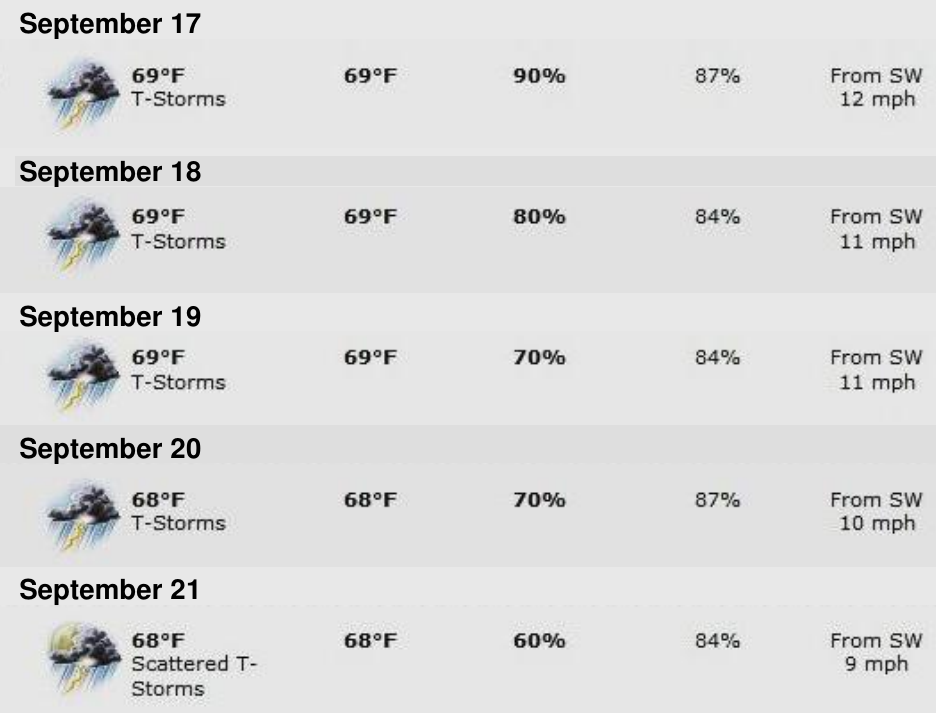
The weather forecast above shows temperatures between 68°F and 69°F over five days. To understand what this means for your packing, you need to convert these temperatures to Celsius.
Example
Worked Example: Converting New York Temperatures
Converting 69°F to Celsius:
- (approximately)
Converting 68°F to Celsius:
Based on these conversions, you can see that the maximum temperatures will be quite mild (around 20-21°C). Combined with the thunderstorm forecasts, you should pack warm clothing and rain gear for your trip.
Exam tips for temperature conversion
Summary
Key Points for Exam Success:
- Always write down the formula first before substituting values
- Show each step clearly in your calculations
- Check your answer by asking if it makes sense (Fahrenheit should be much larger than Celsius for the same temperature)
- Round appropriately - usually to the nearest degree is sufficient
- Include units in your final answer (°C or °F)
Common exam mistakes to avoid
Important
Avoid These Common Mistakes:
- Mixing up the formulas (using the wrong one for the conversion direction)
- Forgetting to subtract 32 when converting from Fahrenheit to Celsius
- Forgetting to add 32 when converting from Celsius to Fahrenheit
- Not showing working steps clearly
- Leaving out units in the final answer
Remember!
Summary
Key Points to Remember:
- Temperature conversion formulas: and
- Fahrenheit values are always much larger than equivalent Celsius temperatures
- Show all steps clearly in your calculations for full marks
- Temperature conversion is useful for interpreting weather forecasts when travelling
- Always include units (°C or °F) in your final answers