Nature of Roots (Grade 11 NSC Matric Mathematics): Revision Notes
📚Revision Notes
Nature of Roots
What is the discriminant?
The discriminant is a mathematical tool that helps us determine what types of roots a quadratic equation will have without actually solving the equation.
Definition: The discriminant is the expression under the square root sign in the quadratic formula.
Formula: For a quadratic equation in standard form , the discriminant is:
Where (delta) is the Greek symbol used to represent the discriminant.
Note
The discriminant appears in the quadratic formula and is the key to understanding root behavior. By calculating this single value, we can predict whether our quadratic equation will have real or imaginary solutions, and if real, whether they are equal or unequal, rational or irrational.
The discriminant appears in the quadratic formula:
How the discriminant determines root types
The value of the discriminant tells us important information about the nature of the roots. The word 'nature' refers to the types of numbers the roots can be - namely real, rational, irrational or imaginary.
The discriminant acts like a decision-making tool that classifies roots into different categories based on its value.
Classification system for roots
Based on the discriminant value, we can classify roots into the following categories:
Important
Case 1: (discriminant is negative)
- Roots are imaginary (non-real)
- The expression under the square root is negative
- These roots are beyond the scope of this course level
Important
Case 2: (discriminant is non-negative)
- Roots are real
- This case splits into two sub-cases:
Sub-case 2a: (discriminant equals zero)
- Roots are real and equal
- There is only one root (or we say there are two identical roots)
- The parabola touches the x-axis at exactly one point
Sub-case 2b: (discriminant is positive)
- Roots are real and unequal
- There are two different roots
When we have real and unequal roots (), we can further classify them:
Note
If is a perfect square of a rational number:
- Roots are rational
- Can be expressed as exact fractions or integers
If is not a perfect square of a rational number:
- Roots are irrational
- Must be expressed in decimal or surd form
Step-by-step method to determine nature of roots
Follow these steps to determine the nature of roots for any quadratic equation:
Note
Step-by-Step Process:
Step 1: Check that the equation is in standard form
Step 2: Identify the coefficients , , and
Step 3: Calculate the discriminant using
Step 4: Apply the classification rules:
- If : roots are imaginary
- If : roots are real and equal
- If : roots are real and unequal
- Check if is a perfect square to determine if roots are rational or irrational
Step 5: State your conclusion clearly
Worked examples
Example
Worked Example 1: Determining if roots are irrational
Question: Show that the roots of are irrational.
Solution:
Step 1: The equation is already in standard form
Step 2: Identify coefficients
Step 3: Calculate the discriminant
Step 4: Interpret the result
Since and 32 is not a perfect square, we can conclude the roots are real, unequal and irrational.
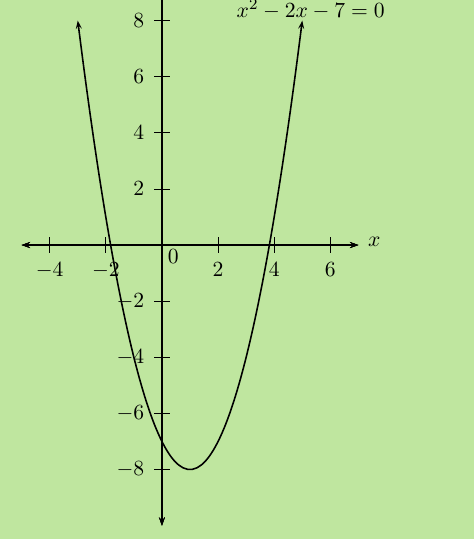
Step 5: Final answer The roots are real, unequal and irrational.
Example
Worked Example 2: Finding values for equal roots
Question: For which value(s) of will the roots of be real and equal?
Solution:
Step 1: Rearrange to standard form
Step 2: Identify coefficients
Step 3: For real and equal roots,
Step 4: Solve for
Step 5: Verify the answers
- For : gives , so (equal roots) ✓
- For : gives , so (equal roots) ✓
Final answer: or
Example
Worked Example 3: Proving roots are always real
Question: Show that the roots of are real for all real values of , and .
Solution:
Step 1: Expand to standard form
Step 2: Identify coefficients
Step 3: Calculate the discriminant
Step 4: Interpret the result
- Since and for all real values, we have:
- Therefore
Step 5: Final answer
- Since , the roots are real for all real values of , and .
Summary
Key Points to Remember:
-
The discriminant formula is - this is your starting point for determining root types
-
Negative discriminant means imaginary roots, zero discriminant means equal roots, positive discriminant means unequal real roots
-
For real unequal roots, check if the discriminant is a perfect square to determine if roots are rational or irrational
-
Always write your equation in standard form first () before identifying coefficients
-
When asked to find parameter values for specific root types, set the discriminant equal to the appropriate value and solve