Simultaneous Equations (Grade 11 NSC Matric Mathematics): Revision Notes
📚Revision Notes
Simultaneous Equations
What are simultaneous equations?
Simultaneous equations are a system of two or more equations that must be solved together to find the values of unknown variables. These equations share the same variables and must all be satisfied at the same time.
Note
To solve for the values of n unknown variables, you need a system of n independent equations. For example, to find two unknown variables (x and y), you need two independent equations.
An example of a system with one linear and one quadratic equation is:
Three methods for solving simultaneous equations
There are three main approaches to solving simultaneous equations:
- Substitution method - Express one variable in terms of another and substitute
- Elimination method - Make coefficients equal and eliminate one variable
- Graphical method - Plot both equations and find intersection points
Note
The graphical method is particularly useful for showing where two equations intersect visually, making it easier to understand the geometric relationship between the equations.
Method 1: Solving by substitution
The substitution method works by reducing the system to one equation with one unknown variable. Here's the step-by-step process:
- Choose the simpler equation and express one variable in terms of the other
- Substitute this expression into the second equation
- Solve the resulting equation which now has only one variable
- Substitute back to find the value of the other variable
- Check your answer by verifying both original equations are satisfied
Example
Worked Example: Substitution Method
Question: Solve for x and y:
- ... (1)
- ... (2)
Solution:
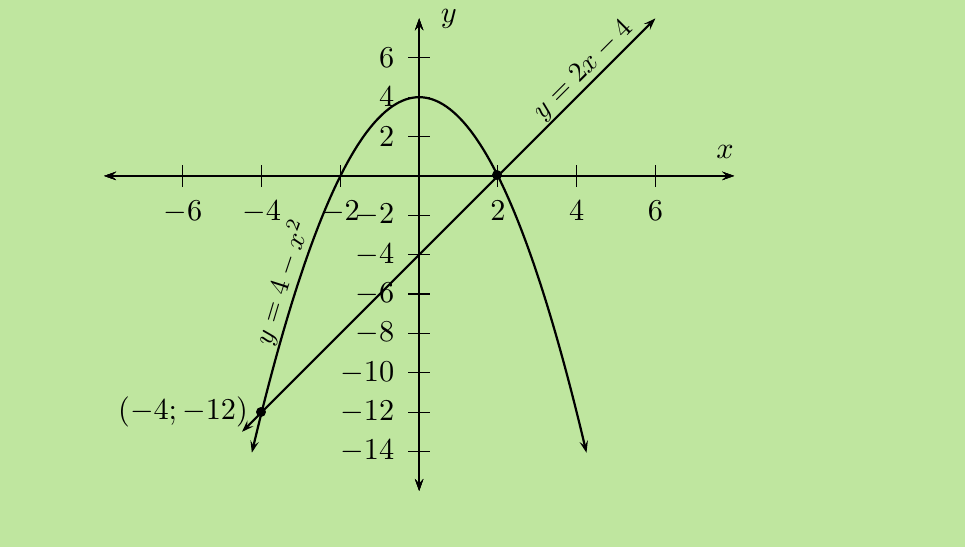
Step 1: Make y the subject of equation (1)
Step 2: Substitute into equation (2)
Step 3: Factorise and solve
- Therefore or
Step 4: Find corresponding y-values
If :
If :
Step 5: Check and write final answer
The solutions are and . These give the coordinate pairs and where the equations intersect.
Method 2: Solving by elimination
The elimination method works by making the coefficients of one variable equal in both equations, then adding or subtracting to eliminate that variable.
Steps for elimination:
- Make coefficients equal for one of the variables in both equations
- Add or subtract the equations to eliminate that variable
- Solve the resulting equation with one unknown
- Substitute back to find the other variable value
- Check that both points satisfy the original equations
Example
Worked Example: Elimination Method
Question: Solve for x and y:
- ... (1)
- ... (2)
Solution:
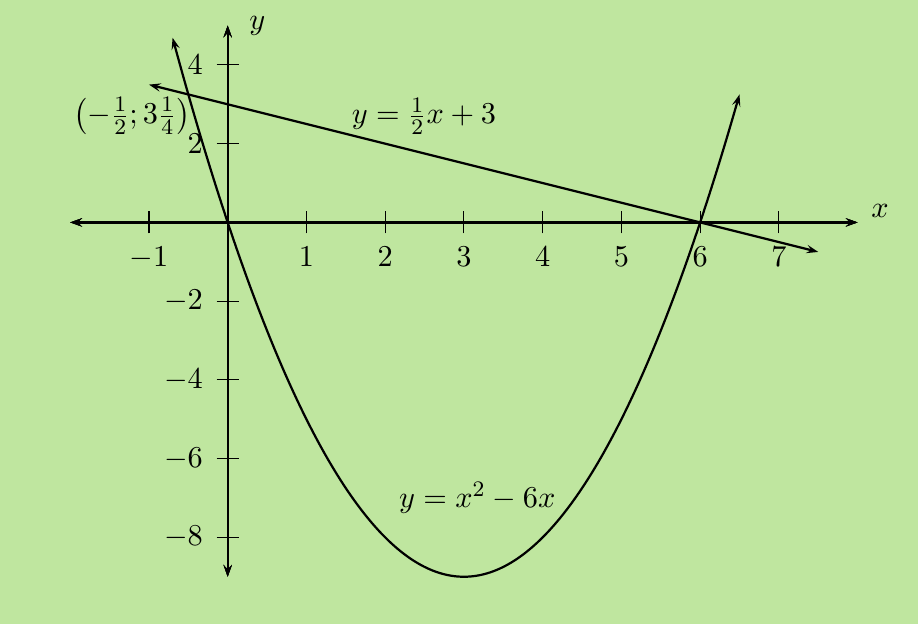
Step 1: Make y the subject of equation (2)
Step 2: Set the equations equal and solve for x
- (multiply by 2)
Therefore or
Step 3: Find corresponding y-values
If :
If :
Final answer: The solutions are and .
Example
Worked Example: Another Elimination Example
Question: Solve for x and y:
- ... (1)
- ... (2)
Solution:
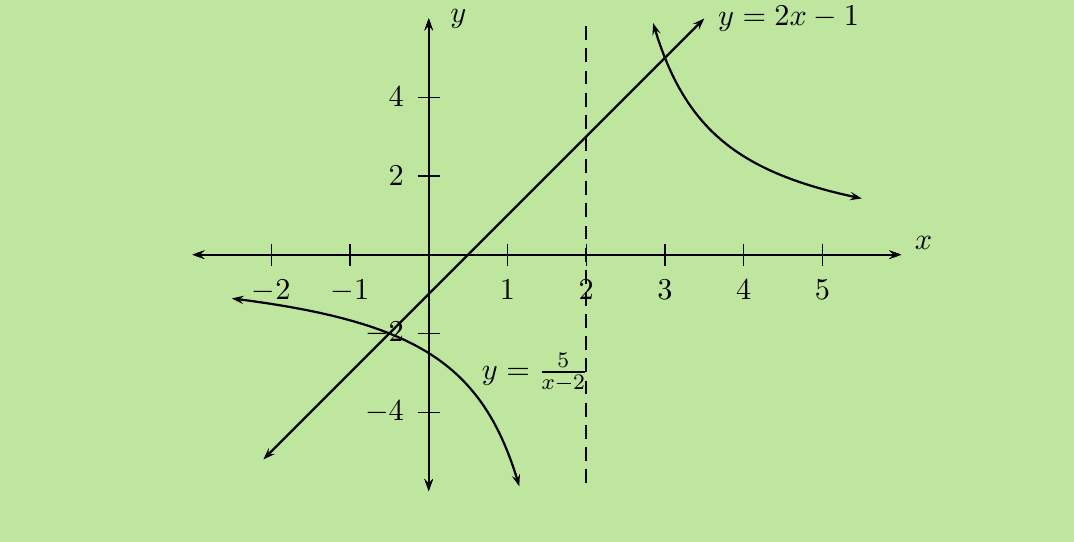
Step 1: Rearrange equation (2)
Step 2: Set equations equal
Therefore or
Step 3: Find y-values
- For :
- For :
Final answer: The solutions are and .
Method 3: Solving graphically
The graphical method involves plotting both equations on the same coordinate system. The solutions are the coordinates where the graphs intersect.
Steps for graphical method:
- Rearrange both equations to make y the subject
- Plot both graphs on the same coordinate system
- Identify intersection points from the graph
- Read off coordinates of intersection points
- Check that these points satisfy both original equations
Example
Worked Example: Graphical Method
Question: Solve graphically for x and y:
- ... (1)
- ... (2)
Solution:
Step 1: Make y the subject of both equations
- From equation (1):
- From equation (2):
Step 2: Plot both graphs on the same axes
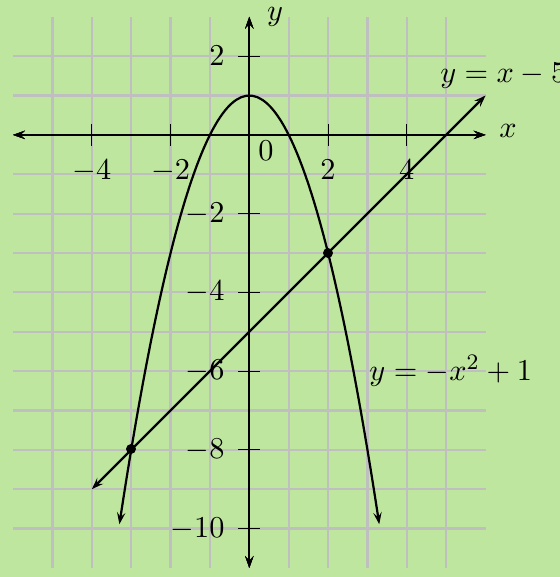
- The first equation is a downward-opening parabola with vertex at (0, 1).
- The second equation is a straight line with slope 1 and y-intercept -5.
Step 3: Find intersection points
- From the graph, the intersection points are at and .
Exam tips and common mistakes
Important
Key exam strategies:
- Always check your solutions by substituting back into both original equations
- When using substitution, choose the simpler equation to rearrange first
- For elimination, look for coefficients that are easy to make equal
- In graphical methods, draw accurate graphs and clearly mark intersection points
Important
Common exam traps:
- Forgetting to find both x and y values for each solution
- Making arithmetic errors when expanding brackets
- Not checking that solutions satisfy both original equations
- Mixing up which method is most appropriate for the given equations
Note
When to use each method:
- Substitution: When one equation is easily rearranged (especially linear equations)
- Elimination: When coefficients can be easily matched
- Graphical: When asked specifically, or to visualise the relationship between equations
Summary
Key Points to Remember:
- Simultaneous equations require finding values that satisfy all equations in the system at once
- Three main methods: substitution (rearrange and substitute), elimination (make coefficients equal), and graphical (plot and find intersections)
- Always check your answers by substituting back into the original equations
- Choose the most efficient method based on the form of the equations given
- Graphical solutions show the geometric relationship between the equations and their intersection points