Revision (Grade 11 NSC Matric Mathematics): Revision Notes
📚Revision Notes
Revision
The number system
Understanding the different types of numbers is essential for working with exponents and surds. Numbers are organised into a hierarchical system where each type has specific properties.
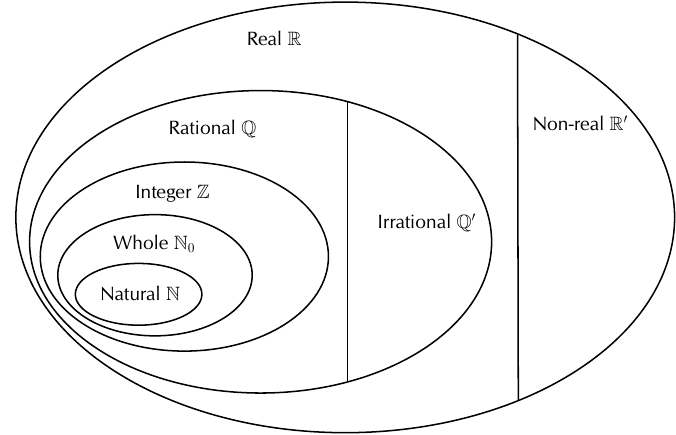
The number system consists of several categories, each containing the previous categories within it. Understanding these key definitions will provide the foundation for all mathematical work with different number types.
Natural numbers (ℕ)
These are the counting numbers we use in everyday life.
Note
Definition: ℕ = {1; 2; 3; ...}
Natural numbers are the most basic numbers we encounter - they represent counting and ordering in the real world.
Whole numbers (ℕ₀)
Natural numbers with zero included.
Note
Definition: ℕ₀ = {0; 1; 2; 3; ...}
The addition of zero to the natural numbers creates the set of whole numbers, which is useful for many mathematical operations.
Integers (ℤ)
All positive and negative whole numbers, including zero.
Note
Definition: ℤ = {...; -3; -2; -1; 0; 1; 2; 3; ...}
Integers extend the whole numbers to include negative values, allowing us to represent concepts like debt, temperature below zero, and direction.
Rational numbers (ℚ)
Numbers that can be expressed as a fraction where both the numerator and denominator are integers, and the denominator is not zero. These include terminating and recurring decimal numbers.
Note
Definition: Any number that can be written as where and are integers and .
Rational numbers include all fractions, decimals that terminate, and decimals that repeat in a pattern.
Example
Examples of Rational Numbers:
- (proper fraction)
- (terminating decimal)
- (can be written as )
- (equals 3, which is )
- (terminating decimal)
- (integer expressed as fraction)
Irrational numbers (ℚ')
Numbers that cannot be written as a fraction with integer numerator and denominator. These are decimal numbers that neither terminate nor have a repeating pattern.
Example
Examples of Irrational Numbers:
- (non-perfect square root)
- (non-perfect cube root)
- (mathematical constant)
- (golden ratio)
- (non-repeating, non-terminating decimal)
Real numbers (ℝ)
The combination of all rational and irrational numbers. This set includes virtually all numbers we work with in everyday mathematics.
Non-real numbers (ℝ')
Numbers that involve the square root of negative numbers, which are not real.
Example
Examples of Non-real Numbers:
- (square root of negative number)
- (cube root of negative number)
- (negative square root of negative fraction)
Laws of exponents
Exponential notation is a shorthand way to show that a number or variable is multiplied by itself a specific number of times.
Understanding exponential notation
Note
Definition: (n times), where and
In the expression :
- is called the base
- is called the exponent, index, or power
Example
Examples of Exponential Notation:
Special vocabulary
Understanding the language of exponents helps with mathematical communication:
- For , we say " is squared"
- For , we say " is cubed"
- For higher powers like , we say " is raised to the sixth power"
Special exponent rules
Important
Rule 1: (where because is undefined)
Rule 2: (where because is undefined)
These rules are fundamental and apply to all exponential expressions. Remember that zero cannot be a base when dealing with negative exponents or the zero power rule.
Example
Examples of Special Exponent Rules:
The five laws of exponents
Note
The Five Fundamental Laws
These laws apply when , and :
Law 1: (Multiplication law)
Law 2: (Division law)
Law 3: (Product law)
Law 4: (Quotient law)
Law 5: (Power law)
Example
Worked Example 1: Simplifying expressions
Question: Simplify the following:
Solution:
Example
Worked Example 2: Factorising with exponents
Question: Simplify:
Solution:
Step 1: Simplify to a form that can be factorised
Step 2: Take out a common factor
Step 3: Cancel the common factor and simplify
Summary
Key Points to Remember:
- Number system hierarchy: Natural ⊂ Whole ⊂ Integer ⊂ Rational ⊂ Real, with irrational numbers also being real numbers
- Special exponent rules: and (where )
- Five laws of exponents: When multiplying same bases, add exponents; when dividing, subtract exponents; when raising a power to a power, multiply exponents
- Always write final answers with positive exponents when possible
- Look for common factors when simplifying complex expressions with exponents