Average Gradient (Grade 11 NSC Matric Mathematics): Revision Notes
📚Revision Notes
Average Gradient
What is average gradient?
The average gradient is a fundamental concept that helps us understand how a function changes between two points. When we look at a curve, we notice that the steepness (or gradient) varies at different points. To find the overall rate of change between two specific points, we calculate the average gradient.
The average gradient between any two points on a curve is simply the gradient of the straight line that passes through those two points. This straight line is called a secant line.
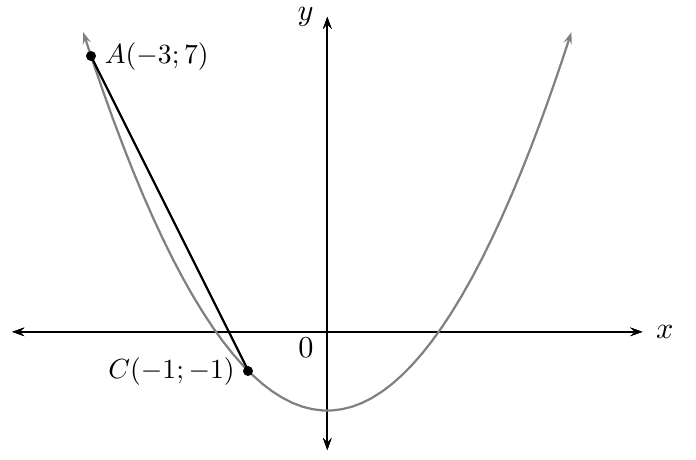
For the diagram above, we can see points A(-3, 7) and C(-1, -1) on a parabola. The average gradient between these points represents how much the function changes on average between these two x-values.
Note
Think of average gradient as finding the "overall steepness" between two points, even though the actual steepness might vary along the curve. It's like finding the average speed for a car trip - the car might go faster or slower at different times, but the average speed tells us the overall rate of travel.
Formula for average gradient
The formula for calculating average gradient is the same as finding the gradient of any straight line:
This is often remembered as "rise over run" - how much the function rises (or falls) divided by how much we move horizontally.
For functions written in the form , we can express this more generally. If we have two points P(a, f(a)) and Q(a+h, f(a+h)), then:
Important
This formula is particularly useful when working with algebraic expressions and will become very important in calculus. The expression is called the difference quotient and forms the foundation for understanding derivatives.
Geometric interpretation
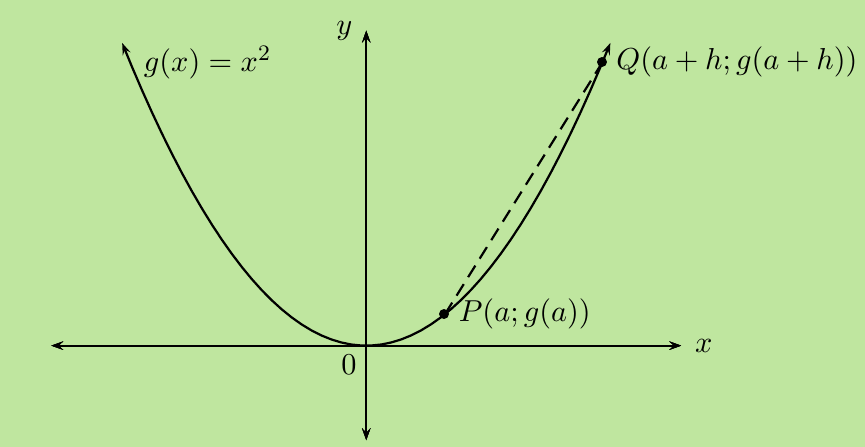
The average gradient has a clear geometric meaning. When we draw a straight line connecting two points on a curve, this line is called a secant line. The gradient of this secant line is exactly the average gradient we calculate using our formula.
As we move the second point closer and closer to the first point, something interesting happens to the secant line. It begins to approach the tangent line to the curve at that point.
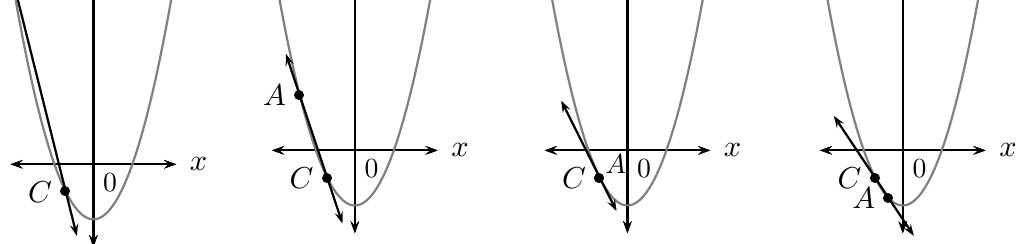
This sequence shows how secant lines gradually approach the tangent line as the two points get closer together. When the two points eventually coincide, the secant line becomes the tangent line, and the average gradient becomes the instantaneous gradient at that point.
Note
This geometric interpretation is crucial for understanding calculus. The process of letting two points get infinitely close together is the foundation of differentiation, which you'll study in Grade 12.
Step-by-step calculation method
When calculating average gradient, follow these systematic steps:
Step 1: Identify the coordinates of your two points
- Label them as and
Step 2: If working with a function, calculate the y-coordinates
- Use the given function rule to find and
Step 3: Apply the average gradient formula
- Calculate
Step 4: Simplify your answer
- Show all algebraic working clearly
Worked example 1: Basic calculation
Example
Worked Example: Basic Average Gradient Calculation
Question: Find the average gradient between points A(-3, 7) and C(-1, -1) on a parabola.
Solution:
Step 1: Identify coordinates
- Point A:
- Point C:
Step 2: Apply the formula
The average gradient between points A and C is -4. This means that for every unit we move to the right, the function decreases by 4 units on average.
Worked example 2: Using function notation
Example
Worked Example: General Algebraic Approach
Question: Find the average gradient between points P(a, g(a)) and Q(a+h, g(a+h)) on the curve .
Solution:
Step 1: Assign labels to x-values
Step 2: Find corresponding y-coordinates using
Step 3: Calculate the average gradient
For the function , the average gradient between any two points is 2a + h, where is the x-coordinate of the first point and is the horizontal distance between the points.
Specific calculation: If P(2, g(2)) and Q(5, g(5)), then and . Average gradient =
Worked example 3: Downward-opening parabola
Example
Worked Example: Downward-Opening Parabola
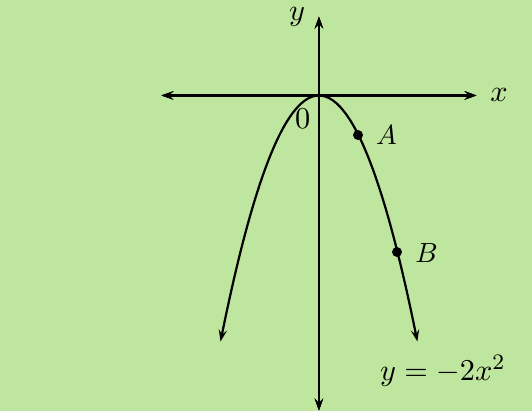
Question: Given , find the average gradient between points A where and B where .
Solution:
Step 1: Examine the function Since , this is a downward-opening parabola with a maximum turning point at the origin.
Step 2: Find the coordinates
- Point A: , so A(1, -2)
- Point B: , so B(3, -18)
Step 3: Calculate average gradient
The negative average gradient confirms that the function is decreasing between these points, which makes sense for a downward-opening parabola.
General formula for any function
For any function , the average gradient between points and is:
Important
This formula is known as the difference quotient and forms the foundation for understanding derivatives in calculus. Remember this formula well - it will be crucial for your future mathematics studies.
Connection to instantaneous gradient
When point Q moves closer and closer to point P, the value of gets smaller and smaller. As approaches 0, the average gradient approaches the instantaneous gradient (or simply the gradient) at point P.
For example, with , as , the average gradient approaches . This means the gradient at any point on the curve is .
Note
This limiting process is the foundation of differential calculus. In Grade 12, you'll learn that this limit defines the derivative of a function, which gives you the instantaneous rate of change at any point.
Key formulas to remember
Important
Essential Formulas for Average Gradient:
- Basic average gradient:
- Function notation:
- For : Average gradient =
- For : Average gradient =
Summary
Key Points to Remember:
- Average gradient measures the overall rate of change between two points on a curve
- It equals the gradient of the secant line connecting the two points
- Use the formula or for calculations
- As the two points get closer together, the average gradient approaches the instantaneous gradient
- Negative gradients indicate the function is decreasing, positive gradients indicate increasing
- The difference quotient is fundamental to calculus