Number Patterns (Grade 11 NSC Matric Mathematics): Revision Notes
📚Revision Notes
Revision
Understanding number patterns and sequences
Number patterns are fundamental concepts in mathematics that help us identify relationships between numbers. While you learned about linear sequences in earlier grades, this revision covers the essential terminology and methods needed to work with different types of sequences effectively.
When working with sequences, you'll encounter patterns where consecutive terms have constant differences (linear sequences) and others where the differences follow their own patterns (quadratic sequences).
Note
Understanding sequences is crucial for success in mathematics as they form the foundation for many advanced topics including series, calculus, and mathematical modeling.
Essential terminology
Understanding the correct mathematical language is crucial for working with number patterns. Here are the key terms you need to know:
Sequence or pattern: This refers to an ordered collection of numbers or variables arranged in a specific way. The order matters, and each number has a particular position.
Successive or consecutive terms: These are terms that come directly one after another in a sequence. For example, in the sequence 5, 8, 11, 14, the terms 8 and 11 are consecutive.
Common difference: Represented by the symbol , this is the constant value you get when you subtract any term from the term that follows it in a linear sequence.
General term: This is a mathematical formula, usually involving the variable , that allows you to calculate any term in the pattern without having to list all the preceding terms.
Conjecture: This is an educated guess or statement that appears to be true based on the available evidence, but hasn't been formally proved.
Note
Mastering this terminology will help you communicate mathematical ideas clearly and understand problem statements more effectively.
Describing patterns using notation
When describing terms in a sequence, mathematicians use a standardised notation system:
- represents the first term of a sequence
- represents the fourth term of a sequence
- represents the general term, often called the term of a sequence
This notation helps you communicate clearly about specific positions in a pattern. When a sequence follows a recognisable pattern, you can develop an equation for the general term that works for any position in the sequence.
For example, consider the linear sequence: 1, 4, 7, 10, 13, ... The general term for this pattern is .
You can verify this works by substituting different values:
- ✓
- ✓
- ✓
Linear sequences
Important
Definition: A linear sequence is a sequence where consecutive terms have a constant difference between them. This constant difference is called the common difference ().
Critical Rule: The common difference is calculated as , not . Always subtract the earlier term from the later term.
Worked example: Finding common difference and general term
Example
Worked Example: Finding Common Difference and General Term
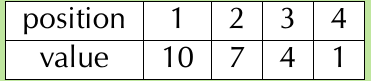
Question: Determine the common difference () and the general term for the following sequence: 10, 7, 4, 1, ...
Solution:
Step 1: Determine the common difference
To calculate the common difference, find the difference between any term and the previous term:
Therefore:
Check with other consecutive terms:
- ✓
- ✓
The pattern shows: 10 → 7 → 4 → 1, with each term decreasing by 3.
Step 2: Determine the general term
To find the general term , identify the relationship between the position of each term and its value.
Starting with the first term, create an expression that includes the common difference () and the position ():
For the second term:
The pattern that emerges links position to value:
Step 3: Drawing a graph of the pattern
Linear sequences can be represented graphically. The graph shows the relationship between position numbers (on the x-axis) and term values (on the y-axis).
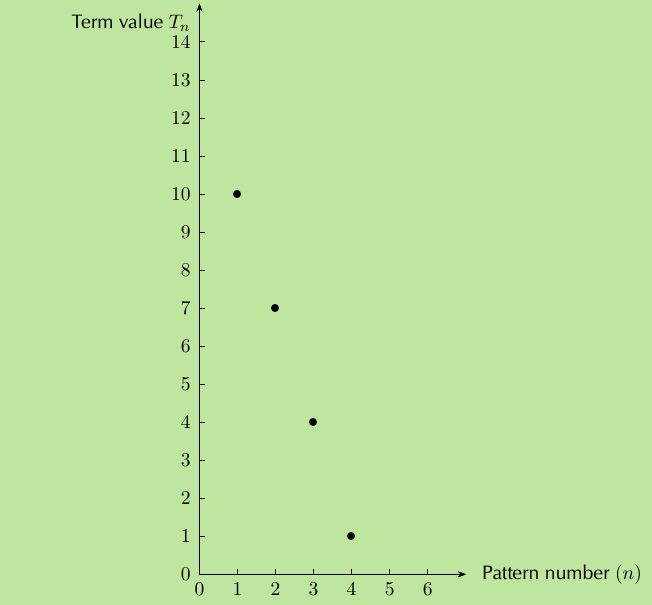
Key observations about the graph:
- Position numbers () must always be positive integers only
- The points form a straight line when connected (hence "linear" sequence)
- The line has a negative slope, reflecting the negative common difference
- The pattern decreases by 3 units for each increase of 1 in position
This pattern can be described in words as: "Each term in the sequence equals negative three times the position number, plus thirteen."
Key properties of linear sequences
Note
Formula structure: The general term of a linear sequence always takes the form , where:
- is the first term
- is the common difference
- is the position number
Graphical representation: Linear sequences always produce straight-line graphs when plotted, with the slope of the line equal to the common difference.
Common differences:
- Positive common difference: sequence increases
- Negative common difference: sequence decreases
- Zero common difference: sequence remains constant
Important
Remember that linear sequences are called "linear" because they form straight lines when graphed. This visual representation makes it easy to identify and verify patterns.
Remember!
Summary
Key Points to Remember:
-
Linear sequences have a constant common difference between consecutive terms, which makes them predictable and easy to work with.
-
Always calculate common difference as later term minus earlier term () to get the correct sign.
-
The general term formula allows you to find any term in a linear sequence without listing all previous terms.
-
Position numbers in sequences must be positive integers - you can't have a term at position 0, -1, or 2.5.
-
Graphically, linear sequences form straight lines when plotted, making it easy to identify the pattern visually and verify your calculations.