Quadratic Sequences (Grade 11 NSC Matric Mathematics): Revision Notes
📚Revision Notes
Quadratic Sequences
What is a quadratic sequence?
Quadratic sequences are fundamental in mathematics and appear frequently in patterns, real-world applications, and higher-level mathematics. Understanding their key characteristics is essential for pattern recognition and problem-solving.
Important
Definition: A quadratic sequence is a special type of number sequence where the second difference between consecutive terms is always the same (constant). This constant second difference is the key characteristic that identifies a quadratic sequence.
Unlike arithmetic sequences where the first differences are constant, quadratic sequences have first differences that change in a regular pattern, but when we look at the differences between these first differences (the second differences), they remain constant.
Understanding the difference method
To identify and work with quadratic sequences, we use a systematic approach called the difference method. This method provides a reliable way to determine whether a sequence is quadratic and helps us understand its structure.
Note
The Difference Method Process:
Step 1: Calculate first differences The first difference is found by subtracting each term from the next term in the sequence.
Step 2: Calculate second differences
The second difference is found by subtracting consecutive first differences.
Step 3: Check for constant second differences If the second differences are all equal, then the sequence is quadratic.
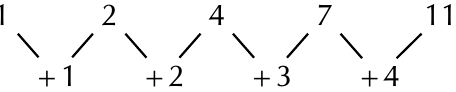
Let's examine this with an example. Consider the sequence: 1, 2, 4, 7, 11, ...
First differences: +1, +2, +3, +4 Second differences: +1, +1, +1
Since the second differences are constant (all equal to 1), this is a quadratic sequence.

General form of quadratic sequences
Every quadratic sequence follows a specific mathematical pattern that can be expressed algebraically. This general form is crucial for solving problems and making predictions about sequence behavior.
Important
Standard Form: Every quadratic sequence can be written as:
Where:
- a, b, and c are constants (with a ≠ 0)
- n represents the position number (1st term, 2nd term, etc.)
- is the value of the nth term
Important relationship
The constant second difference always equals 2a, where 'a' is the coefficient of in the general formula.
This means: Second difference = 2a
This relationship is extremely useful because it allows us to quickly determine the value of 'a' once we've calculated the second differences.
Finding the general term
To find the values of a, b, and c in the general formula, we use the first three terms of the sequence and set up simultaneous equations. This algebraic approach ensures we can find the exact formula for any quadratic sequence.
Note
Method for Finding Coefficients:
For the general form :
- When n = 1:
- When n = 2:
- When n = 3:
We then solve these three equations simultaneously to find a, b, and c.
Worked example 1: Finding the general term
Example
Worked Example: Finding the General Term
Question: Find the general term for the sequence 5, 12, 23, 38, ...
Solution:
Step 1: Calculate the differences
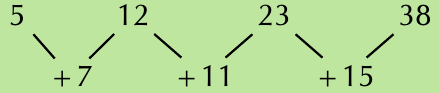
- First differences: +7, +11, +15
- Second differences: +4, +4
Since the second differences are constant (equal to 4), this is a quadratic sequence.
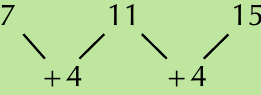
Step 2: Use the relationship 2a = second difference
- Since the second difference = 4, we have: 2a = 4, so a = 2
Step 3: Set up simultaneous equations
Using with a = 2:
- : →
- : →
- : →
Step 4: Solve the equations
From equations 1 and 2:
This gives us: , so b = 1
Substituting back: , so c = 2
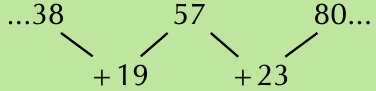
Step 5: Write the general term
Worked example 2: Triangular number pattern
Example
Worked Example: Triangular Number Pattern
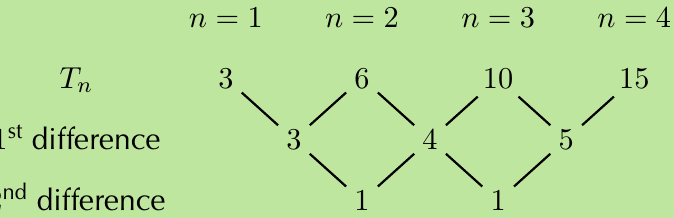
Question: Consider the sequence 3, 6, 10, 15, 21, ...
Solution:
Step 1: Calculate differences
- First differences: 3, 4, 5, 6, ...
- Second differences: 1, 1, 1, ...
The constant second difference of 1 confirms this is quadratic with a = ½.
Step 2: Find the general term Using the same method as before:
- When n = 1: T₁ = 3
- When n = 2: T₂ = 6
- When n = 3: T₃ = 10
Setting up equations with : Through solving simultaneously, we get: , ,
Therefore:
Graphical representation
When we plot the terms of a quadratic sequence against their position numbers, the points form a parabolic curve. This visual representation helps confirm that we're dealing with a quadratic relationship and provides another way to understand the sequence behavior.
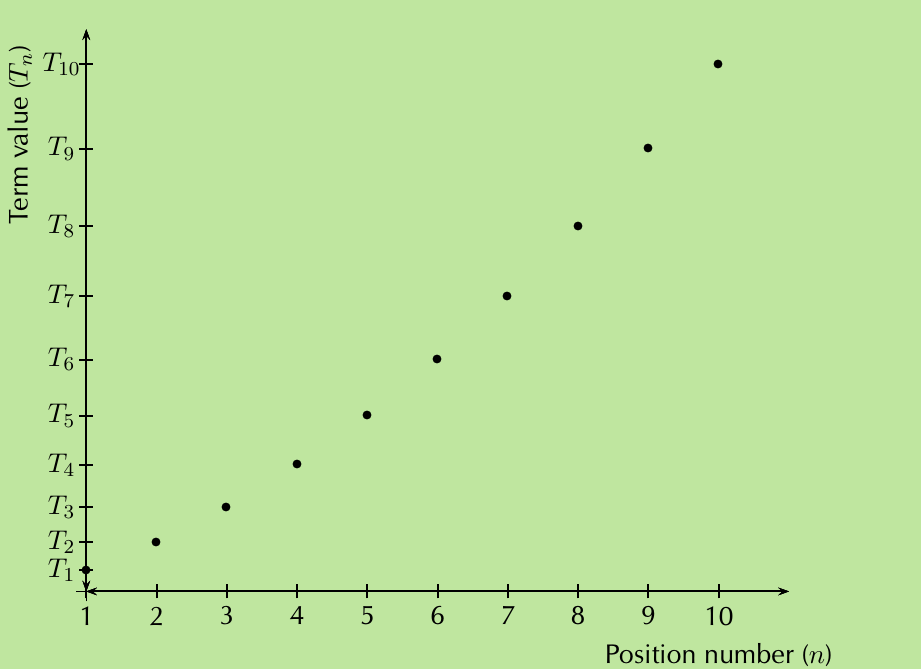
The parabolic shape is characteristic of all quadratic sequences, though the specific curve depends on the values of a, b, and c in the general formula. The coefficient 'a' determines whether the parabola opens upward (a > 0) or downward (a < 0).
Real-world applications
Quadratic sequences appear in many practical situations, making them highly relevant beyond pure mathematics. Understanding these patterns helps solve real problems in various fields.
Note
Tournament Example: In tournament arrangements where teams play each other once (round-robin format), the number of matches follows a quadratic pattern.
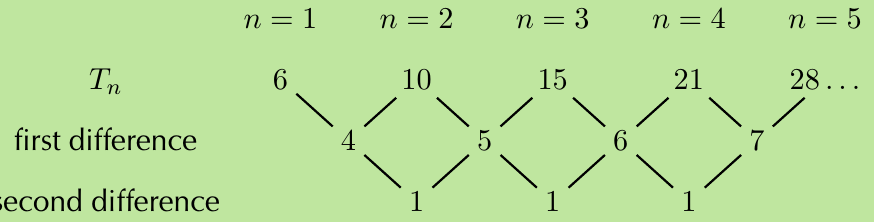
For a tournament with n teams:
- 4 teams need 6 matches
- 5 teams need 10 matches
- 6 teams need 15 matches
This follows the pattern described by .
Key exam tips
Successful work with quadratic sequences requires systematic thinking and careful calculation. These strategies will help you approach problems confidently and avoid common pitfalls.
Note
Essential Strategies:
- Always check second differences first to confirm if a sequence is quadratic
- Remember that second difference = 2a
- Use the first three terms to set up your simultaneous equations
- Verify your answer by substituting back into the formula
- When graphing, remember that quadratic sequences create parabolic curves
Common mistakes to avoid
Important
Watch Out For These Common Errors:
- Forgetting to check that second differences are constant
- Mixing up the relationship between second difference and coefficient 'a'
- Making calculation errors when solving simultaneous equations
- Not checking the answer by substituting back into the original sequence
- Confusing first differences with second differences when identifying sequence types
Summary
Summary
Key Points to Remember:
- Quadratic sequences have constant second differences - this is the key identifying feature
- The general form is always where the second difference equals 2a
- Use three terms to create three equations for finding a, b, and c values
- Second differences reveal the coefficient 'a' since second difference = 2a
- Quadratic sequences create parabolic curves when graphed, confirming the quadratic relationship
- The difference method provides a systematic approach to working with these sequences
- Real-world applications include tournament scheduling, projectile motion, and many optimization problems