Summary (Grade 11 NSC Matric Mathematics): Revision Notes
📚Revision Notes
Summary
This section covers the essential concepts of number patterns, specifically focusing on linear and quadratic sequences. Understanding these patterns is crucial for identifying sequence types and finding general terms in mathematical sequences.
What is a sequence?
A sequence is an ordered list of numbers that follow a specific pattern. Each number in the sequence is called a term.
Note
The general term of a sequence is represented by , where indicates the position of the term in the sequence. For example, is the first term, is the second term, and so on.
Successive terms (also called consecutive terms) are terms that appear one after another in a sequence. These are any two terms that are next to each other in the sequence order.
Linear sequences
A linear sequence is a sequence where there is a constant difference between any two successive terms. This constant difference is called the common difference and is represented by the letter .
Finding the common difference
The formula for calculating the common difference is:
This means you subtract any term from the term that comes immediately after it.
Note
Key properties of linear sequences:
- The first differences are always constant
- When you plot the terms on a graph, they form a straight line
- The pattern increases or decreases at a steady rate
Quadratic sequences
A quadratic sequence is a sequence where the second differences between successive terms are constant. Unlike linear sequences, the first differences are not constant, but when you find the differences of the differences (second differences), these remain constant.
General term of a quadratic sequence
Important
The general term for a quadratic sequence follows the formula:
where , , and are constants, and .
Understanding differences in quadratic sequences
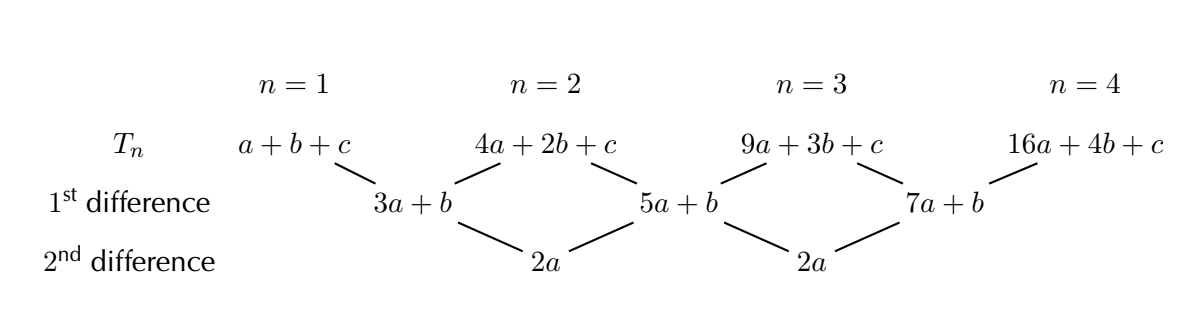
The diagram above illustrates how differences work in quadratic sequences. Here's what happens:
- First difference: The difference between consecutive terms
- Second difference: The difference between consecutive first differences
Note
For any quadratic sequence:
- The second differences are always constant
- The second difference equals (where is the coefficient of in the general term)
- This constant second difference is the key identifying feature
Worked examples
Example
Worked Example: Finding the first five terms of a quadratic sequence
Given:
Find the first five terms:
The first five terms are: 4, 9, 16, 25, 36
Example
Worked Example: Identifying a linear sequence
Consider the sequence: 6, 9, 14, 21, 30, ...
Step 1: Find the first differences
Step 2: Check if differences are constant The first differences (3, 5, 7, 9) are not constant.
Step 3: Find the second differences
Since the second differences are constant (all equal 2), this is a quadratic sequence.
Example
Worked Example: Identifying sequence types
For the sequence: 1, 7, 17, 31, 49, ...
First differences: 6, 10, 14, 18
Second differences: 4, 4, 4
Since the second differences are constant, this is a quadratic sequence.
How to determine sequence type
Important
Follow this systematic approach:
- Calculate first differences between consecutive terms
- If first differences are constant → Linear sequence
- If first differences are not constant → Calculate second differences
- If second differences are constant → Quadratic sequence
- If neither first nor second differences are constant → Neither linear nor quadratic
Exam tips
Note
Essential exam strategies:
- Always work systematically: Start with first differences, then move to second differences if needed
- Show your working clearly: Examiners want to see your difference calculations
- Check your pattern: Make sure the differences you find are truly constant
- Verify answers: Substitute values back into formulas to double-check your work
- Remember the key formulas: for linear sequences, and for quadratic sequences
Summary
Key Points to Remember:
- General term represents any term in a sequence based on its position
- Linear sequences have constant first differences and increase/decrease at a steady rate
- Quadratic sequences have constant second differences and contain an term in their general formula
- Use the common difference formula to identify linear patterns
- Always work through differences systematically: first differences first, then second differences if needed