Probability (Grade 11 NSC Matric Mathematics): Revision Notes
📚Revision Notes
Contingency Tables
What are contingency tables?
A contingency table is a useful tool for organizing and recording data in probability problems. These tables are particularly helpful when you need to determine whether two events are dependent or independent.
Note
Contingency tables show the frequency counts or percentages for different combinations of outcomes. They make it easier to calculate probabilities and analyze relationships between different variables in your data.
Understanding two-way contingency tables
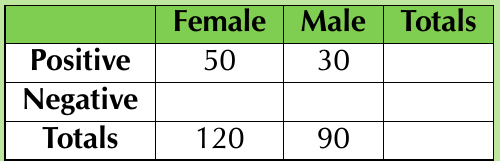
A two-way contingency table displays data for two different events and their complements, creating four possible combinations in total. This type of table shows:
- The counts for each possible combination of events
- The totals for each individual event and its complement
- The overall total for all observations
Two-way contingency tables are especially useful for computing probabilities of various events and determining whether events are dependent or independent.
Note
The table structure includes rows and columns representing the different categories, with marginal totals showing the sum of each row and column.
How to work with contingency tables
When working with contingency tables, always follow this systematic approach:
Important
Step 1: Complete the contingency table
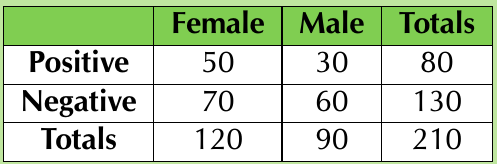
The most important first step is to fill in all missing values in the table. Since each column and row must sum to its respective total, you can calculate missing values using simple arithmetic.
Use the fact that:
- Each row total equals the sum of all entries in that row
- Each column total equals the sum of all entries in that column
- The grand total can be found by summing either all row totals or all column totals
Important
Step 2: Identify what probability you need to calculate
Read the question carefully to determine exactly which probability is being asked for. Pay attention to conditional statements like "given that" or "if we know that."
Calculating probabilities from contingency tables
Conditional probabilities
When calculating conditional probabilities, use the appropriate subset as your denominator:
-
P(positive if female) =
-
P(negative if male) =
Joint probabilities
For joint probabilities, use the total sample size as your denominator:
- P(female and positive) =
Testing for independence
Two events A and B are independent if and only if:
Important
Testing for Independence Procedure:
- Calculate P(A), P(B), and P(A and B) from your contingency table
- Multiply P(A) × P(B)
- Compare this product with P(A and B)
- If they are equal, the events are independent
- If they are not equal, the events are dependent
Worked example 1: Medical trial data
Example
Worked Example: Medical Trial Analysis
Question: A medical trial tested a new medication on 210 participants (120 females and 90 males). Out of these, 50 females and 30 males responded positively.
Solution:
-
Complete the table:
- Negative females: 120 - 50 = 70
- Negative males: 90 - 30 = 60
- Total positive: 50 + 30 = 80
- Total negative: 70 + 60 = 130
-
Calculate probabilities:
-
Test for independence:
Since , the events are dependent.
Worked example 2: Cellphone ownership by grade
Example
Worked Example: Cellphone Ownership Survey
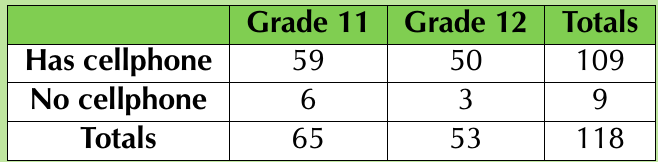
Question: A survey of 118 high school students examined cellphone ownership by grade level.
Solution:
-
P(Grade 11 learner has cellphone) =
-
P(learner without cellphone is from Grade 11) =
-
Test for independence:
Since , grade level and cellphone ownership are dependent.
Worked example 3: Hair and eye colour
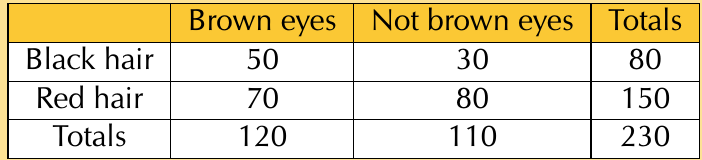
This table shows the relationship between hair colour and eye colour in a sample of 230 people. You can use this data to:
- Calculate conditional probabilities (e.g., probability of brown eyes given black hair)
- Test whether hair colour and eye colour are independent characteristics
- Find joint probabilities for specific combinations
Summary
Key Points to Remember:
-
Always complete the contingency table first before attempting any probability calculations
-
Pay careful attention to the wording of probability questions - conditional probabilities have different denominators than joint probabilities
-
For independence testing, calculate P(A) × P(B) and compare it with P(A and B) - if they're equal, the events are independent
-
Use appropriate denominators - for conditional probabilities, use the given condition as your sample space; for overall probabilities, use the total sample size
-
Check your arithmetic - row totals and column totals should always add up correctly in your completed table