Atomic Combinations (Grade 11 NSC Matric Physical Sciences): Revision Notes
📚Revision Notes
Electronegativity
What is electronegativity?
Electronegativity is a fundamental concept that helps us understand how atoms behave when they form bonds. It measures how strongly an atom attracts shared electrons towards itself when it forms a chemical bond.
Note
Definition: Electronegativity
Electronegativity is a chemical property which describes the power of an atom to attract electrons towards itself.
Think of electronegativity like a "tug-of-war" between atoms. The atom with higher electronegativity will pull the shared electrons more strongly towards itself. This affects the type of bond that forms and the properties of the resulting molecule.
Each element has its own electronegativity value, and these values help us predict what kind of bonds will form between different atoms. The concept was introduced by scientist Linus Pauling, who won the Nobel Prize for his work on chemical bonding.
Electronegativity values
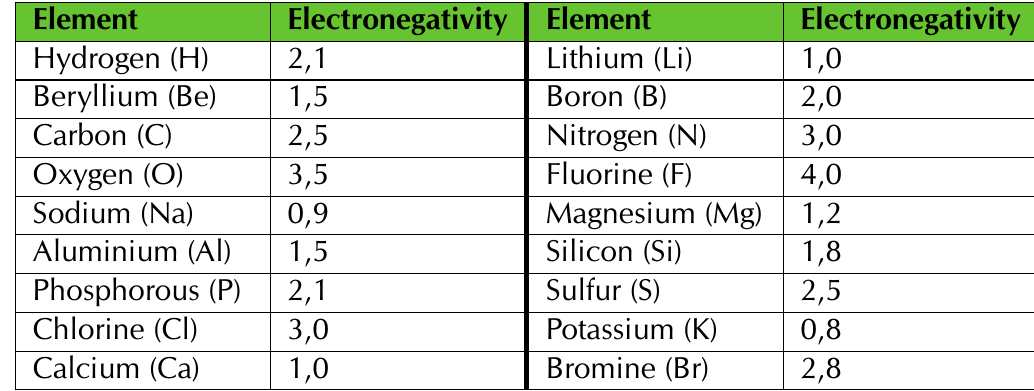
Different elements have different electronegativity values. These values typically range from about 0.8 to 4.0 on the Pauling scale. Here are the electronegativity values for some common elements:
Note
Key points about electronegativity values:
- Fluorine has the highest electronegativity (4.0)
- Metals generally have low electronegativity values (0.8-1.5)
- Non-metals typically have higher electronegativity values (2.0-4.0)
- You can find electronegativity values in the top right corner of each element on the periodic table
Important
Exam tip: Don't confuse electronegativity values with other numbers on the periodic table. Electronegativity values are always between 0 and 4, and if you see a number greater than 4, you're looking at the wrong value.
Calculating electronegativity differences
To determine what type of bond forms between two atoms, we need to calculate the electronegativity difference. This is simply the difference between the electronegativity values of the two atoms.
Formula:
Example
Worked Example: Calculating electronegativity differences
Question: Calculate the electronegativity difference between hydrogen and oxygen.
Solution:
Step 1: Read the electronegativity values from the periodic table
- Hydrogen: 2.1
- Oxygen: 3.5
Step 2: Calculate the electronegativity difference Electronegativity difference = |3.5 - 2.1| = 1.4
The electronegativity difference between hydrogen and oxygen is 1.4.
Electronegativity and bond types
The electronegativity difference between two atoms determines what type of bond forms between them. We can classify bonds into four main categories based on this difference.
Note
Here's what each bond type means:
- Non-polar covalent (0): Electrons are shared equally between atoms
- Weak polar covalent (0-1): Electrons are slightly more attracted to one atom
- Strong polar covalent (1.1-2): Electrons are significantly more attracted to one atom
- Ionic (>2.1): Electrons are almost completely transferred from one atom to another
Important
Exam tip: Remember that bonding is more like a spectrum than distinct categories. The boundaries between bond types are approximate guidelines rather than absolute rules.
Non-polar and polar covalent bonds
Understanding the difference between polar and non-polar covalent bonds is crucial for predicting molecular properties.
Non-polar covalent bonds
Non-polar covalent bonds occur when two atoms have identical electronegativities. This happens in molecules like , , and , where both atoms are the same. The electrons are shared equally between the atoms, so there's no charge separation.
Polar covalent bonds
Polar covalent bonds form when two different non-metal atoms bond together. The atom with higher electronegativity pulls the shared electrons more strongly towards itself, creating an unequal distribution of charge.
This unequal sharing creates partial charges:
- The more electronegative atom gets a slightly negative charge (δ-)
- The less electronegative atom gets a slightly positive charge (δ+)
Note
For example, in hydrogen chloride (HCl):
- Chlorine (electronegativity 3.0) attracts electrons more strongly
- Hydrogen (electronegativity 2.1) becomes δ+
- Chlorine becomes δ-
Polar and non-polar molecules
Just because a molecule contains polar bonds doesn't automatically make the whole molecule polar. The molecular shape and symmetry also play important roles.
Polar molecules
Note
Definition: Polar molecules
A polar molecule is one that has one end with a slightly positive charge, and one end with a slightly negative charge. Examples include water, ammonia and hydrogen chloride.
Polar molecules have an uneven distribution of charge across the molecule. This happens when:
- The molecule contains polar bonds AND
- The molecule is not symmetrical
Non-polar molecules
Note
Definition: Non-polar molecules
A non-polar molecule is one where the charge is equally spread across the molecule or a symmetrical molecule with polar bonds. Examples include carbon dioxide and oxygen.
Non-polar molecules have an even distribution of charge. This occurs when:
- All bonds in the molecule are non-polar, OR
- The molecule is symmetrical, so polar bonds cancel each other out
Determining molecular polarity: worked examples
Example
Worked Example 1: Hydrogen gas ()
Question: State whether hydrogen () is polar or non-polar.
Solution:
Step 1: Determine the shape of the molecule The molecule is linear with one bonding pair and no lone pairs.
Step 2: Write down the electronegativity of each atom Hydrogen: 2.1 (both atoms are identical)
Step 3: Determine the electronegativity difference There is only one bond and the difference is 0.
Step 4: Determine the polarity of the bond The bond is non-polar.
Step 5: Determine the polarity of the molecule The molecule is non-polar.
Example
Worked Example 2: Methane ()
Question: State whether methane () is polar or non-polar.
Solution:
Step 1: Determine the shape of the molecule The molecule is tetrahedral with four bonding pairs and no lone pairs.
Step 2: Determine the electronegativity difference Carbon: 2.5, Hydrogen: 2.1 Electronegativity difference = 2.5 - 2.1 = 0.4
Step 3: Determine the polarity of each bond Each C-H bond is polar (weak polar covalent).
Step 4: Determine the polarity of the molecule The molecule is symmetrical, so even though it has polar bonds, the charges cancel out. The molecule is non-polar.
Example
Worked Example 3: Hydrogen cyanide (HCN)
Question: State whether hydrogen cyanide (HCN) is polar or non-polar.
Solution:
Step 1: Determine the shape of the molecule The molecule is linear with four bonding pairs (including a triple bond) and one lone pair on the nitrogen atom.
Step 2: Determine the electronegativity differences
- Carbon-Hydrogen: 2.5 - 2.1 = 0.4
- Carbon-Nitrogen: 3.0 - 2.5 = 0.5
Step 3: Determine the polarity of each bond Both bonds are polar.
Step 4: Determine the polarity of the molecule The molecule is not symmetrical, so it is polar.
Important
Exam tip: When determining molecular polarity, always consider both the individual bond polarities and the overall molecular shape. A symmetrical molecule with polar bonds can still be non-polar overall.
Summary
Key Points to Remember:
- Electronegativity measures how strongly an atom attracts shared electrons
- Fluorine has the highest electronegativity (4.0) - it's the most electronegative element
- Calculate electronegativity difference by subtracting the smaller value from the larger value
- Bond type depends on electronegativity difference: 0 = non-polar, 0-1 = weak polar, 1.1-2 = strong polar, >2.1 = ionic
- Molecular polarity depends on both bond polarity and molecular shape - symmetrical molecules can be non-polar even with polar bonds