Energy and Bonding (Grade 11 NSC Matric Physical Sciences): Revision Notes
📚Revision Notes
Energy and Bonding
Understanding energy changes in chemical bonding
When atoms come together to form chemical bonds, significant energy changes occur. These energy changes help us understand why bonds form and how stable they are.
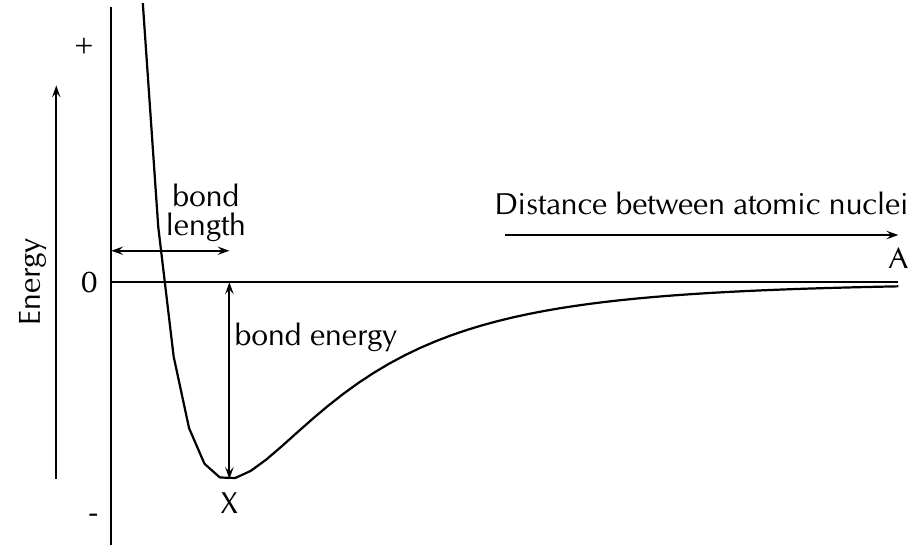
The relationship between energy and bonding can be visualised using an energy diagram that shows what happens as two atoms approach each other.
Note
This energy diagram reveals several important principles:
- At large distances: Atoms are far apart and don't interact, so the energy is zero
- As atoms approach: Energy decreases (becomes more negative) due to attractive forces
- At the minimum point (X): This represents the most stable arrangement where attractive and repulsive forces are balanced
- At very close distances: Energy increases sharply due to repulsion between the nuclei
The minimum point on this curve corresponds to the natural bond length, whilst the depth of the minimum represents the bond energy.
Key bond properties
Important
Understanding three fundamental properties of chemical bonds is essential for predicting molecular behaviour and stability.
Bond length
Bond length is the distance between the nuclei of two atoms when they are chemically bonded together.
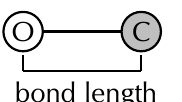
This distance represents the equilibrium position where attractive and repulsive forces are perfectly balanced.
Note
Bond length is measured in nanometres (nm) or picometres (pm).
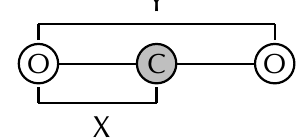
When working with molecules containing multiple bonds, it's important to identify which specific bond length is being measured. For example, in carbon dioxide (CO₂), each C-O bond has its own bond length.
Bond energy
Bond energy refers to the amount of energy required to break a chemical bond that has already formed between two atoms.
This energy represents how much work must be done to completely separate bonded atoms. The greater the bond energy, the stronger and more stable the bond. Bond energies are typically measured in kilojoules per mole (kJ/mol).
Note
When atoms form bonds, they release energy (exothermic process). Conversely, breaking bonds requires energy input (endothermic process).
Bond strength
Bond strength describes how strongly two atoms are held together in a chemical bond.
Important
Factors affecting bond strength:
- Bond length: Shorter bonds are generally stronger because atoms are held more tightly together
- Atomic size: Smaller atoms form stronger bonds because their nuclei are closer together
- Number of bonds: Multiple bonds (double or triple) are stronger than single bonds between the same atoms
These relationships help explain why some molecules are more stable than others and why certain reactions require more energy to occur.
Working with molecular properties
Understanding how bond properties relate to molecular behaviour is crucial for predicting chemical properties.
The polarity of bonds and molecules depends on electronegativity differences between atoms.
Example
Worked Example: Analyzing Molecular Polarity
When analysing molecules:
- Calculate electronegativity differences between bonded atoms
- Determine if individual bonds are polar or non-polar
- Consider molecular geometry to determine overall molecular polarity
Key relationships:
- Large electronegativity differences → polar bonds
- Molecular shape determines whether polar bonds cancel out
- Molecular polarity affects physical properties like boiling point and solubility
Important
Common Mistakes to Avoid:
- Don't forget that molecular polarity depends on both bond polarity AND molecular geometry
- Remember that symmetrical molecules with polar bonds can still be non-polar overall
Summary
Key Points to Remember:
- Energy reaches a minimum when atoms are at their optimal bonding distance
- Bond length is the distance between nuclei of bonded atoms at this energy minimum
- Bond energy is the energy needed to break an existing bond completely
- Shorter bonds are generally stronger and require more energy to break
- Molecular polarity depends on both individual bond polarities and overall molecular shape