Energy Changes in Chemical Reactions (Grade 11 NSC Matric Physical Sciences): Revision Notes
📚Revision Notes
Energy Changes in Chemical Reactions
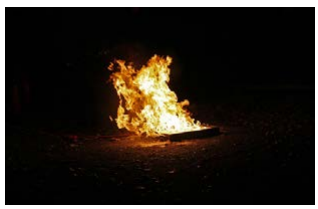
Chemical reactions are all around us, from the burning campfire that provides warmth to the food we digest for energy. One of the most important aspects of chemical reactions is that they all involve energy changes. Understanding these energy changes helps us predict how reactions behave and why they occur.
Note
The study of energy changes in chemical reactions is called chemical thermodynamics or thermochemistry. When reactions occur, we can observe energy changes as increases or decreases in temperature, or sometimes as light being produced or absorbed.
What causes energy changes in chemical reactions
Energy changes in chemical reactions happen because of what occurs to the chemical bonds during the reaction. When a reaction takes place, existing bonds in the reactant molecules must break, and new bonds form in the product molecules.
Let's examine this using a simple example. When hydrogen gas reacts with oxygen gas to form water:
During this reaction, the bonds between hydrogen atoms in H₂ molecules must break, and the bonds between oxygen atoms in O₂ molecules must also break. At the same time, new bonds form between hydrogen and oxygen atoms to create water molecules.
Important
Here's the key principle: breaking bonds always requires energy, while forming bonds always releases energy. The overall energy change depends on whether more energy is needed to break bonds or more energy is released when new bonds form.
Bond energy
Understanding bond strength is fundamental to predicting energy changes in reactions. Bond energy is a measure of bond strength in a chemical bond. It tells us exactly how much energy is needed to break the bond between two atoms. Bond energies are measured in kilojoules per mole (kJ·mol⁻¹).
The energy needed to break a bond is also called bond dissociation energy. When we look at the overall energy change in a reaction, we need to consider both the energy required to break existing bonds and the energy released when new bonds form.
Note
An energy diagram helps us visualise this process. The diagram shows how energy changes as atoms move closer together or further apart. At the lowest point on the curve, atoms are at their most stable distance - this is where the chemical bond exists. Moving away from this point (breaking the bond) requires energy input, while moving towards this point (forming the bond) releases energy.
Enthalpy
When we study the total energy of a chemical reaction system, we use a concept called enthalpy. Enthalpy is a measure of the total energy of a chemical system at a given pressure, represented by the symbol H.
Enthalpy helps us understand the overall energy changes that occur during reactions. As we learn about different types of reactions, the concept of enthalpy becomes essential for understanding why some reactions release energy while others absorb it.
Exothermic reactions
An exothermic reaction is one that releases energy in the form of heat or light. In these reactions, the energy needed to break the bonds in the reactants is less than the energy released when new bonds form in the products.
We can represent exothermic reactions using the general formula: Reactants → Products + Energy
Another way to understand exothermic reactions is that the energy of the products is less than the energy of the reactants because energy has been released during the reaction. When energy is released, the surroundings (like the air around the reaction) become warmer.
Common examples of exothermic reactions include:
Combustion reactions: When fuels burn, they release large amounts of energy. For example, when petrol burns:
This is why we use fuels for energy - the combustion reactions release energy that we can use for heating, electricity, and powering vehicles.
Respiration: The chemical reaction in our bodies that produces energy from food:
This reaction allows our cells to function by providing the energy they need.
Endothermic reactions
An endothermic reaction is one that absorbs energy in the form of heat or light. In these reactions, the energy needed to break bonds in the reactants is greater than the energy released when new bonds form in the products.
We can represent endothermic reactions using the general formula: Reactants + Energy → Products
In endothermic reactions, the energy of the products is greater than the energy of the reactants because energy has been absorbed during the reaction. When energy is absorbed, the surroundings become cooler.
Common examples of endothermic reactions include:
Photosynthesis: Plants use energy from sunlight to convert carbon dioxide and water into glucose:
Thermal decomposition of limestone: In industry, limestone is heated to very high temperatures to break it down:
This reaction requires continuous heating because it absorbs energy.
Heat of reaction and enthalpy change
The difference in energy between the reactants and products is called the heat of the reaction. This is also referred to as the enthalpy change of the system, represented by the symbol ΔH (delta H).
Important
For exothermic reactions, ΔH has a negative value because energy is released (the system loses energy). For endothermic reactions, ΔH has a positive value because energy is absorbed (the system gains energy).
Worked example 1: investigating an endothermic reaction
Example
Worked Example: Citric Acid and Sodium Bicarbonate Reaction
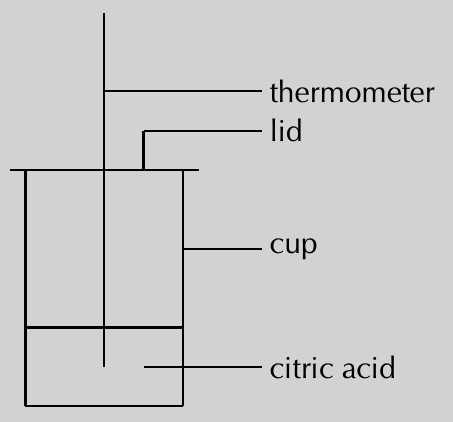
Let's examine how we can identify whether a reaction is endothermic or exothermic by measuring temperature changes. This experiment investigates the reaction between citric acid and sodium bicarbonate.
Materials needed:
- Citric acid
- Sodium bicarbonate (baking soda)
- Polystyrene cup
- Lid for the cup
- Thermometer
- Glass stirring rod
Method:
- Pour citric acid into the polystyrene cup and cover with the lid
- Record the initial temperature of the solution
- Add sodium bicarbonate and stir gently, then cover the cup again
- Record the temperature every two minutes for six minutes
The chemical equation for this reaction is:
Data collection:
| Time (mins) | 0 | 2 | 4 | 6 |
|---|---|---|---|---|
| Temperature (°C) |
Expected results: The temperature should decrease during this reaction, indicating that energy is being absorbed from the surroundings.
Conclusion: This is an endothermic reaction because the temperature decreases, showing that energy is absorbed during the reaction. The cup is kept covered to prevent heat exchange with the environment, ensuring accurate measurements.
Worked example 2: investigating an exothermic reaction
Example
Worked Example: Steel Wool Oxidation
This experiment investigates the oxidation of steel wool, demonstrating an exothermic reaction.
Materials needed:
- Vinegar
- Steel wool
- Thermometer
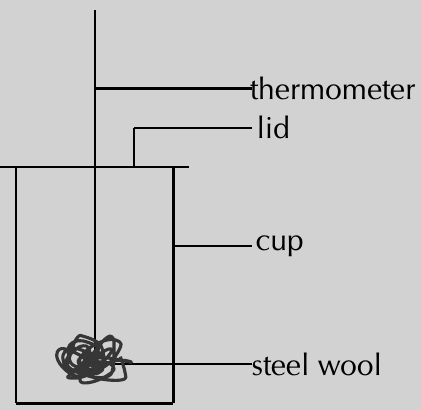
- Polystyrene cup and lid (from previous experiment)
Method:
- Place the thermometer in the empty cup and record the initial temperature
- Soak steel wool in vinegar for about one minute (this removes the protective coating)
- Remove the thermometer from the cup
- Remove the steel wool from vinegar and wrap it around the thermometer
- Place the wrapped thermometer back in the cup and wait five minutes
- Record the final temperature and observations
Expected results: The temperature increases when the steel wool is wrapped around the thermometer.
Explanation: The vinegar removes the protective coating from the steel wool, allowing the iron metal to react directly with oxygen in the air. This oxidation reaction is exothermic, releasing energy and causing the temperature to increase.
Conclusion: The reaction between oxygen and iron in steel wool is exothermic because energy is released, as shown by the temperature increase.
Identifying reaction types through temperature changes
Note
A simple way to identify whether a reaction is exothermic or endothermic is to measure temperature changes in the surroundings:
- Temperature increases: The reaction is exothermic (releases energy)
- Temperature decreases: The reaction is endothermic (absorbs energy)
This method works because energy released by exothermic reactions heats up the surroundings, while energy absorbed by endothermic reactions cools down the surroundings.
Exam tips for energy changes
Summary
Key Strategies for Success:
- Remember the definitions: Be able to clearly state what exothermic and endothermic reactions are
- Link temperature to reaction type: Temperature increase = exothermic, temperature decrease = endothermic
- Understand bond energy: Breaking bonds requires energy, forming bonds releases energy
- Know common examples: Combustion and respiration are exothermic; photosynthesis is endothermic
- Practice calculations: Be comfortable with enthalpy change problems using ΔH values
Summary
Key Points to Remember:
- All chemical reactions involve energy changes due to bond breaking and forming
- Exothermic reactions release energy - temperature of surroundings increases
- Endothermic reactions absorb energy - temperature of surroundings decreases
- Bond breaking always requires energy input, while bond forming always releases energy
- The overall energy change determines reaction type - more energy released = exothermic, more energy absorbed = endothermic
- Temperature measurements help identify reaction types in practical situations