Boyle's Law (Grade 11 NSC Matric Physical Sciences): Revision Notes
📚Revision Notes
Boyle's Law
Introduction to gas laws
Several laws help us understand how ideal gases behave under different conditions. These laws work under very specific circumstances and can be combined to create more general equations for gas behaviour.
Before studying these gas laws, we need to understand the units used for gas calculations. Different units are commonly used for the same quantities, so conversions are essential.
Note
Important unit relationships to remember:
- Volume: 1 mL = 1 cm³ and 1 L = 1 dm³
- Pressure: Standard atmospheric pressure can be expressed as 760 mmHg, 1 atm, or 101,325 Pa
- Temperature: Must always be in Kelvin for gas law calculations (K = °C + 273)
Definition and meaning
Boyle's Law states that when the temperature stays constant, the pressure of a fixed amount of gas changes inversely with its volume. This means:
- When volume increases, pressure decreases
- When volume decreases, pressure increases
- The relationship is predictable and mathematical
Think about pushing the plunger of a syringe while blocking the opening with your finger. As you reduce the volume, you feel increased resistance from the higher pressure inside.
Important
The key concept here is the inverse relationship - as one variable increases, the other decreases in a predictable pattern. This is different from a direct relationship where both variables change in the same direction.
Investigating Boyle's law experimentally
Scientists verify Boyle's law through practical experiments using specialised apparatus.
Apparatus needed
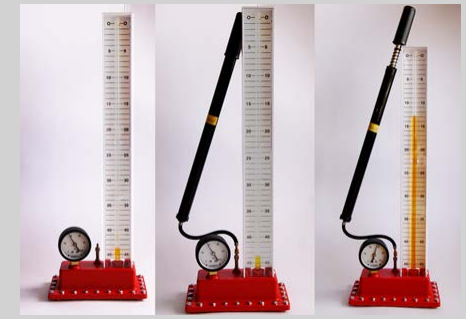
The experimental setup includes syringes or glass tubes with pressure gauges that can measure both pressure and volume changes simultaneously.
Experimental method
The investigation follows these key steps:
- Initial measurement: Fill the apparatus with air and record the maximum pressure and corresponding volume
- Pressure release: Slowly reduce pressure by approximately 20 units and allow the system to stabilise
- Stabilisation: Wait about 2 minutes for equilibrium, then record the new volume
- Repetition: Continue this process until you have collected six pressure-volume pairs
- Data recording: Use a systematic approach to record all measurements
Note
Experimental Tips:
- Allow sufficient time for the system to reach equilibrium at each measurement point
- Take multiple readings to ensure accuracy
- Record measurements systematically to avoid errors
Expected results and observations
When pressure decreases, volume increases proportionally. This creates a specific pattern that confirms the inverse relationship predicted by Boyle's law.
Analysing the relationship
The relationship between pressure and volume produces a characteristic curve when graphed.
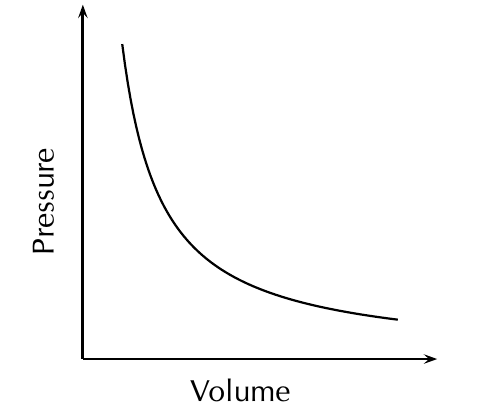
This curved graph shows the inverse relationship - as one variable increases, the other decreases in a predictable pattern.
Understanding why Boyle's law works
The kinetic theory of gases explains Boyle's law through particle behaviour. Gas pressure results from particles colliding with container walls.
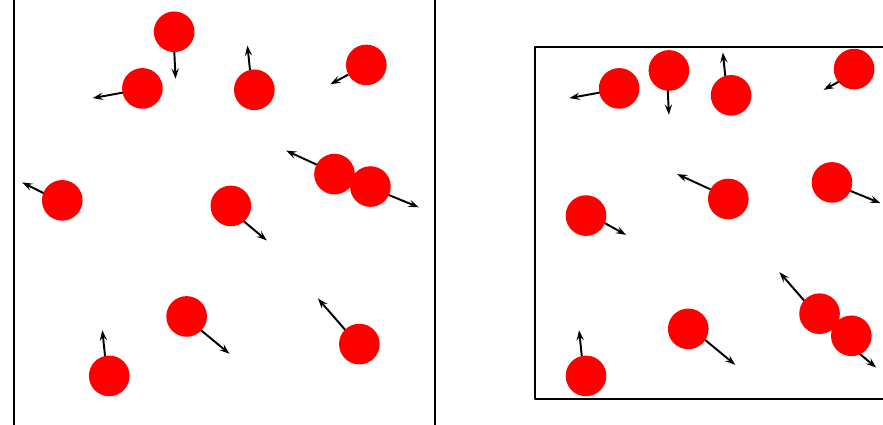
When volume decreases:
- The same number of gas particles occupy less space
- Particles collide more frequently with the walls
- More frequent collisions create higher pressure
When volume increases:
- Particles have more space to move
- Collisions with walls become less frequent
- Reduced collision frequency results in lower pressure
Note
Microscopic Explanation: The behaviour we observe at the macroscopic level (pressure and volume changes) is directly caused by what happens at the molecular level. Understanding this particle behaviour helps explain why the mathematical relationship exists.
Mathematical expressions
Basic relationship
Boyle's law can be expressed mathematically as:
This means pressure is inversely proportional to volume.
Equation form
We can write this relationship as:
where k is a proportionality constant that depends on the amount of gas and temperature.
Practical calculation form
Rearranging gives us the most useful form:
This tells us that for any gas sample at constant temperature, the product of pressure and volume always equals the same constant value.
Comparing different conditions
For the same gas sample under different conditions:
This equation allows us to calculate unknown pressure or volume values when conditions change.
Important
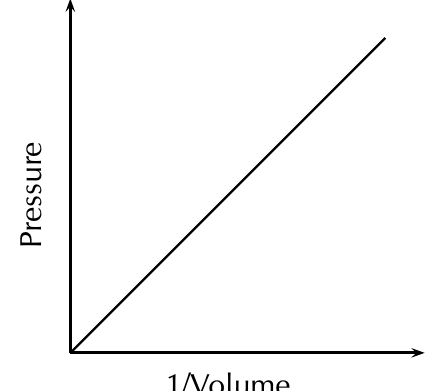
When we plot pressure against 1/volume, we get a straight line, confirming that pressure and volume are inversely proportional. This linear relationship on a 1/V graph is key evidence supporting Boyle's law.
Worked examples
Example
Worked Example 1: Volume change with pressure change
Problem: A helium sample occupies 160 cm³ at 100 kPa and 25°C. What volume will it occupy at 80 kPa if temperature remains unchanged?
Solution:
Step 1: Identify known information
- p₁ = 100 kPa
- p₂ = 80 kPa
- V₁ = 160 cm³
- V₂ = ?
- Temperature constant
Step 2: Choose appropriate equation
Since temperature is constant, use Boyle's law:
Step 3: Substitute and solve
Step 4: Check the answer Pressure decreased, so volume should increase. Our answer shows volume increased from 160 cm³ to 200 cm³, which is reasonable.
Example
Worked Example 2: Pressure change with volume change
Problem: A gas sample has volume 2.5 L at 695 Pa. What pressure will result if volume increases to 2.8 L at constant temperature?
Solution:
Step 1: Identify known information
- V₁ = 2.5 L
- V₂ = 2.8 L
- p₁ = 695 Pa
- p₂ = ?
Step 2: Apply Boyle's law
Step 3: Substitute and solve
Step 4: Verify the result Volume increased, so pressure should decrease. Our answer shows pressure decreased from 695 Pa to 620.5 Pa, confirming the inverse relationship.
Important conditions and limitations
Boyle's law only works under specific conditions:
Temperature must remain constant
Heating or cooling the gas changes particle motion, affecting both pressure and volume independently. Temperature changes break the simple inverse relationship.
Amount of gas must stay fixed
Adding or removing gas particles changes the total number of collisions, altering the pressure-volume relationship. The container must remain sealed.
Real vs ideal behaviour
Real gases follow Boyle's law closely under normal conditions, but deviations occur at very high pressures or very low temperatures.
Important
Critical Limitations: Remember that Boyle's law is an approximation that works well under normal laboratory conditions. Extreme conditions (very high pressure or very low temperature) can cause real gases to deviate significantly from ideal behaviour.
Exam tips and common mistakes
Note
Exam Success Tips:
- Always check units: Ensure pressure and volume units are consistent throughout calculations
- Temperature constant: Remember that Boyle's law only applies when temperature doesn't change
- Inverse relationship: When pressure increases, volume must decrease, and vice versa
- Mathematical manipulation: Practice rearranging p₁V₁ = p₂V₂ to solve for different variables
Summary
Key Points to Remember:
-
Boyle's law describes the inverse relationship between pressure and volume for a fixed amount of gas at constant temperature
-
Mathematical expression: p₁V₁ = p₂V₂ allows calculations when conditions change
-
Physical explanation: Changes in volume affect collision frequency between gas particles and container walls
-
Essential conditions: Temperature and amount of gas must remain constant for the law to apply
-
Practical applications: Understanding Boyle's law helps explain breathing, syringes, and many industrial processes involving gases