Charles' Law (Grade 11 NSC Matric Physical Sciences): Revision Notes
📚Revision Notes
Charles' Law
Introduction and historical background
Charles' Law describes how the volume of a gas changes when its temperature changes. This important gas law was first published by Joseph Louis Gay-Lussac in 1802, but he credited earlier unpublished work by Jacques Charles from around 1787. Understanding this law helps explain many everyday phenomena, from why balloons shrink in cold weather to how hot air balloons work.
Note
While the law bears Charles' name, it was actually Gay-Lussac who first published the relationship in 1802. This highlights how scientific discoveries often build upon previous unpublished work and collaboration between researchers.
Definition of Charles' Law
Charles' Law forms one of the fundamental relationships in gas behavior, establishing a clear connection between temperature and volume.
Important
Charles' Law: The volume of an enclosed sample of gas is directly proportional to its Kelvin temperature, provided the pressure and amount of gas remain constant.
This means that when you heat a gas, its volume increases. When you cool a gas, its volume decreases. The key point is that volume and temperature change together in the same direction.
Mathematical relationship
The relationship between volume and temperature can be expressed mathematically in several ways:
Proportionality:
This shows that volume is directly proportional to temperature.
With constant:
Where is the constant of proportionality.
Rearranged form:
This shows that the ratio of volume to temperature remains constant.
Comparing two states:
This is the most useful form for solving problems, where:
- = initial volume
- = initial temperature
- = final volume
- = final temperature
Temperature scales and absolute zero
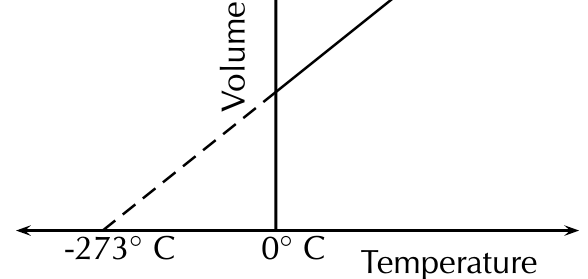
When plotting volume against temperature using the Celsius scale, something interesting happens. If you extend the line backwards, it reaches zero volume at -273°C. This temperature is called absolute zero.
Important
Charles' Law only works properly when using the Kelvin temperature scale. The Kelvin scale starts at absolute zero, making all temperatures positive. This is essential for accurate calculations.
Temperature conversion:
Where:
- = temperature in Kelvin
- = temperature in Celsius
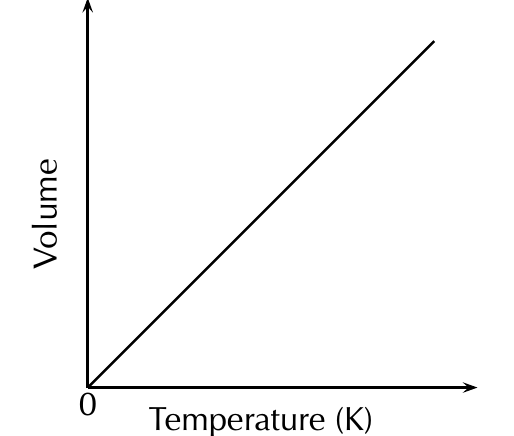
When using the Kelvin scale, the volume-temperature relationship produces a straight line that passes through the origin (0,0).
Practical experiment: demonstrating Charles' Law
Understanding Charles' Law becomes much clearer when you can observe it directly through experimentation.
Example
Demonstration: Charles' Law in Action
Aim: To demonstrate Charles' Law
Equipment needed:
- Empty glass bottle
- Balloon
- Water bath or beaker
- Hot plate
- Water
Method:
- Place the balloon over the opening of the empty bottle
- Fill the beaker with water and place it on the hot plate
- Stand the bottle in the water bath and turn on the hot plate
- Observe what happens to the balloon as the water heats up
Results: The balloon expands as the air inside the bottle is heated. The pressure inside cannot change much, so the increased temperature causes the air to expand into the balloon.
Alternative observation: Place the bottle and balloon in a freezer. The balloon will shrink as the temperature decreases.
Conclusion: Temperature and volume are directly related. As temperature increases, volume increases. As temperature decreases, volume decreases.
Kinetic theory explanation
Charles' Law can be explained using the kinetic theory of gases, which provides the molecular basis for this macroscopic observation.
Note
Molecular Explanation of Charles' Law
When you increase the temperature of a gas:
- The average speed of gas molecules increases
- Molecules collide with container walls more frequently and with greater force
- These more energetic collisions push the walls outward
- The gas expands to occupy a larger volume
This expansion continues until the pressure inside equals the external pressure again.
Worked example 1: temperature decrease
Example
Worked Example: Volume Change with Temperature Decrease
Question: A sample of CO₂ gas occupies 6 L at 298 K. What temperature will the gas be at if its volume is reduced to 5.5 L? The pressure remains constant.
Solution:
Step 1: Write down known information
- L
- L
- K
Step 2: Check units
Temperature is already in Kelvin, so no conversion needed.
Step 3: Choose appropriate equation
Since pressure and amount of gas are constant, use Charles' Law:
Step 4: Substitute and calculate
Cross multiply:
Step 5: Check the answer
Volume decreased, so temperature should decrease. Our answer shows temperature dropping from 298 K to 273.2 K, which is correct.
Worked example 2: temperature increase
Example
Worked Example: Volume Change with Temperature Increase
Question: A gas syringe contains ammonia at 20°C with a volume of 122 mL. The syringe is placed in a water bath at 32°C. What will the volume reading be after one hour?
Solution:
Step 1: Write down known information
- mL
Step 2: Convert temperatures to Kelvin
Step 3: Use Charles' Law equation
Rearranging:
Step 4: Substitute and calculate
Step 5: Check the answer
Temperature increased, so volume should increase. Our answer shows volume increasing from 122 mL to 127 mL, which is correct.
Exam tips
Success in Charles' Law problems requires attention to specific details and systematic problem-solving approaches.
Summary
Key Exam Success Strategies:
- Always convert Celsius to Kelvin - Charles' Law only works with absolute temperature
- Check that pressure and amount of gas remain constant before applying Charles' Law
- Remember the direct relationship - if temperature goes up, volume goes up
- Units matter - keep volume units consistent throughout your calculation
- Show all working - examiners want to see your method clearly
Remember!
Summary
Key Points to Remember:
- Charles' Law shows volume is directly proportional to temperature (in Kelvin) when pressure is constant
- Always convert Celsius to Kelvin by adding 273
- Use the equation for calculations
- Temperature and volume change in the same direction - both increase or both decrease together
- The kinetic theory explains this law - higher temperature means faster-moving molecules that push walls outward