Motion of Particles (Grade 11 NSC Matric Physical Sciences): Revision Notes
📚Revision Notes
Motion of Particles
Introduction to kinetic theory of gases
The kinetic theory of gases builds on what you learned about the kinetic theory of matter in Grade 10. This theory explains that all matter consists of tiny particles that possess energy, allowing them to move at different speeds depending on temperature. These particles have spaces between them and experience attractive forces when they come close together.
We can now apply these same principles to understand how gases behave.
Note
The kinetic theory provides a microscopic explanation for macroscopic gas properties like pressure and temperature by describing the behavior of individual gas particles.
Main assumptions of kinetic theory of gases
The kinetic theory of gases is built on a foundation of five fundamental assumptions that help us understand and predict gas behavior:
Important
The Five Key Assumptions of Kinetic Theory:
-
Gases consist of particles (atoms or molecules) that are extremely small compared to the distances separating them
-
Gas particles are in constant motion because they possess kinetic energy, moving in straight lines at various speeds
-
Attractive forces between particles are very weak for gases under normal conditions
-
Collisions between particles and container walls are elastic, meaning they do not change the total kinetic energy of the system
-
Temperature measures the average kinetic energy of all the gas particles
These assumptions form the theoretical foundation that allows us to derive gas laws and explain observable gas behavior.
Understanding pressure and temperature
Understanding the relationship between pressure and temperature is crucial for grasping gas behavior at the molecular level.
Pressure
Pressure is a measure of how frequently gas particles collide with each other and with the walls of their container. More frequent collisions result in higher pressure.
Temperature
Temperature measures the average kinetic energy of the gas particles. When a gas is heated, its particles gain kinetic energy and move faster on average.
Note
The Pressure-Temperature Connection:
When gas particles gain energy (temperature increases), they move faster and collide more frequently, increasing pressure. If particles lose significant energy, they slow down considerably and the gas may liquefy.
Ideal gases versus real gases
To understand gas behavior, we must distinguish between theoretical ideal gases and the real gases we encounter in nature.
Ideal gas
An ideal gas is a theoretical concept where:
- All particles are identical with zero volume
- No intermolecular forces exist between particles
- All particles move at exactly the same speed
Real gas
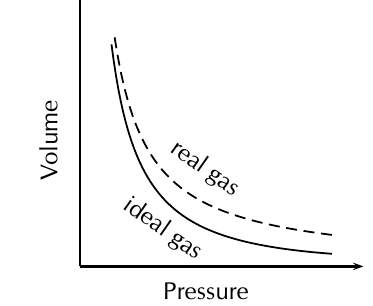
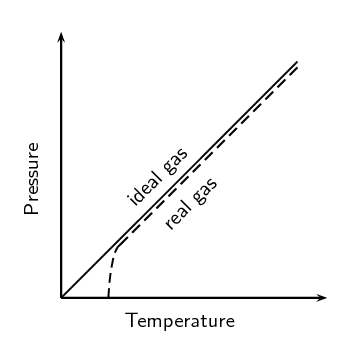
Real gases behave similarly to ideal gases under normal conditions, but deviate from ideal behavior at high pressures and low temperatures.
Most gases follow gas laws reasonably well within limited ranges of pressure and temperature, allowing us to use gas laws to predict real gas behavior with good accuracy.
Why real gases deviate from ideal behavior
Real gases don't behave as ideal gases under certain conditions because two key assumptions of the ideal gas model break down:
Important
Two Critical Deviations from Ideal Behavior:
1. Molecules do occupy volume
At very high pressures, gas molecules become compressed and their individual volumes become significant compared to the total space available. This reduces the actual volume available for molecular movement, making collisions more frequent. Consequently, real gas pressure becomes higher than predicted by ideal gas laws.
2. Attractive forces exist between molecules
At low temperatures, gas molecules slow down and move closer together, making intermolecular attractive forces more noticeable. These forces reduce molecular movement and decrease collision frequency. Therefore, real gas pressure becomes lower than ideal gas predictions. If temperature drops sufficiently or pressure increases enough, the gas will liquefy.
Comparing ideal and real gas properties
| Property | Ideal gas | Real gas |
|---|---|---|
| Size of particles | Zero volume | Have measurable volume |
| Attractive forces | None | Weak but present |
| Speed of molecules | All identical | Variable speeds (we use average) |
Note
This comparison highlights why real gases deviate from ideal behavior under extreme conditions - the assumptions that work well under normal conditions break down when particles are forced close together or when they move slowly enough for intermolecular forces to become significant.
Summary
Key Points to Remember:
- Kinetic theory explains gas behavior through particle motion and energy
- Temperature directly relates to the average kinetic energy of gas particles
- Pressure results from particle collisions with container walls
- Ideal gases are theoretical - real gases deviate at high pressures and low temperatures
- High pressure makes real gases occupy more volume than predicted due to particle size
- Low temperature makes real gases exert less pressure than predicted due to attractive forces