Intermolecular Forces (Grade 11 NSC Matric Physical Sciences): Revision Notes
📚Revision Notes
Intermolecular and Interatomic Forces
What are intermolecular forces?
Matter around us exists in different phases - gases like the air we breathe, liquids like water we drink, and solids like the chair we sit on. Understanding why matter exists in these different states requires us to examine the forces that hold molecules together.
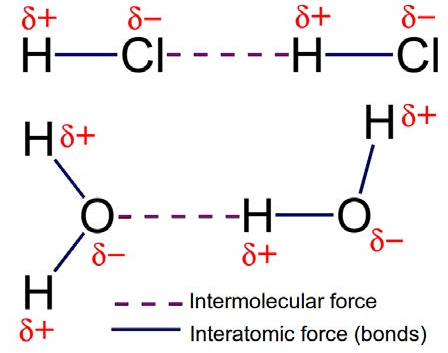
When atoms join together, they form molecules. These molecules are held together by forces called intermolecular forces. These forces are different from the forces that exist between atoms within a molecule, which are called interatomic forces or chemical bonds.
Note
Intermolecular forces are forces that act between separate molecules and determine many important properties like melting points, boiling points, and solubility.
Polar vs non-polar molecules
To understand intermolecular forces, you must first understand the difference between polar and non-polar molecules.
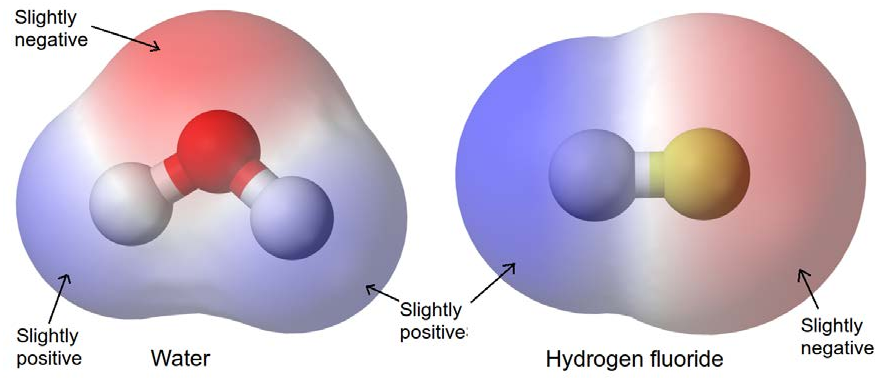
A polar molecule contains atoms with different electronegativities, causing electrons to spend more time near one atom than another. This creates partially positive (δ+) and partially negative (δ-) regions in the molecule, forming a dipole.
Note
The shape of a molecule also affects its polarity. Even if bonds within a molecule are polar, the overall molecule may be non-polar if the shape causes the charges to balance out.
| Molecule | Chemical formula | Bond between atoms | Shape of molecule | Polarity of molecule |
|---|---|---|---|---|
| Hydrogen | H₂ | Non-polar covalent | Linear | Non-polar |
| Hydrogen chloride | HCl | Polar covalent | Linear | Polar |
| Carbon tetrafluoride | CF₄ | Polar covalent | Tetrahedral | Non-polar |
| Trifluoromethane | CHF₃ | Polar covalent | Tetrahedral | Polar |
Types of intermolecular forces
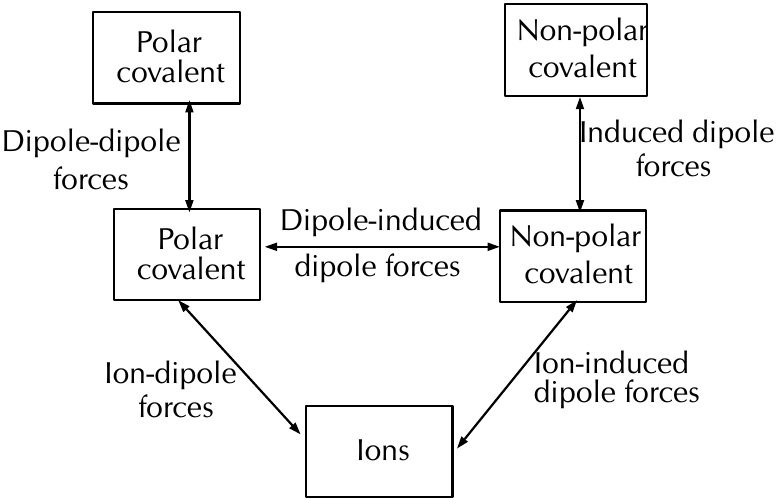
The type of intermolecular forces present in a substance depends on whether the molecules are polar or non-polar. This is crucial for explaining the substance's properties.
1. Ion-dipole forces
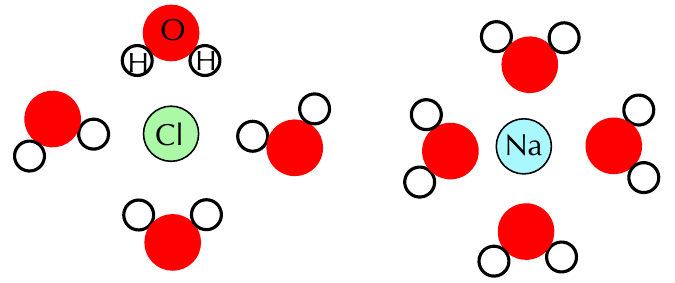
These forces exist between an ion (charged atom) and a polar molecule. The ion is attracted to the oppositely charged end of the polar molecule.
Example
Example: Sodium Chloride Dissolution
When sodium chloride (NaCl) dissolves in water, the positive sodium ion (Na⁺) is attracted to the slightly negative oxygen atoms in water molecules, while the negative chloride ion (Cl⁻) is attracted to the slightly positive hydrogen atoms.
2. Ion-induced-dipole forces
These forces occur between ions and non-polar molecules. The ion causes a temporary dipole in the non-polar molecule, creating a weak attraction. This type of force is found in haemoglobin, where Fe²⁺ ions attract oxygen molecules.
3. Dipole-dipole forces
When two polar molecules come close together, the positive end of one molecule attracts the negative end of another molecule. This creates dipole-dipole forces.
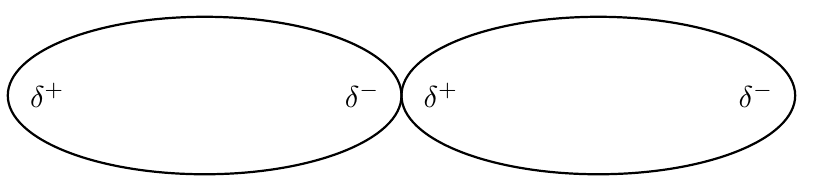
Examples: Materials like HCl, SO₂ and CHF₃Cl are held together by dipole-dipole forces.
Hydrogen bonding - a special case
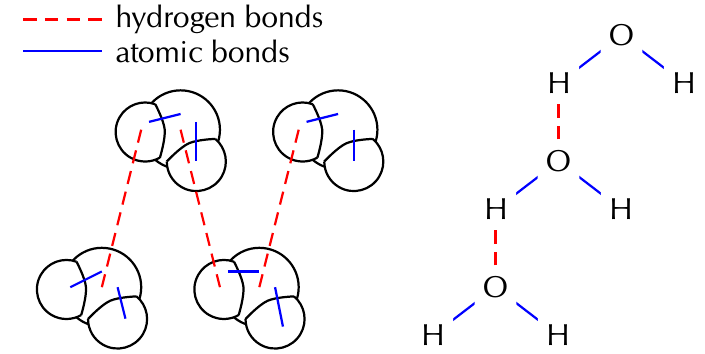
Hydrogen bonding is a particularly strong type of dipole-dipole force that occurs when hydrogen is bonded to highly electronegative atoms (N, O, or F). The hydrogen atom is attracted to a lone pair on a nearby molecule.
Important
Water molecules are held together by hydrogen bonds, making them stronger than regular dipole-dipole forces but weaker than covalent bonds between atoms.
4. Induced dipole forces
Non-polar molecules can still attract each other through induced dipole forces. At any moment, electrons in a molecule might not be evenly distributed, creating a temporary dipole. This temporary dipole can induce dipoles in nearby molecules, causing weak attractions.
Examples: These forces are found in halogens (F₂, I₂) and non-polar molecules like carbon dioxide and carbon tetrachloride.
5. Dipole-induced-dipole forces
This occurs when a polar molecule induces a dipole in a non-polar molecule, similar to ion-induced dipole forces.
Example: Chloroform (CHCl₃) in carbon tetrachloride (CCl₄).
The difference between intermolecular and interatomic forces
Important
Key Distinction Between Force Types
| Interatomic forces | Intermolecular forces | |
|---|---|---|
| Act between | Atoms | Molecules |
| Strength | Strong forces | Relatively weak forces |
| Distance | Very short distances | Larger distances than bonds |
Interatomic forces (chemical bonds) hold atoms together within molecules, while intermolecular forces hold separate molecules together. Van der Waals forces is a collective term for dipole-dipole, dipole-induced dipole, and induced dipole forces.
Understanding intermolecular forces and their effects on properties
The strength of intermolecular forces determines many physical properties of substances. Stronger intermolecular forces result in:
- Higher melting and boiling points
- Lower rates of evaporation
- Higher surface tension
- Greater viscosity
- Different solubility patterns
Phase behaviour
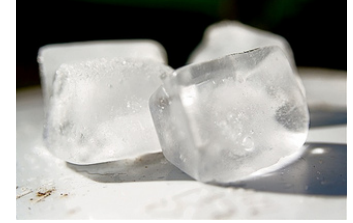
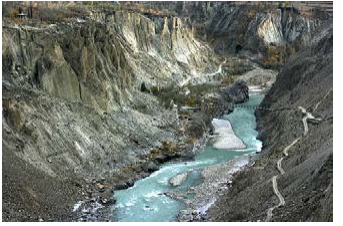
The three phases of matter (solid, liquid, gas) depend on the balance between kinetic energy of particles and intermolecular forces. Stronger forces hold particles together more tightly, while higher temperatures give particles more energy to overcome these forces.
Properties affected by intermolecular forces
Evaporation
Substances with weaker intermolecular forces evaporate faster than substances with stronger intermolecular forces. This is because less energy is needed to overcome the forces holding the molecules together.
Note
Experimental observation: Water (with hydrogen bonds) evaporates more slowly than nail polish remover (with only dipole-dipole forces).
Surface tension
Surface tension results from intermolecular forces at the liquid's surface. Substances with stronger intermolecular forces have higher surface tension, causing droplets to form more easily and meniscus shapes to be more pronounced.
Solubility
Important
The "Like Dissolves Like" Rule
- Polar substances dissolve in polar solvents
- Non-polar substances dissolve in non-polar solvents
- Ionic substances dissolve in polar solvents where ion-dipole forces can form
Capillarity
The ability of liquids to travel up narrow tubes depends on the balance between intermolecular forces within the liquid and forces between the liquid and tube walls. Substances with stronger intermolecular forces generally show greater capillarity.
Molecular size and intermolecular forces
Larger molecules have stronger intermolecular forces because they have more surface area for interactions. This explains why larger alkanes have higher boiling points:
| Formula | Name | Molecular mass (g·mol⁻¹) | Melting point (°C) | Boiling point (°C) | Phase at room temperature |
|---|---|---|---|---|---|
| CH₄ | Methane | 16 | -183 | -164 | Gas |
| C₂H₆ | Ethane | 30 | -183 | -89 | Gas |
| C₅H₁₂ | Pentane | 72 | -130 | 36 | Liquid |
| C₆H₁₄ | Hexane | 86 | -95 | 69 | Liquid |
| C₂₀H₄₂ | Icosane | 282 | 37 | 343 | Solid |
Viscosity
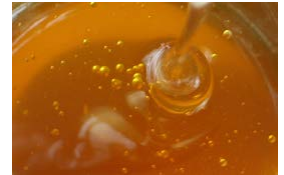
Viscosity describes a liquid's resistance to flow. Substances with stronger intermolecular forces are more viscous because molecules are held together more tightly, making flow more difficult.
Density
Solid phases are often the most dense because strong intermolecular forces pull molecules together, resulting in more molecules per unit volume than in liquid or gas phases.
Thermal properties
Thermal expansion: When heated, molecules move more vigorously, causing substances to expand.
Thermal conductivity: Metals conduct heat well due to free electrons, while covalent molecular compounds conduct heat poorly because they lack free electrons.
Worked examples
Example
Worked Example 1: Identifying intermolecular forces in carbon tetrachloride (CCl₄)
Step 1: Analyze the molecule
- Carbon has electronegativity 2.5, chlorine has electronegativity 3.0
- The electronegativity difference is 1.0, making C-Cl bonds polar
- Carbon tetrachloride has a tetrahedral shape and is symmetrical, making it non-polar overall
Step 2: Determine the intermolecular forces
Since carbon tetrachloride is non-polar, it can only have induced dipole forces.
Example
Worked Example 2: Intermolecular forces in sodium chloride solution
Step 1: Identify the components
- Sodium chloride is ionic (electronegativity difference 2.1)
- Water is polar (bent or angular shape)
Step 2: Determine the interaction
This is an ionic substance interacting with a polar substance, resulting in ion-dipole forces.
Example
Worked Example 3: Comparing melting points
Question: Why does oxygen (O₂) have a much lower melting point than hydrogen chloride (HCl)?
Solution:
- Oxygen is non-polar and has only induced dipole forces
- Hydrogen chloride is polar and has dipole-dipole forces
- Stronger intermolecular forces lead to higher melting points
- Therefore, oxygen has a lower melting point because it has weaker intermolecular forces
Summary
Key Points to Remember:
- Intermolecular forces act between molecules, while interatomic forces act between atoms within molecules
- Stronger intermolecular forces result in higher melting/boiling points, greater surface tension, higher viscosity, and slower evaporation
- Hydrogen bonding is the strongest type of intermolecular force and occurs only when H is bonded to N, O, or F
- "Like dissolves like" - polar substances dissolve in polar solvents, non-polar in non-polar solvents
- Molecular size matters - larger molecules generally have stronger intermolecular forces due to greater surface area for interactions