The Chemistry of Water (Grade 11 NSC Matric Physical Sciences): Revision Notes
📚Revision Notes
The Chemistry of Water
Introduction
Water is a remarkable substance that behaves very differently from other compounds. Understanding the microscopic structure of water and how intermolecular forces affect its properties is essential for explaining why water is so important for life on Earth.
Note
Water's unique properties make it the perfect medium for life. Every living organism depends on water's special characteristics, which all stem from its molecular structure and the way water molecules interact with each other.
The microscopic structure of water
Molecular shape and polarity
Water molecules have a unique structure that gives them special properties. Each water molecule consists of two hydrogen atoms bonded to a central oxygen atom. The oxygen atom also has two lone pairs of electrons.
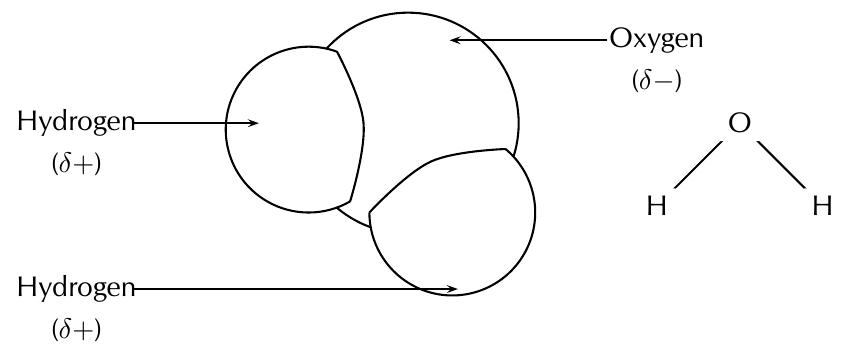
This arrangement creates a bent or angular shape rather than a straight line. The bent shape is crucial because it makes water a polar molecule. The oxygen atom has a partial negative charge (δ-) while each hydrogen atom has a partial positive charge (δ+).
Hydrogen bonding between water molecules
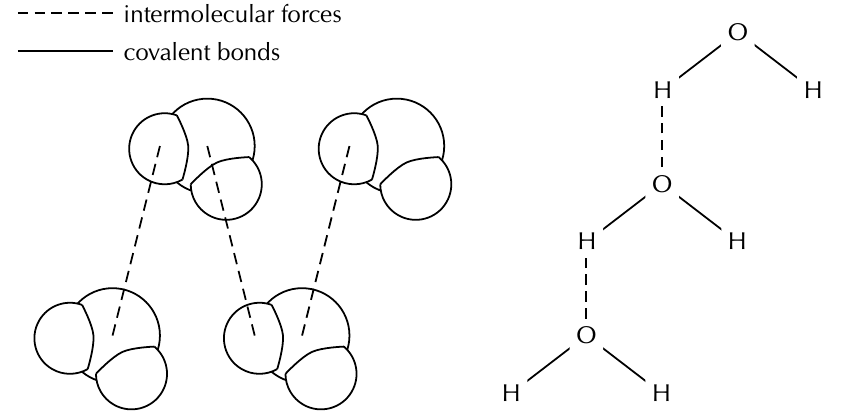
The polar nature of water molecules allows them to form hydrogen bonds with each other. These hydrogen bonds are much stronger than the intermolecular forces found in many other substances.
Important
Understanding the difference between bond types:
Hydrogen bonds occur between different water molecules (intermolecular forces), while covalent bonds hold the atoms together within each water molecule (intramolecular forces). This distinction is crucial for understanding water's properties.
The unique properties of water
Water's unique properties all stem from its molecular structure and the hydrogen bonds between molecules. These properties make water essential for life.
1. Specific heat
Note
Definition of Specific Heat:
Specific heat is the amount of heat energy needed to increase the temperature of a unit mass of a substance by one degree.
Water has a high specific heat, meaning lots of energy must be absorbed before its temperature changes significantly. This happens because the strong hydrogen bonds between water molecules must be disrupted before the particles can move faster.
Practical example: When you heat water in a metal pot, the pot gets hot quickly while the water takes much longer to warm up. The metal needs less energy to heat up, but water needs considerable energy to break its hydrogen bonds before the temperature can increase.
2. Absorption of infra-red radiation
Water can absorb infra-red radiation (heat) from the sun. This property allows oceans and large bodies of water to act as heat reservoirs, helping to moderate Earth's climate.
3. Melting point and boiling point
Water has a melting point of 0°C and a boiling point of 100°C at standard pressure. The large difference between these temperatures (100°C) is very important because it means water can exist as a liquid over a wide temperature range.
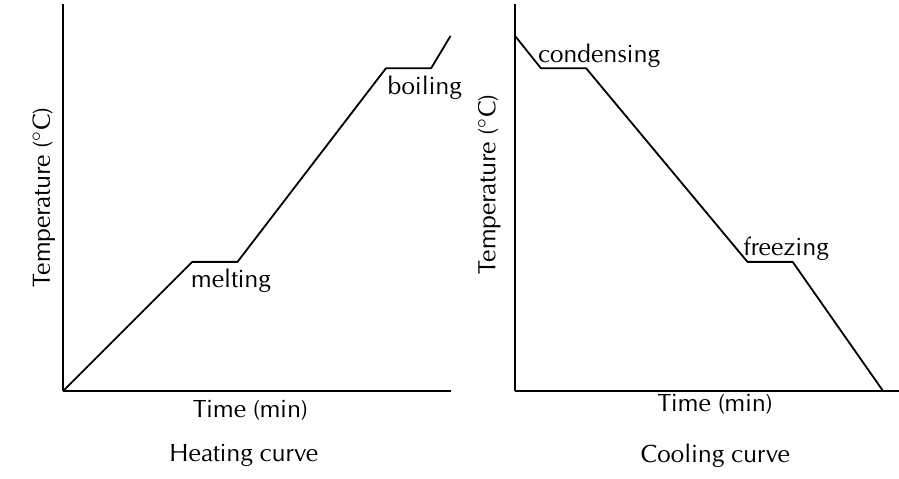
This wide liquid range is essential for life on Earth, as most biological processes require water in its liquid state.
4. High heat of vaporisation
Note
Definition of Heat of Vaporisation:
Heat of vaporisation is the energy needed to change a given quantity of a substance into a gas.
Water has a high heat of vaporisation () because of the strong hydrogen bonds between molecules. A lot of energy is needed to break these bonds and allow water molecules to escape into the gas phase.
Why this matters: This property is crucial for life. If water had a low heat of vaporisation, the water in our bodies would evaporate easily, making liquid-based life impossible.
5. Less dense solid phase
Water has an unusual property - ice is less dense than liquid water. This is why ice floats on water rather than sinking to the bottom.
Why this happens: When water freezes, the hydrogen bonds arrange the molecules in a more open, structured pattern that takes up more space than the liquid form.
Environmental importance: If ice sank, lakes and oceans would freeze from the bottom up, killing aquatic life. Instead, floating ice acts as an insulating layer, protecting life underneath.
Example
Worked Example: Properties of Water
Question: Explain why water takes a long time to heat up, but the pot you are heating it in gets hot quickly.
Solution:
Step 1: Identify which property applies We need to consider the high specific heat of water compared to metals.
Step 2: Explain the difference
Water has a high specific heat due to its strong hydrogen bonds. The metal pot has a much lower specific heat. This means the metal needs less energy to increase its temperature, so it heats up faster. Water requires lots of energy to break its hydrogen bonds before the temperature can rise, so it takes longer to get hot.
Summary
Key Points to Remember:
-
Water molecules are polar due to their bent shape and the difference in electronegativity between oxygen and hydrogen atoms
-
Hydrogen bonds between water molecules are responsible for all of water's unique properties
-
High specific heat means water needs lots of energy to change temperature, making it an excellent temperature buffer
-
High heat of vaporisation prevents water from evaporating easily, which is essential for life
-
Ice floats because the solid form of water is less dense than the liquid form, protecting aquatic life in winter