Stoichiometric Calculations (Grade 11 NSC Matric Physical Sciences): Revision Notes
📚Revision Notes
Stoichiometric Calculations
Introduction to stoichiometry
Stoichiometry is the calculation of quantities in chemical reactions using balanced chemical equations. When you know the ratios of substances in a reaction, you can calculate the amount of reactants needed or products formed. This is essential for understanding how much of each substance participates in a chemical reaction.
Note
The key to stoichiometric calculations is understanding that moles serve as the bridge between different quantities. You can convert between mass, concentration, volume, and number of moles using specific relationships.
Stoichiometric relationships
The relationships between different chemical quantities are shown in this important diagram:
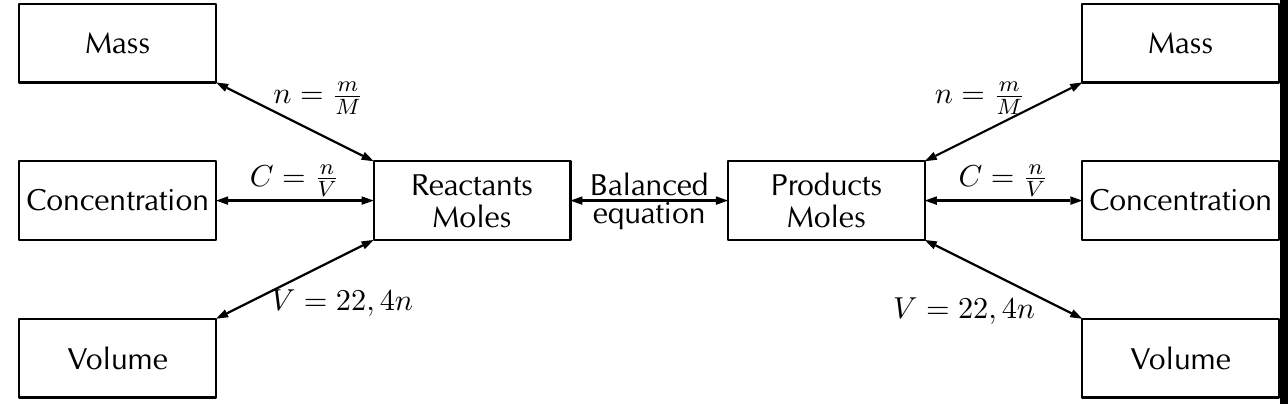
This diagram shows how moles connect all other quantities:
- Mass to moles: (where = moles, = mass, = molar mass)
- Concentration to moles: (where = concentration, = volume)
- Volume to moles (for gases at STP):
Important
The balanced chemical equation tells you the molar ratios between reactants and products. These ratios allow you to convert moles of one substance to moles of another.
Limiting reagents
Definition and concept
Important
A limiting reagent (or limiting reactant) is a reagent that is completely used up in a chemical reaction. When this reagent is consumed, the reaction stops, even if other reactants remain.
An excess reagent (or excess reactant) is a reagent that is not completely used up in a chemical reaction. Some of this reagent will remain after the reaction is complete.
Understanding limiting reagents through an activity
Imagine you have different coloured pieces of paper representing different reactants. When you stick them together in specific ratios (like the balanced equation requires), you'll find that one colour runs out first - this represents the limiting reagent. The colours that have pieces left over represent excess reagents.
Note
This hands-on approach helps visualize why one reactant limits the amount of product that can be formed, regardless of how much of the other reactants you have available.
Worked example: Limiting reagents
Example
Worked Example: Determining Limiting Reagents
Question: Sulfuric acid (H₂SO₄) reacts with ammonia (NH₃) to produce ammonium sulfate ((NH₄)₂SO₄):
H₂SO₄(aq) + 2NH₃(g) → (NH₄)₂SO₄(aq)
What is the maximum mass of ammonium sulfate that can be obtained from 2,0 kg of sulfuric acid and 1,0 kg of ammonia?
Solution:
Step 1: Convert masses to moles
For sulfuric acid:
For ammonia:
Step 2: Determine the limiting reagent
Look at how many moles of product each reactant can produce:
From H₂SO₄: The mole ratio is 1:1, so 20,4 mol H₂SO₄ can produce 20,4 mol (NH₄)₂SO₄
From NH₃: The mole ratio is 2:1, so 58,8 mol NH₃ can produce mol (NH₄)₂SO₄
Since H₂SO₄ produces the smaller amount (20,4 mol), sulfuric acid is the limiting reagent.
Step 3: Calculate the maximum mass of product
Using the limiting reagent result:
The maximum mass of ammonium sulfate that can be produced is 2,69 kg.
Percent yield
Definition and importance
Percent yield measures how efficient a chemical reaction is. In reality, reactions rarely produce the theoretical maximum amount of product due to side reactions, incomplete reactions, or loss during processing.
Important
The percent yield formula is:
Where:
- Actual yield = the amount of product actually obtained in the experiment
- Theoretical yield = the maximum amount of product calculated using stoichiometry
Worked example: Percent yield
Example
Worked Example: Calculating Percent Yield
Question: Using the same reaction as before, a factory worker gets 2,5 kg of ammonium sulfate from 2,0 kg of sulfuric acid and 1,0 kg of ammonia. What is the percentage yield?
Solution:
Step 1: Identify the limiting reagent and theoretical yield
From the previous example, we know sulfuric acid is limiting and the theoretical yield is 2,69 kg.
Step 2: Apply the percent yield formula
This reaction has a high percent yield (92,8%), making it useful for industrial purposes.
Molecular and empirical formulae
Definitions
Important
The empirical formula is the simplest formula showing the ratio of atoms of each element in a compound.
The molecular formula shows the actual number of atoms of each element in one molecule of the compound.
Worked example: Finding empirical and molecular formulae
Example
Worked Example: Determining Empirical and Molecular Formulae
Question: Acetic acid has the following percentage composition: 39,9% carbon, 6,7% hydrogen, and 53,4% oxygen. The molar mass is 60,06 g·mol⁻¹. Find the empirical and molecular formulae.
Solution:
Step 1: Find the mass of each element in 100 g In 100 g of acetic acid: 39,9 g C, 6,7 g H, 53,4 g O
Step 2: Convert masses to moles
Step 3: Find the simplest ratio
Divide each by the smallest number (3,325):
- C:
- H:
- O:
Empirical formula: CH₂O
Step 4: Find the molecular formula
Empirical formula mass =
Molecular formula factor =
Molecular formula: C₂H₄O₂ (or CH₃COOH)
Percent purity
Definition and application
Percent purity determines how much of a desired compound is present in an impure sample. This is important in industry and quality control.
Important
The formula is:
Worked example 1: Percent purity
Example
Worked Example: Basic Percent Purity Calculation
Question: A shell weighs 5 g. After experiments, the mass of calcium carbonate and crucible is 3,2 g, and the crucible alone is 0,5 g. How much calcium carbonate is in the shell?
Solution:
Step 1: Find the mass of the product Mass of CaCO₃ =
Step 2: Calculate percent purity
Worked example 2: Percent purity using chemical reaction
Example
Worked Example: Percent Purity Through Chemical Reaction
Question: Jake adds HCl to a 3,5 g limestone sample. The reaction produces 3,6 g of CaCl₂. What is the percent purity?
CaCO₃(s) + 2HCl(aq) → CO₂(g) + CaCl₂(aq) + H₂O(l)
Solution:
Step 1: Calculate moles of CaCl₂ produced
Step 2: Use stoichiometry to find moles of CaCO₃
From the equation, the ratio is 1:1, so moles of CaCO₃ = 0,032 mol
Step 3: Calculate mass of CaCO₃
Step 4: Calculate percent purity
Practical applications
Thermal decomposition experiment
Note
Understanding stoichiometry helps explain what happens in practical experiments. For example, when lead(II) nitrate is heated:
2Pb(NO₃)₂(s) + heat → 2PbO(s) + 4NO₂(g) + O₂(g)
The balanced equation allows you to calculate theoretical yields and compare them with experimental results.
Stoichiometry experiment for percent yield
By mixing measured amounts of reactants like magnesium sulfate and sodium carbonate, you can:
- Predict the theoretical yield using stoichiometry
- Measure the actual yield experimentally
- Calculate the percent yield to evaluate reaction efficiency
The equation: MgSO₄(aq) + Na₂CO₃(aq) → Na₂SO₄(aq) + MgCO₃(s)
Note
This type of experiment demonstrates the practical importance of stoichiometric calculations in real laboratory work and industrial processes.
Summary
Summary
Key Points to Remember:
- Moles are the key - always convert other quantities to moles first
- Balanced equations give molar ratios - use these to convert between different substances
- The limiting reagent produces the smaller amount of product
- Percent yield = - measures reaction efficiency
- Percent purity = - measures sample purity