The Lithosphere (Grade 11 NSC Matric Physical Sciences): Revision Notes
📚Revision Notes
Introduction to the Lithosphere
What is the lithosphere?
When we look at Earth from space, we see a beautiful planet with continents, oceans, and swirling clouds. But what lies beneath the surface that we can see?
Note
The view of Earth from space shows us only the surface features, but the real story lies in the complex layered structure beneath our feet that has shaped human civilization for millions of years.
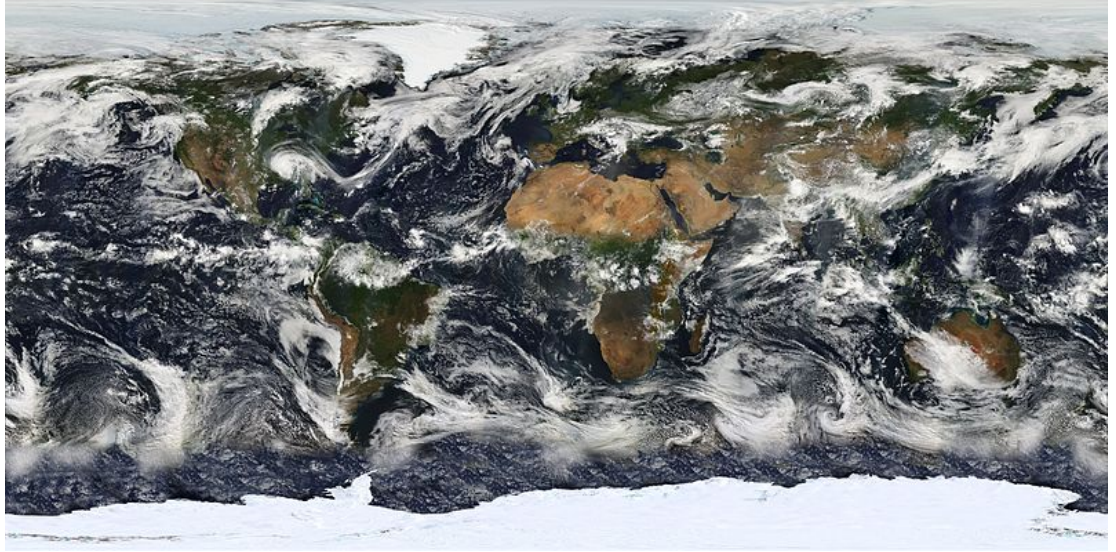
The lithosphere is the solid, rocky outer shell of our planet. It includes both the crust and the upper part of the mantle, forming the rigid layer that contains all the continents and ocean floors on Earth's surface.
Earth's structure
To understand the lithosphere properly, we need to know about Earth's internal structure. If we could slice Earth in half, we would see several distinct layers:
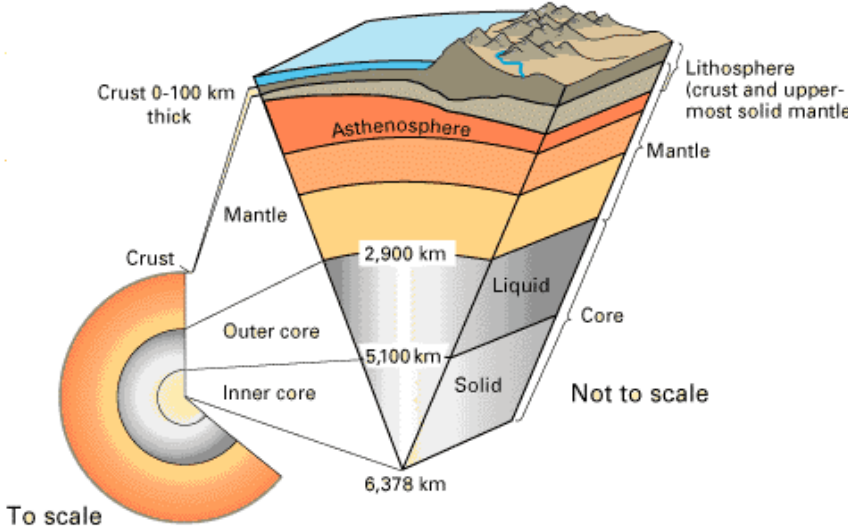
Earth consists of four main layers:
- Inner core: The solid centre made mostly of iron (about 6,378 km from surface)
- Outer core: A liquid layer also made of iron (starts at about 5,100 km from surface)
- Mantle: A thick layer of hot, flowing rock called magma that moves due to convection currents (starts at about 2,900 km from surface)
- Crust: The thin, hard outer layer that "floats" on the magma (0-100 km thick)
Important
The lithosphere combines the crust and the uppermost solid part of the mantle. This is the part of Earth that supports us, provides resources, and gives us materials to use.
Why is the lithosphere important?
The lithosphere is vital to humans because it is the part of Earth that we live on and can easily access. It supports us, provides for us, and gives us a wealth of materials to use. Throughout history, humans have slowly become aware of the mineral wealth beneath their feet and have learned to use these materials for their benefit.
History of mankind and the lithosphere
Human civilisation can be understood through the materials that people used from the lithosphere. The development of technology is closely linked to our ability to extract and work with different materials from Earth's crust.
The Stone Age periods
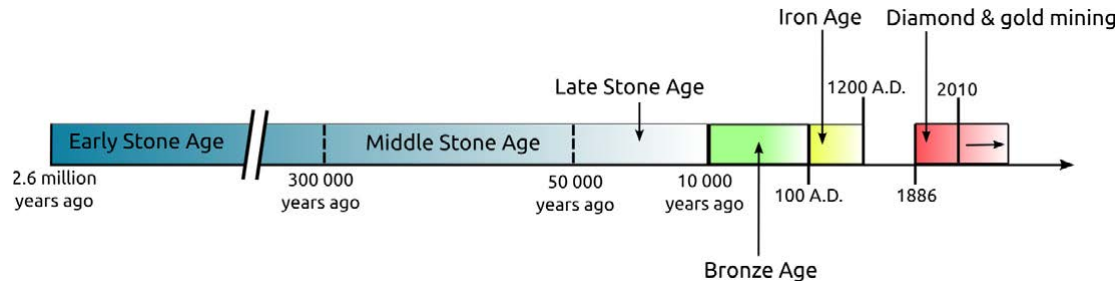
The ancient history of humankind can be divided into several periods based on the materials they used:
Early Stone Age (2.6 million - 300,000 years ago):
- Humans used basic stone tools
- They mainly used rocks and stones found lying around
- Evidence has been found in caves at the Cradle of Humankind in South Africa
Middle Stone Age (300,000 - 50,000 years ago):
- Humans learned to use fire to treat stones before making tools
- Stone tools became more refined during this period
- Evidence found at sites like Swartkrans and Klasies River Mouth
Late Stone Age (50,000 - 10,000 years ago):
- Humans began experimenting with different materials
- They started combining stone with other natural materials
- Evidence found at Melkhoutboom Cave in the Eastern Cape
Example
Archaeological Evidence: Swartkrans Cave
At Swartkrans Cave in South Africa, archaeologists found evidence that early humans used controlled fire to heat-treat stones before making tools. This represents a major technological advancement - the first time humans actively modified materials from the lithosphere to improve their properties.
Metal Ages
Bronze Age (10,000 B.C. - 100 A.D.):
- First use of smelted copper and bronze for tools and weapons
- This represented a major technological advancement
- Evidence found in North Africa
Iron Age (100 A.D. - 1200 A.D.):
- Primitive mining for materials became common
- Furnaces were used to heat metals to make weapons and tools
- Evidence found at sites like Melville Koppies and Mapungubwe
Note
The transition from stone to metal tools represents humanity's first major success in extracting and processing materials from deep within the lithosphere, rather than just using surface materials.
Modern mining era
After the Iron Age ended, people began exploring new ways to access precious metals. Mining became more common as people looked for new sources of metals and minerals.
When European colonists arrived in Southern Africa, they discovered the region's rich mineral resources:
- Diamonds: Found outside Kimberley in the 1860s, leading to extensive mining operations
- Gold: Discovered near present-day Johannesburg around 1880, creating a gold rush that led to the founding of Johannesburg
These discoveries required massive labour forces and led to the development of modern industrial mining techniques.
Elements and minerals in the lithosphere
Now that we understand how humans have used materials from the lithosphere throughout history, let's examine what exactly makes up this important layer.
Composition of Earth's crust
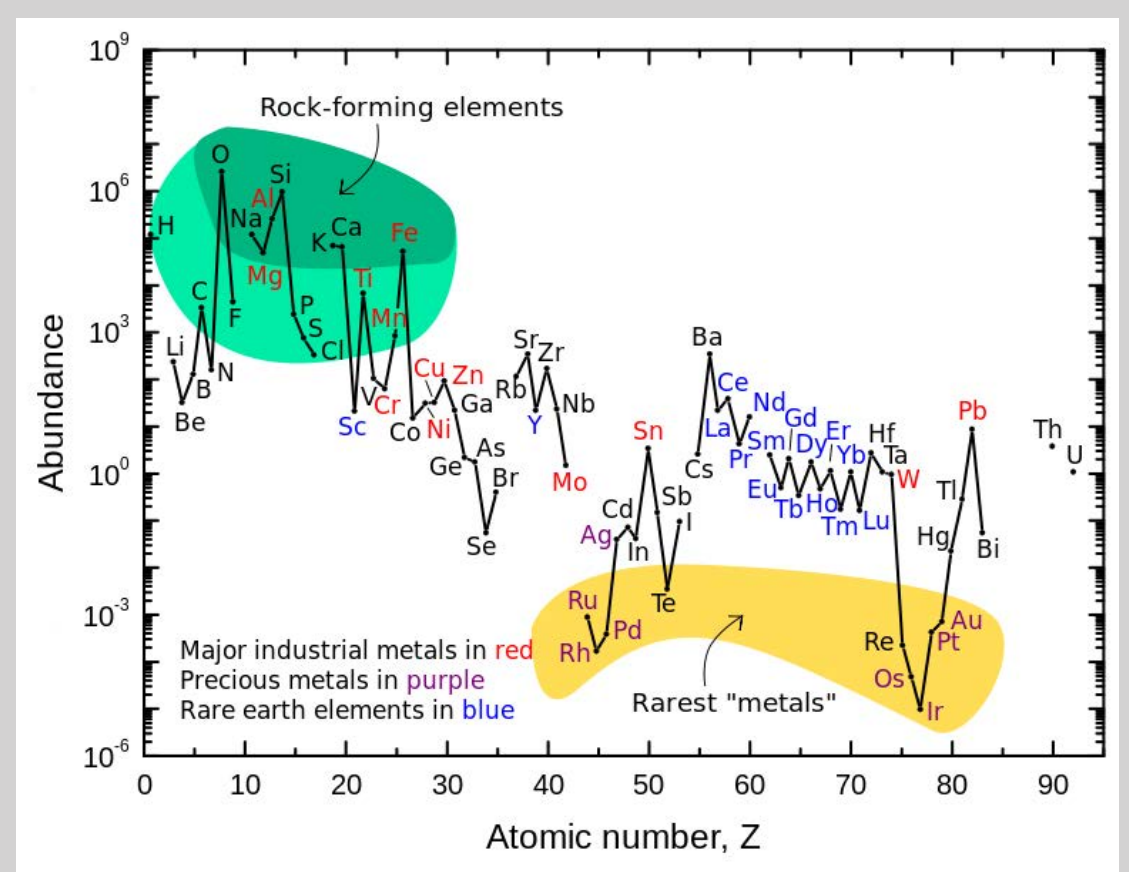
The crust contains about 80 different elements, which occur in over 2000 different compounds and minerals. However, most of the crust's mass consists of only 8 elements:
- Oxygen (O) - most abundant
- Silicon (Si)
- Aluminium (Al)
- Iron (Fe)
- Calcium (Ca)
- Sodium (Na)
- Potassium (K)
- Magnesium (Mg)
These are called rock-forming elements because they make up the bulk of all rocks and minerals.
Note
Memory Aid for Rock-Forming Elements: Remember "Only Scientists Actually Find Calcium, Sodium, Potassium, Magnesium" to recall the 8 most abundant elements: O, Si, Al, Fe, Ca, Na, K, Mg.
What are minerals?
Minerals are natural compounds formed through geological processes. The term "mineral" includes both the material's chemical composition and its structure. Minerals range in composition from pure elements to complex compounds.
A mineral can be a pure element, but more often minerals consist of many different elements combined.
Example
Example: Quartz Formation
Quartz is one of the most common minerals in Earth's crust. It consists of silicon and oxygen atoms arranged in a specific crystal structure with the chemical formula . This shows how two abundant rock-forming elements (Si and O) combine to form a stable mineral.
Common minerals and their chemistry
Here are some important minerals and the elements they contain:
| Element | Most common mineral | Chemical formula |
|---|---|---|
| Gold | Calaverite or pure element | Au or AuTe₂ |
| Iron | Hematite | Fe₂O₃ |
| Copper | Pure element or chalcocite | Cu or Cu₂S |
| Carbon | Diamond, graphite, coal | C |
| Platinum | Pure element or combined | Pt |
| Zinc | Sphalerite | ZnS |
| Manganese | Manganese dioxide | MnO₂ |
| Chromium | Chromite | FeCr₂O₄ |
The rock cycle
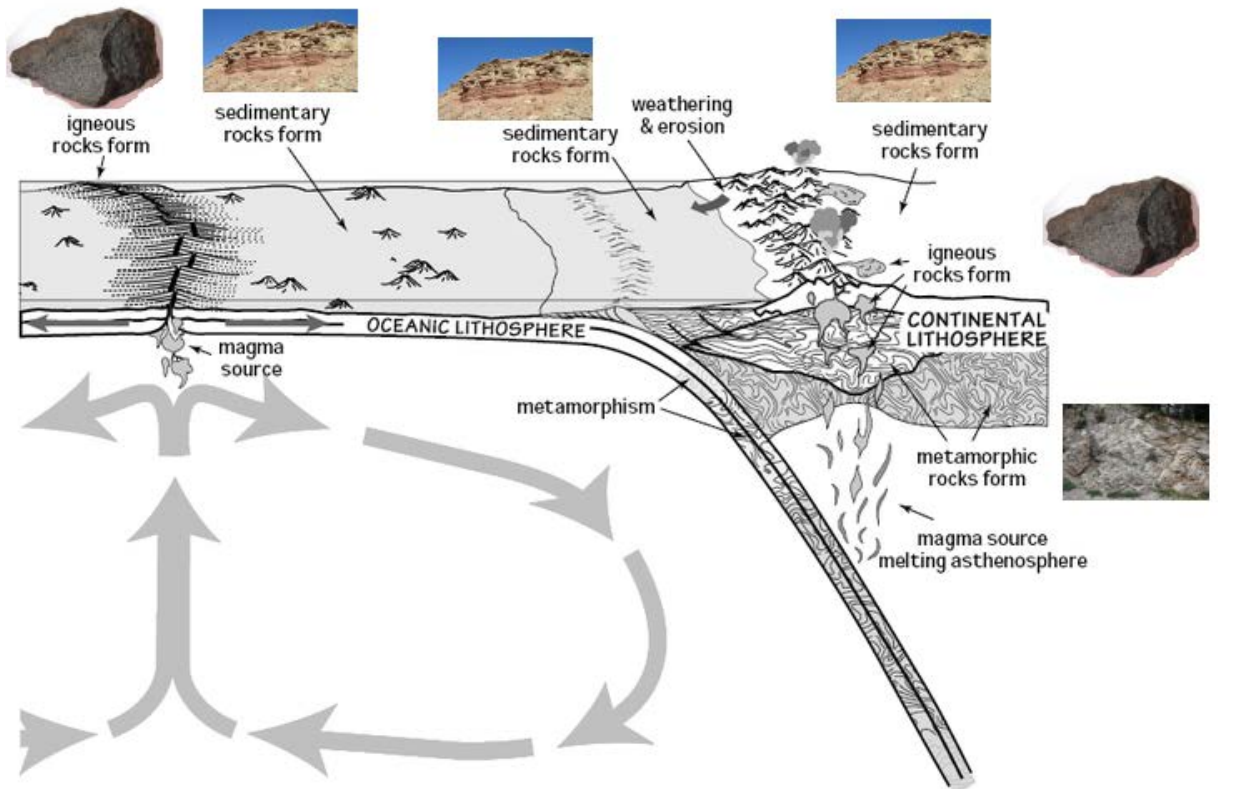
Rocks are combinations of one or more minerals. There are three main types of rocks, and they can transform from one type to another through the rock cycle:
Igneous rocks: Form when magma cools and solidifies (e.g., granite, basalt)
Sedimentary rocks: Form when rock fragments, organic matter, or sediments are deposited and compressed over time (e.g., sandstone, limestone)
Metamorphic rocks: Form when existing rocks are subjected to intense heat and pressure (e.g., slate, marble)
Important
The Rock Cycle is Continuous
The rock cycle shows how these rock types continuously transform into each other through geological processes like weathering, erosion, melting, and metamorphism. This means that the materials in the lithosphere are constantly being recycled and reformed over geological time scales.
Ores and mining
Many elements of interest to humans (like gold, iron, and copper) are unevenly distributed in the lithosphere. In places where these elements are abundant, it becomes profitable to extract them through mining.
Ore is a volume of rock that contains minerals which make it valuable for mining. If the concentration of valuable minerals is too low, the cost of extraction becomes more than the money that would be made from selling them.
Note
Economic Considerations in Mining
Mining operations must consider both the concentration of valuable minerals and the cost of extraction. Even if an ore contains precious metals, it may not be economically viable to mine if the extraction costs exceed the value of the materials recovered.
Mineral distribution in South Africa
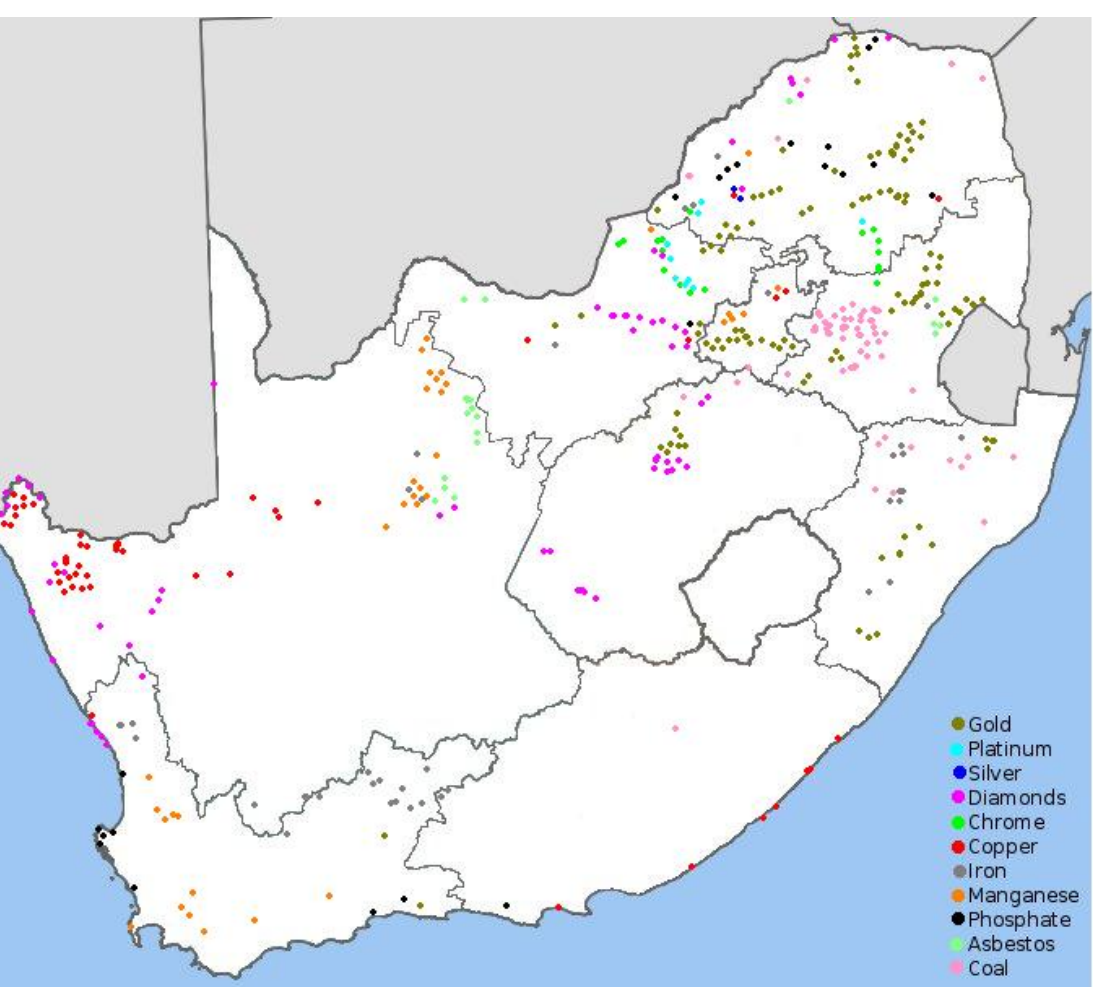
South Africa is particularly rich in mineral resources. The country contains significant deposits of gold, platinum, diamonds, chrome, copper, iron, manganese, and many other valuable minerals.
As humans, we are particularly interested in:
- Metal-containing ores (for tools, construction, electronics)
- Energy-producing minerals (coal, uranium for power generation)
- Gemstones (diamonds, precious stones for jewellery)
Summary
Key Points to Remember:
-
The lithosphere is Earth's solid outer shell, including the crust and upper mantle, where all our mineral resources are found
-
Human civilisation progressed through different ages based on the materials they could extract and use: Stone Age → Bronze Age → Iron Age → Modern mining era
-
Earth's crust contains about 80 elements, but only 8 rock-forming elements (O, Si, Al, Fe, Ca, Na, K, Mg) make up most of its mass
-
Minerals are natural compounds formed by geological processes, ranging from pure elements to complex chemical combinations
-
The rock cycle shows how igneous, sedimentary, and metamorphic rocks continuously transform into each other through natural processes
-
Economic mining depends on both the concentration of valuable minerals in ore and the cost-effectiveness of extraction