Redox Reactions (Grade 11 NSC Matric Physical Sciences): Revision Notes
📚Revision Notes
Redox Reactions
What are redox reactions?
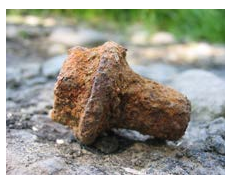
When you observe a piece of rusty metal, you are seeing the result of a redox reaction where iron and oxygen combine to form iron oxide. Redox reactions are essential processes that occur in electrochemistry and biological systems.
During certain chemical reactions, electrons are transferred between substances. This electron movement causes changes in the electrical charge of atoms, which we studied in Grade 10. When an atom gains electrons, it becomes more negative, and when it loses electrons, it becomes more positive.
Oxidation occurs when an atom loses electrons, while reduction happens when an atom gains electrons. These two processes always occur together in a reaction, with one substance gaining electrons whilst another loses them. This is why we call it a redox reaction - a shortened way of saying reduction-oxidation reaction!
Important
Key Definitions
Oxidation occurs when a molecule, atom or ion loses electrons.
Reduction occurs when a molecule, atom or ion gains electrons.
Before examining redox reactions in detail, we must first understand how to identify when a redox reaction has occurred. In Grade 10, you learned that redox reactions involve charge changes on atoms. Now we will explore why these charge changes happen.
Oxidation numbers
By assigning oxidation numbers to elements, we can track whether an element is losing or gaining electrons during a chemical reaction. The loss of electrons in one part of the reaction must be balanced by a gain of electrons in another part.
Important
Definition: Oxidation Number
An oxidation number represents the charge an atom would have if it existed in a compound made entirely of ions.
Rules for assigning oxidation numbers
Note
Seven Essential Rules for Oxidation Numbers
-
Single element molecules always have an oxidation number of zero, since they are electrically neutral.
- For example: hydrogen in H₂ has an oxidation number of 0, and bromine in Br₂ also has an oxidation number of 0.
-
Monatomic ions (ions containing only one type of atom) have oxidation numbers equal to their ionic charge.
- For example: chloride ion Cl⁻ has an oxidation number of -1, and magnesium ion Mg²⁺ has an oxidation number of +2.
-
In molecules or compounds, the sum of all oxidation numbers for each element equals zero.
- For example: in water, the sum of oxidation numbers for all elements equals 0.
-
In polyatomic ions, the sum of oxidation numbers equals the total charge on the ion.
- For example: in the sulfate ion SO₄²⁻, the sum of oxidation numbers equals -2.
-
Oxygen atoms usually have an oxidation number of -2. The main exception is in peroxides (like hydrogen peroxide), where oxygen has an oxidation number of -1.
- For example: oxygen in water has an oxidation number of -2, while in hydrogen peroxide (H₂O₂) it has an oxidation number of -1.
-
Hydrogen atoms typically have an oxidation number of +1. The exception is in metal hydrides, where hydrogen has an oxidation number of -1.
- For example: hydrogen in water has an oxidation number of +1, while hydrogen in lithium hydride (LiH) has an oxidation number of -1.
-
Fluorine always has an oxidation number of -1.
Worked examples of oxidation numbers
Let's work through some examples to practice calculating oxidation numbers.
Example
Worked Example 1: Finding oxidation numbers in sulfate ion
Question: Find the oxidation number of sulfur in a sulfate (SO₄²⁻) ion.
Solution:
Step 1: Determine known oxidation numbers
Oxygen has an oxidation number of -2 (Rule 5, this is not a peroxide).
Sulfur's oxidation number is unknown at this stage.
Step 2: Use the rule that oxidation numbers must sum to the total charge
In the polyatomic SO₄²⁻ ion, the sum of oxidation numbers must equal -2 (Rule 4).
Let sulfur's oxidation number =
Since there are four oxygen atoms, their total contribution =
Step 3: Set up and solve the equation
Therefore, sulfur has an oxidation number of +6 in the sulfate ion.
Example
Worked Example 2: Finding oxidation numbers in ammonia
Question: Find the oxidation numbers of both elements in ammonia (NH₃).
Solution:
Step 1: Determine known oxidation numbers
Hydrogen has an oxidation number of +1 (Rule 6, ammonia is not a metal hydride).
Nitrogen's oxidation number is unknown.
Step 2: Use the rule for neutral compounds
In compound NH₃, the sum of oxidation numbers must equal 0 (Rule 3).
Let nitrogen's oxidation number =
Since there are three hydrogen atoms:
Step 3: Set up and solve the equation
Therefore, hydrogen has an oxidation number of +1 and nitrogen has an oxidation number of -3.
Example
Worked Example 3: Finding oxidation numbers in ionic compounds
Question: Find the oxidation numbers for all atoms in sodium chloride (NaCl).
Solution:
Step 1: Identify the compound type
This is an ionic compound containing Na⁺ and Cl⁻ ions.
Step 2: Apply Rule 2 for monatomic ions
Sodium ion has an oxidation number of +1
Chlorine ion has an oxidation number of -1
This gives us a sum of 0 for the compound, confirming our answer.
Understanding oxidation and reduction
Now that we can calculate oxidation numbers, we can use this knowledge to analyze reactions and identify redox processes.
Identifying oxidation and reduction
By examining how oxidation numbers change during a reaction, we can easily determine whether an element is being oxidised (loses electrons) or reduced (gains electrons).
Note
When an oxidation number becomes more positive, the species has been oxidised. When an oxidation number becomes more negative, the species has been reduced.
Let's examine the reaction between magnesium and chlorine as an example:
As a reactant, magnesium has an oxidation number of zero. As part of the product magnesium chloride, the element has an oxidation number of +2. Magnesium has lost two electrons and has therefore been oxidised (notice how the oxidation number becomes more positive). This process can be written as a half-reaction:
As a reactant, chlorine has an oxidation number of zero. As part of the product magnesium chloride, the element has an oxidation number of -1. Each chlorine atom has gained one electron and the element has therefore been reduced (notice how the oxidation number becomes more negative). The half-reaction for this change is:
Important
Definition: Half-reaction
A half-reaction represents either the oxidation or reduction part of a redox reaction.
In redox reactions, the number of electrons donated is exactly equal to the number of electrons accepted. We use this principle to help balance redox equations.
Oxidising and reducing agents
Two additional terms commonly used in redox reactions are reducing agents and oxidising agents.
An element that is oxidised is called a reducing agent, while an element that is reduced is called an oxidising agent.
Note
You can remember this by thinking that when a compound is oxidised, it causes another compound to be reduced (the electrons must go somewhere, and they transfer to the compound being reduced).
What are redox reactions?
Important
Definition: Redox Reaction
A redox reaction involves both oxidation and reduction processes, where there is always a change in the oxidation numbers of the elements involved. Redox reactions involve electron transfer from one compound to another.
Practical investigations
Understanding redox reactions becomes clearer through hands-on experiments. Here are three important types of redox reactions you can investigate.
Displacement reaction investigation
Example
Investigation: Displacement Reaction
Aim: To investigate the redox reaction between copper sulfate and zinc.
Materials:
- A few granules of zinc
- 15 ml copper (II) sulfate solution (blue colour)
- Glass beaker
Method: Add zinc granules to the copper sulfate solution and observe what happens. Note any changes to the zinc granules and the solution colour.
Results:
- Zinc becomes covered in a layer that looks like copper
- The blue copper sulfate solution becomes clearer
Explanation: Cu²⁺ ions from the CuSO₄ solution are reduced to form copper metal, which deposits on the zinc crystals. The reduction of copper ions also explains the colour change (copper ions in solution appear blue).
The half-reaction for copper reduction:
Zinc is oxidised to form Zn²⁺ ions which are colourless in solution:
The overall reaction:
This is called a displacement reaction because zinc displaces the copper ions to form zinc sulfate.
Synthesis reaction investigation
Example
Investigation: Synthesis Reaction
Aim: To investigate the redox reaction that occurs when magnesium burns in air.
Materials: Strip of magnesium; bunsen burner; tongs; glass beaker
Method:
- Light the bunsen burner and use tongs to hold the magnesium ribbon in the flame
- Hold the lit magnesium over a beaker and observe what happens
WARNING: Do not look directly at the flame.
Results: The magnesium burns with a bright white flame. When held over a beaker, a fine powder is observed in the beaker. This powder is magnesium oxide.
The overall reaction:
Conclusion: A redox reaction has occurred. Magnesium is oxidised and oxygen is reduced. This is a synthesis reaction because we have made magnesium oxide from magnesium and oxygen.
Decomposition reaction investigation
Example
Investigation: Decomposition Reaction
Aim: To investigate the decomposition of hydrogen peroxide.
Materials: Dilute hydrogen peroxide (about 3%); manganese dioxide; test tubes; water bowl; stopper and delivery tube; bunsen burner
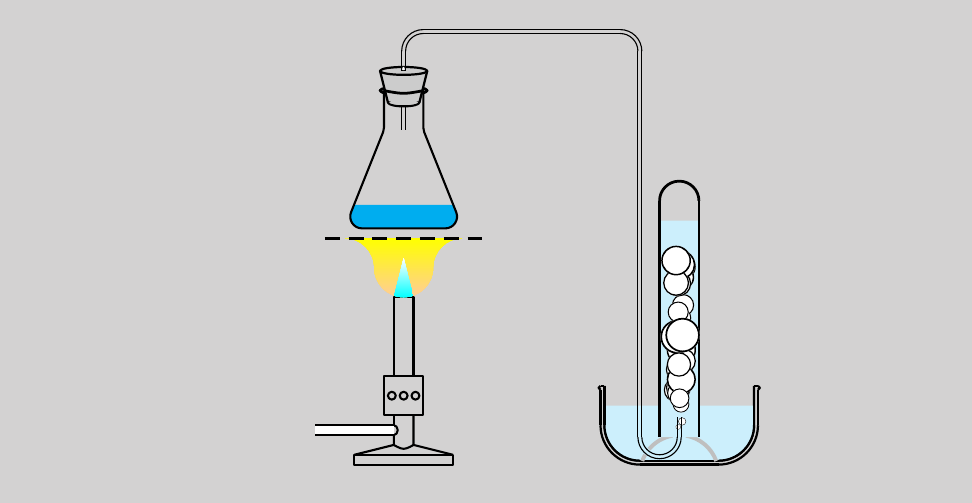
Method:
- Put a small amount (about 5 ml) of hydrogen peroxide in a test tube
- Set up the apparatus as shown above
- Very carefully add a small amount (about 0.5 g) of manganese dioxide to the test tube containing hydrogen peroxide
Results: You should observe gas bubbling into the second test tube. This reaction happens quite rapidly.
The overall reaction:
Conclusion: A redox reaction has occurred. H₂O₂ is both oxidised and reduced in this decomposition reaction.
Balancing redox reactions
Using your knowledge of oxidation numbers and redox reactions, you can balance redox equations using the same principles you learned for other reactions. The following worked examples demonstrate the method.
Step-by-step balancing method
Example
Worked Example: Balancing simple redox reactions
Question: Balance the following redox reaction:
Solution:
Step 1: Write separate reactions for each compound
Step 2: Balance the atoms on either side
We check that atoms are balanced:
(already balanced)
(now balanced)
Step 3: Add electrons to balance the charges
We add electrons to the side with greater positive charge:
Step 4: Balance the number of electrons
The iron reaction has one electron, while the chlorine reaction has two electrons. We multiply the iron reaction by 2 to ensure charges balance:
Step 5: Combine the two half-reactions
Combined:
Step 6: Write the final answer
Cancelling the electrons:
The iron reaction is the oxidation half-reaction (iron becomes more positive). The chlorine reaction is the reduction half-reaction (chlorine becomes more negative).
Balancing redox reactions in acidic conditions
Example
Worked Example: Complex redox balancing
Question: Balance the following redox reaction: The reaction takes place in acidic conditions.
Solution:
Step 1: Write separate reactions for each compound
Step 2: Balance atoms on either side
For the first reaction: 2 chromium atoms and 7 oxygen atoms on left, 1 chromium atom on right. Since we're in acidic conditions, we can add water to balance oxygen and H⁺ ions to balance hydrogen:
Now we have hydrogen atoms on the right but not on the left, so we add 14 hydrogen ions to the left:
For the second reaction, we add 2 hydrogen ions to the right:
Step 3: Add electrons to balance charges
Step 4: Balance electron numbers
The chromium reaction has 6 electrons, the sulfur reaction has 2 electrons. We multiply the sulfur reaction by 3:
Step 5: Combine the half-reactions
Combined:
Step 6: Write the final answer
Cancelling electrons and hydrogen ions:
The sulfur reaction is the oxidation half-reaction (sulfur becomes more positive). The chromium reaction is the reduction half-reaction (chromium becomes more negative).
Exam tips and common mistakes
Important
Essential Tips for Success
When working with redox reactions, remember these important points:
- Always check your oxidation number calculations using the sum rules
- Remember OIL RIG: Oxidation is Loss, Reduction is Gain (of electrons)
- In balancing: The number of electrons lost must equal the number gained
- For acidic conditions: Add H⁺ ions and H₂O molecules to balance hydrogen and oxygen
- For basic conditions: Add OH⁻ ions and H₂O molecules to balance
- Common mistake: Forgetting to multiply half-reactions to balance electron numbers
- Exam tip: Always write out half-reactions separately before combining them
Summary
Key Points to Remember:
-
Redox reactions involve the transfer of electrons between substances, with one being oxidised (loses electrons) and another being reduced (gains electrons)
-
Oxidation numbers help us track electron movement by assigning theoretical charges to atoms, following seven specific rules
-
Half-reactions show the oxidation and reduction processes separately, making it easier to balance complex redox equations
-
Balancing redox reactions requires balancing atoms, charges, and electrons in a systematic step-by-step approach
-
Practical examples include displacement reactions (like zinc and copper sulfate), synthesis reactions (like burning magnesium), and decomposition reactions (like hydrogen peroxide breakdown)