Ohm’s Law (Grade 11 NSC Matric Physical Sciences): Revision Notes
📚Revision Notes
Ohm's Law
What is Ohm's law?
Ohm's Law is one of the most fundamental principles in electrical circuits. It describes the relationship between three essential electrical quantities that you need to understand:
- Current (I) - the rate at which electric charge flows through a circuit, measured in amperes (A)
- Voltage (V) - the amount of energy needed per unit charge to move that charge between two points in a circuit, measured in volts (V)
- Resistance (R) - how difficult it is to push current through a circuit element, measured in ohms (Ω)
Important
Definition: Ohm's Law states that the electric current through a metal conductor at constant temperature is directly proportional to the voltage across the conductor.
This means that when you increase the voltage, the current increases proportionally. When you decrease the voltage, the current decreases proportionally. The resistance remains constant for ohmic conductors at constant temperature.
The relationship between current, voltage and resistance
The mathematical relationship discovered by Georg Simon Ohm can be expressed as:
This equation tells us that:
- Current equals voltage divided by resistance
- If voltage increases and resistance stays the same, current increases
- If resistance increases and voltage stays the same, current decreases
You can rearrange this equation to solve for different variables:
- (to find voltage)
- (to find resistance)
Ohm's law equation and graph
When you plot voltage on the x-axis and current on the y-axis for an ohmic conductor, you get a straight line passing through the origin.
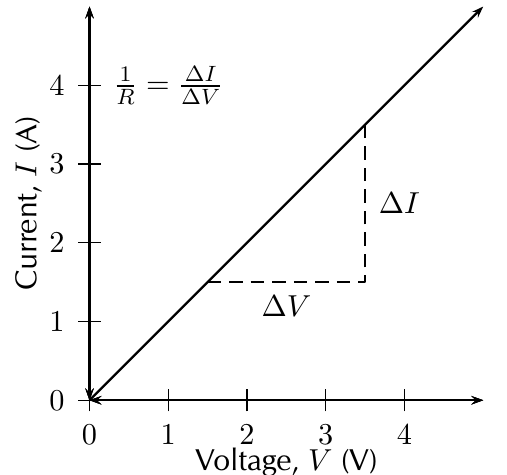
The gradient (slope) of this straight line is related to the resistance:
- Gradient =
- Therefore:
Note
The steeper the line, the smaller the resistance. The gentler the slope, the larger the resistance.
Practical investigation of Ohm's law
To verify Ohm's Law experimentally, you need to measure current and voltage values for the same resistor under different conditions.
Note
Equipment needed:
- Battery cells
- Resistors
- Ammeter (measures current - connected in series)
- Voltmeter (measures voltage - connected in parallel)
- Connecting wires
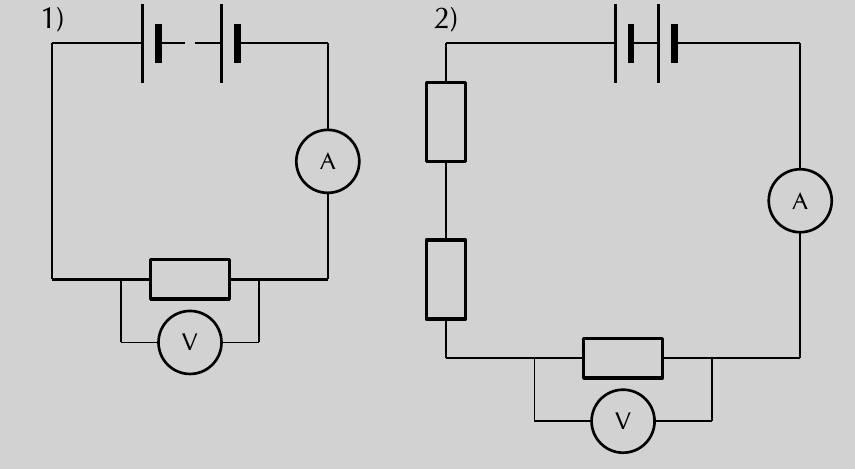
Method:
Part 1 - Varying the voltage:
- Set up a circuit with one cell and a resistor
- Measure the voltage across the resistor and current through the circuit
- Add more cells one by one, recording voltage and current each time
- Create a data table:
| Number of cells | Voltage, V (V) | Current, I (A) |
|---|---|---|
| 1 | ||
| 2 | ||
| 3 | ||
| 4 |
Part 2 - Varying the current:
- Use a fixed voltage but change the total resistance by adding resistors in series
- Measure voltage across the original resistor and current through the circuit
- Record your measurements in a similar table
Here's sample data that demonstrates Ohm's Law:
| Voltage, V (V) | Current, I (A) |
|---|---|
| 3.0 | 0.4 |
| 6.0 | 0.8 |
| 9.0 | 1.2 |
| 12.0 | 1.6 |
Notice how the current doubles when the voltage doubles - this shows the direct proportional relationship.
Note
Analysis:
- Plot current (y-axis) versus voltage (x-axis)
- Calculate the gradient of your graph
- The gradient equals 1/R, so you can find the resistance
- A straight line through the origin confirms Ohm's Law
Ohmic and non-ohmic conductors
Not all electrical components follow Ohm's Law perfectly.
Ohmic conductors:
- Have constant resistance when temperature remains constant
- Follow Ohm's Law exactly
- Produce straight-line I-V graphs
- Examples: metal wires, carbon resistors
Non-ohmic conductors:
- Have resistance that changes with voltage or current
- Do not follow Ohm's Law
- Produce curved I-V graphs
- Examples: light bulbs, diodes, transistors
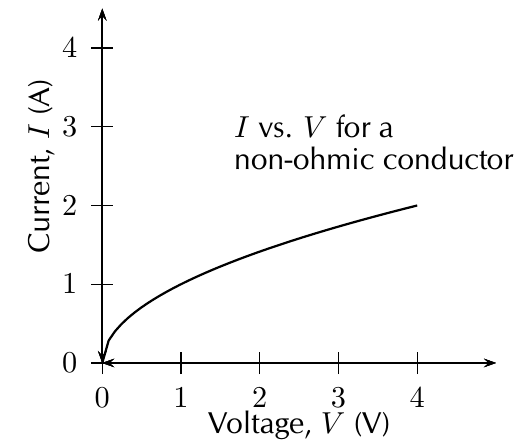
In a light bulb, the filament wire heats up as current increases. This causes the resistance to increase dramatically, which limits further current increases. The resistance can change by a factor of 10 or more between room temperature and operating temperature.
Important
For most metal conductors in normal applications, resistance changes are small enough to ignore. However, for devices like lamp filaments that operate at very high temperatures (around 1000°C), the resistance change is significant.
Using Ohm's law in calculations
When solving circuit problems, always start by drawing a circuit diagram. Then identify what values you know and what you need to find.
Example
Worked Example: Finding Voltage
A resistor has a resistance of 10 Ω and carries a current of 4 A. Calculate the voltage across the resistor.
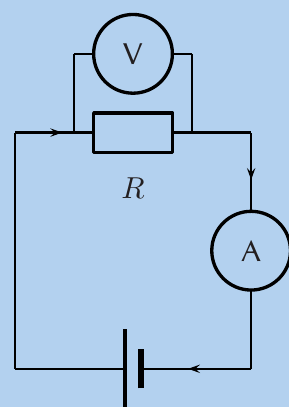
Step 1: Identify the known values
- R = 10 Ω
- I = 4 A
- V = ?
Step 2: Choose the correct form of Ohm's Law Since we need to find voltage:
Step 3: Substitute and calculate
Step 4: State the final answer The voltage across the resistor is 40 V.
Note
Exam tip: Always draw the circuit diagram first, even if it seems simple. This helps you visualise the problem and avoid mistakes.
Remember!
Summary
Key Points to Remember:
-
Ohm's Law states that current is directly proportional to voltage for a conductor at constant temperature
-
The equation can be rearranged to or depending on what you need to find
-
Ohmic conductors produce straight-line I-V graphs, while non-ohmic conductors produce curved graphs
-
Temperature affects resistance - this is why Ohm's Law only applies at constant temperature
-
Always draw a circuit diagram before attempting calculations, and clearly identify known and unknown values