Ohm’s Law in Series and Parallel Circuits (Grade 11 NSC Matric Physical Sciences): Revision Notes
📚Revision Notes
Ohm's Law in Series and Parallel Circuits
Introduction to series and parallel circuits
When working with electrical circuits, resistors can be connected in two fundamental ways: in series or in parallel. Understanding how current and voltage behave in these configurations is essential for applying Ohm's Law effectively.
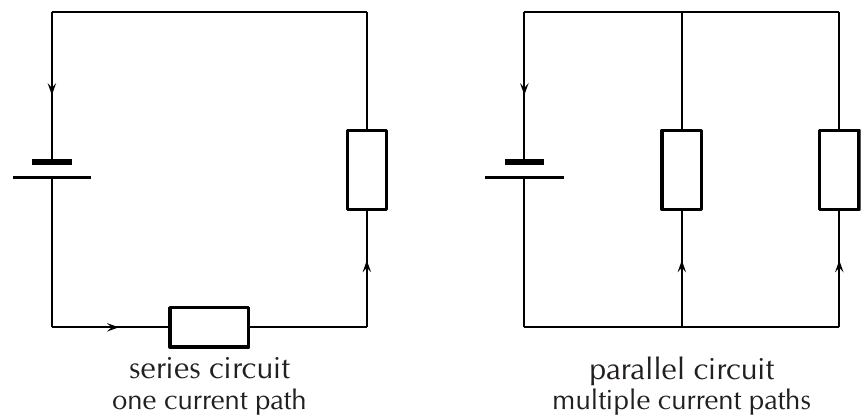
In a series circuit, there is only one path for current to flow through all components. In a parallel circuit, there are multiple paths for current to flow, with each component on a separate branch.
When circuits contain more than one resistor, we can calculate the total combined resistance of all resistors. This combined resistance is called the equivalent resistance.
Note
Understanding the difference between series and parallel connections is fundamental to circuit analysis. The key distinction is the number of current paths available.
Equivalent resistance in series circuits
Definition: Equivalent resistance in a series circuit is the sum of all individual resistances.
For resistors connected in series, the equivalent resistance is:
Example
Worked Example: Calculating Series Equivalent Resistance
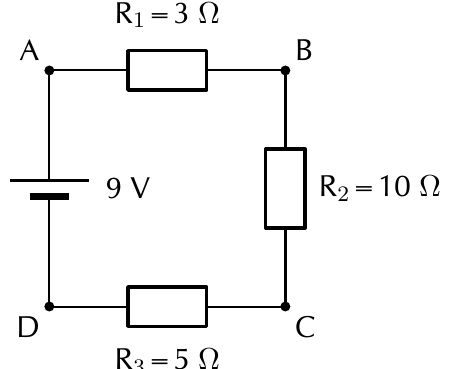
In the circuit shown above with three resistors in series:
- R₁ = 3 Ω
- R₂ = 10 Ω
- R₃ = 5 Ω
Solution:
This means the three resistors together act like a single 18 Ω resistor.
Equivalent resistance in parallel circuits
Definition: Equivalent resistance in a parallel circuit is calculated using the reciprocal formula.
For resistors connected in parallel, the equivalent resistance is:
Example
Worked Example: Calculating Parallel Equivalent Resistance
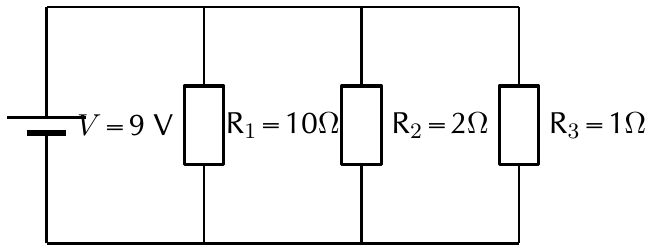
Using the parallel circuit shown above with three resistors:
- R₁ = 10 Ω
- R₂ = 2 Ω
- R₃ = 1 Ω
Solution:
Therefore:
Important
Notice that the equivalent resistance in parallel is always smaller than the smallest individual resistor.
Applying Ohm's Law in series circuits
Key principles for series circuits
Understanding these fundamental principles is crucial for series circuit analysis:
- Current is the same throughout all components:
- Voltage adds up across all components:
The current flows in one continuous path, so it must be identical at every point. However, each resistor drops a portion of the total voltage according to its resistance value.
Worked example: calculating current in a series circuit
Example
Worked Example: Current in a Series Circuit
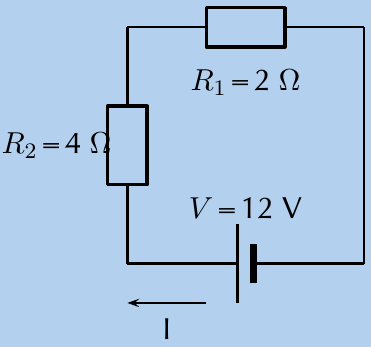
Question: Calculate the current flowing through this series circuit with two resistors.
Given:
- V = 12 V
- R₁ = 2 Ω
- R₂ = 4 Ω
Solution:
Step 1: Find the total equivalent resistance
Step 2: Apply Ohm's Law to find current
- Using , we rearrange to get:
The current flowing through the circuit is 2 A.
Worked example: finding unknown resistance in series
Example
Worked Example: Finding Unknown Resistance in Series
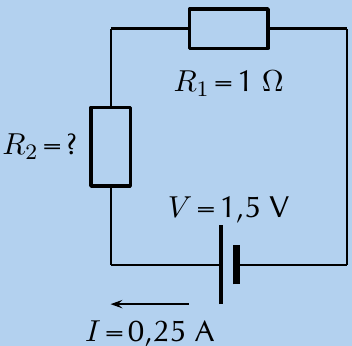
Question: Find the unknown resistance R₂ in this series circuit.
Given:
- V = 1.5 V
- R₁ = 1 Ω
- I = 0.25 A
- R₂ = ?
Solution:
Step 1: Use Ohm's Law to find total resistance
Step 2: Find the unknown resistance
- Since
Therefore, R₂ = 5 Ω.
Worked example: calculating voltage drops in series
Example
Worked Example: Voltage Drops in Series Circuit
Question: For a series circuit with three resistors, calculate the voltage drop across each resistor.
Given:
- V = 18 V
- I = 2 A
- R₁ = 1 Ω
- R₂ = 3 Ω
- R₃ = ? (unknown)
Solution:
Step 1: Calculate voltage drop across R₁
Step 2: Calculate voltage drop across R₂
Step 3: Find voltage drop across R₃
- Since
Step 4: Calculate R₃
Applying Ohm's Law in parallel circuits
Key principles for parallel circuits
These fundamental principles govern parallel circuit behavior:
- Voltage is the same across all components:
- Current adds up through all branches:
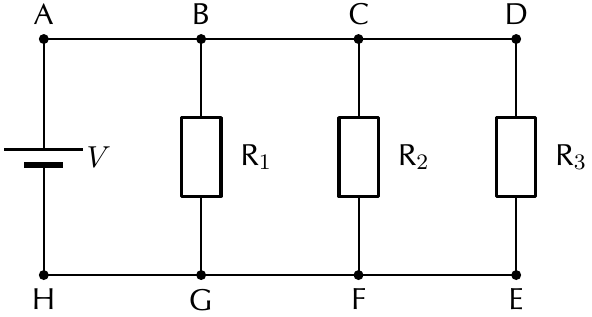
In parallel circuits, each resistor is connected directly across the voltage source, so they all experience the same voltage. However, the current divides among the different paths according to each resistor's resistance.
Worked example: calculating current in parallel circuit
Example
Worked Example: Total Current in Parallel Circuit
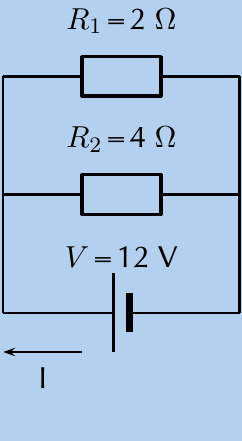
Question: Calculate the total current in this parallel circuit.
Given:
- V = 12 V
- R₁ = 2 Ω
- R₂ = 4 Ω
Solution:
Step 1: Find equivalent resistance
Therefore:
Step 2: Apply Ohm's Law
The total current flowing through the circuit is 9 A.
Worked example: finding unknown resistance in parallel
Example
Worked Example: Finding Unknown Resistance in Parallel
Question: Two resistors are connected in parallel. Find the unknown resistance R₂.
Given:
- V = 9 V
- R₁ = 3 Ω
- I = 4.8 A (total current)
- R₂ = ?
Solution:
Step 1: Find equivalent resistance
Step 2: Use parallel resistance formula
Rearranging:
Therefore: R₂ = 5 Ω
Worked example: current distribution in parallel
Example
Worked Example: Current Distribution in Parallel Circuit
Question: Calculate the current through each resistor in a parallel circuit.
Given:
- V = 18 V
- R₁ = 4 Ω
- R₂ = 12 Ω
Solution:
Step 1: Calculate current through R₁
- Since voltage is the same across parallel resistors:
Step 2: Calculate current through R₂
Step 3: Verify using total current
- Total current:
Series and parallel networks
Many circuits combine both series and parallel arrangements. These are called series-parallel networks or combination circuits.
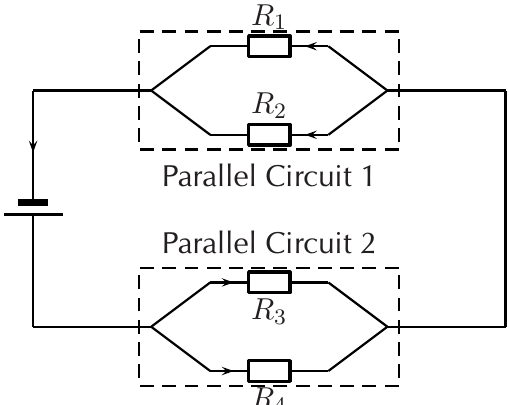
To solve combination circuits, follow these systematic steps:
- Identify parallel and series sections
- Calculate equivalent resistance for each parallel section
- Simplify the circuit to a series arrangement
- Apply series circuit rules to find total resistance
Example
Worked Example: Combination Circuit Analysis
Consider a circuit where two parallel sections are connected in series:
Step 1: Calculate equivalent resistance of each parallel section
For Parallel Circuit 1: Therefore:
For Parallel Circuit 2:
Therefore:
Step 2: Add series resistances
Total equivalent resistance:
Common exam tips and problem-solving strategies
Note
Series Circuit Strategies
- Always start by finding the equivalent resistance
- Remember current is constant throughout
- Use voltage division to find individual voltage drops
- Check that all voltage drops add to the source voltage
Note
Parallel Circuit Strategies
- Calculate equivalent resistance using the reciprocal formula
- Remember voltage is constant across all branches
- Find individual currents using Ohm's Law for each resistor
- Verify that branch currents add to the total current
Important
Common Mistakes to Avoid
- Don't mix up series and parallel resistance formulas
- Always draw the circuit diagram before calculating
- Double-check your equivalent resistance calculations
- Ensure your final answer has correct units (A, V, or Ω)
Summary
Key Points to Remember:
-
Series circuits have the same current flowing through all components, while voltages add up across resistors
-
Parallel circuits have the same voltage across all components, while currents add up through different branches
-
Equivalent resistance in series is the sum of individual resistances:
-
Equivalent resistance in parallel uses the reciprocal formula:
-
Always apply Ohm's Law after finding the equivalent resistance to solve for unknown quantities