Magnetic Field Associated With a Current (Grade 11 NSC Matric Physical Sciences): Revision Notes
📚Revision Notes
Magnetic Field Associated With a Current
Introduction to electromagnetism
Electromagnetism describes the interaction between charges, currents and the electric and magnetic fields they create. This fundamental relationship shows us that an electric current creates a magnetic field, and a changing magnetic field will create a flow of charge. This connection between electricity and magnetism has led to the development of many useful devices including mobile phones, microwave ovens, radios, televisions and countless other technologies we use daily.
Basic principles of magnetic fields around currents
When you hold a compass near a wire carrying electric current, the compass needle deflects. Since compasses work by pointing along magnetic field lines, this tells us that there must be a magnetic field present near the current-carrying wire.
Important
Key principle: The magnetic field produced by an electric current is always oriented perpendicular to the direction of the current flow. We use to represent a magnetic field, with arrows on field lines showing the direction of the magnetic field.
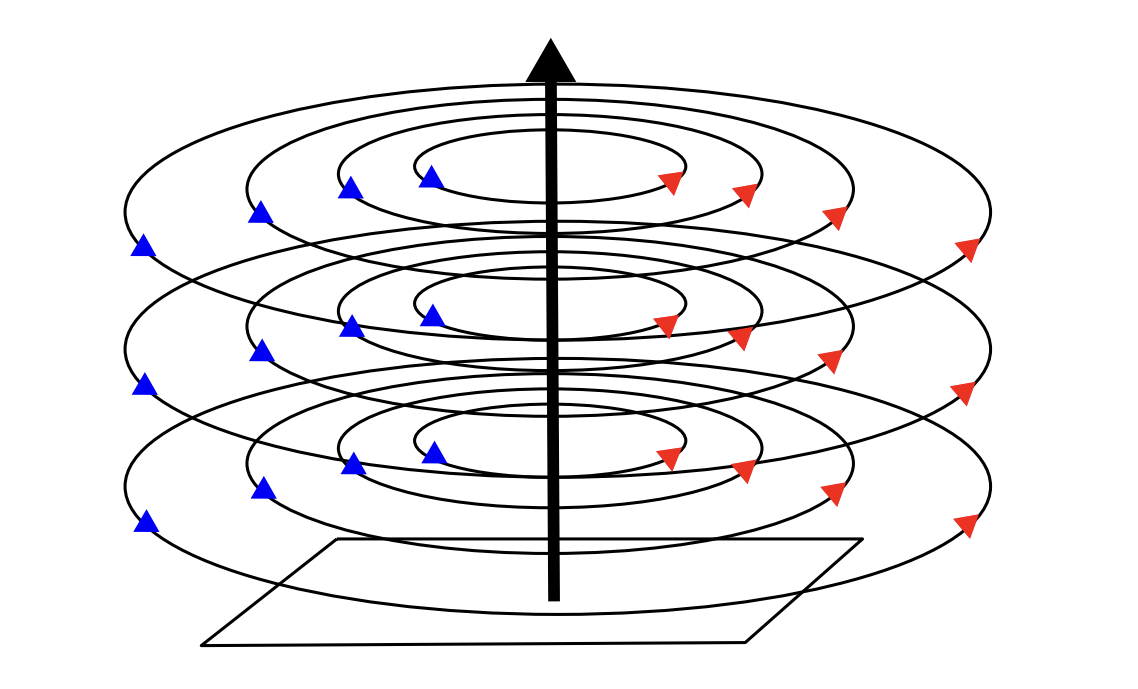
Important note: If there is no current flowing, there will be no magnetic field present.
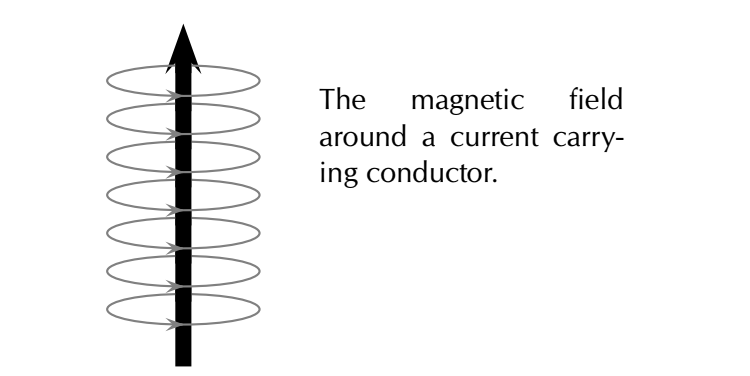
The magnetic field around a current-carrying conductor forms circular patterns around the wire. The direction of current in the conductor (wire) is shown by a central arrow. The circles are field lines and they have a direction indicated by arrows on the lines. Similar to electric field lines, the greater the number of field lines (or the closer they are together) in an area, the stronger the magnetic field.
Understanding field direction symbols
When drawing magnetic fields and currents, we use special symbols to show direction:
- ⊙ (dot symbol): represents an arrow coming out of the page
- ⊗ (cross symbol): represents an arrow going into the page
Note
Think of these symbols like looking at an arrow from different angles. The dot represents seeing the sharp tip of an arrow head, while the cross represents seeing the feathers at the back of an arrow in the shape of a cross.
The right hand rule
There is a simple method for finding the relationship between current direction and magnetic field direction called the Right Hand Rule.
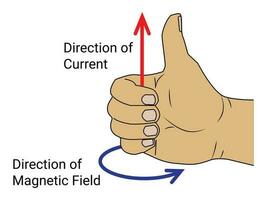
The Right Hand Rule states: The magnetic field lines produced by a current-carrying wire will be oriented in the same direction as the curled fingers of your right hand (in the "hitchhiking" position), with the thumb pointing in the direction of the current flow.
Important
Critical warning: You must always use your right hand for this rule. Your right hand and left hand are unique - you cannot rotate one to be in the same position as the other. This means you will always get the wrong answer if you use the wrong hand.
This rule applies to all current-carrying conductors and helps you determine the direction of the magnetic field at any point around the conductor.
Magnetic field around a straight wire
When current flows through a straight wire, the magnetic field forms concentric circles around the wire. The field direction depends on the current direction.
Note
Experimental evidence: You can demonstrate this relationship by connecting a wire to a battery and observing how a compass needle behaves when placed near the wire. When current flows, the compass deflects from its normal north-pointing position. When you reverse the battery polarity (changing current direction), the compass deflects in the opposite direction.
Example
Worked Example: Investigating magnetic fields
Apparatus needed:
- One 9V battery with holder
- Two hookup wires with alligator clips
- Compass
- Stop watch
Method:
- Connect wires to battery, leaving one end of each wire unconnected so the circuit is not closed
- Limit current flow to 10 seconds at a time (the wire has very little resistance so the battery will drain quickly, and this prevents overheating)
- Place compass close to wire
- Close circuit and observe what happens to the compass
- Reverse polarity of battery and close circuit again, observing what happens to the compass
Conclusions:
- Does a current flowing in a wire generate a magnetic field? Yes - the compass deflects when current flows
- Is magnetic field present when current is not flowing? No - compass points north normally when no current flows
- Does direction of magnetic field depend on current direction? Yes - compass deflects opposite ways when current direction is reversed
Magnetic field around a current-carrying loop
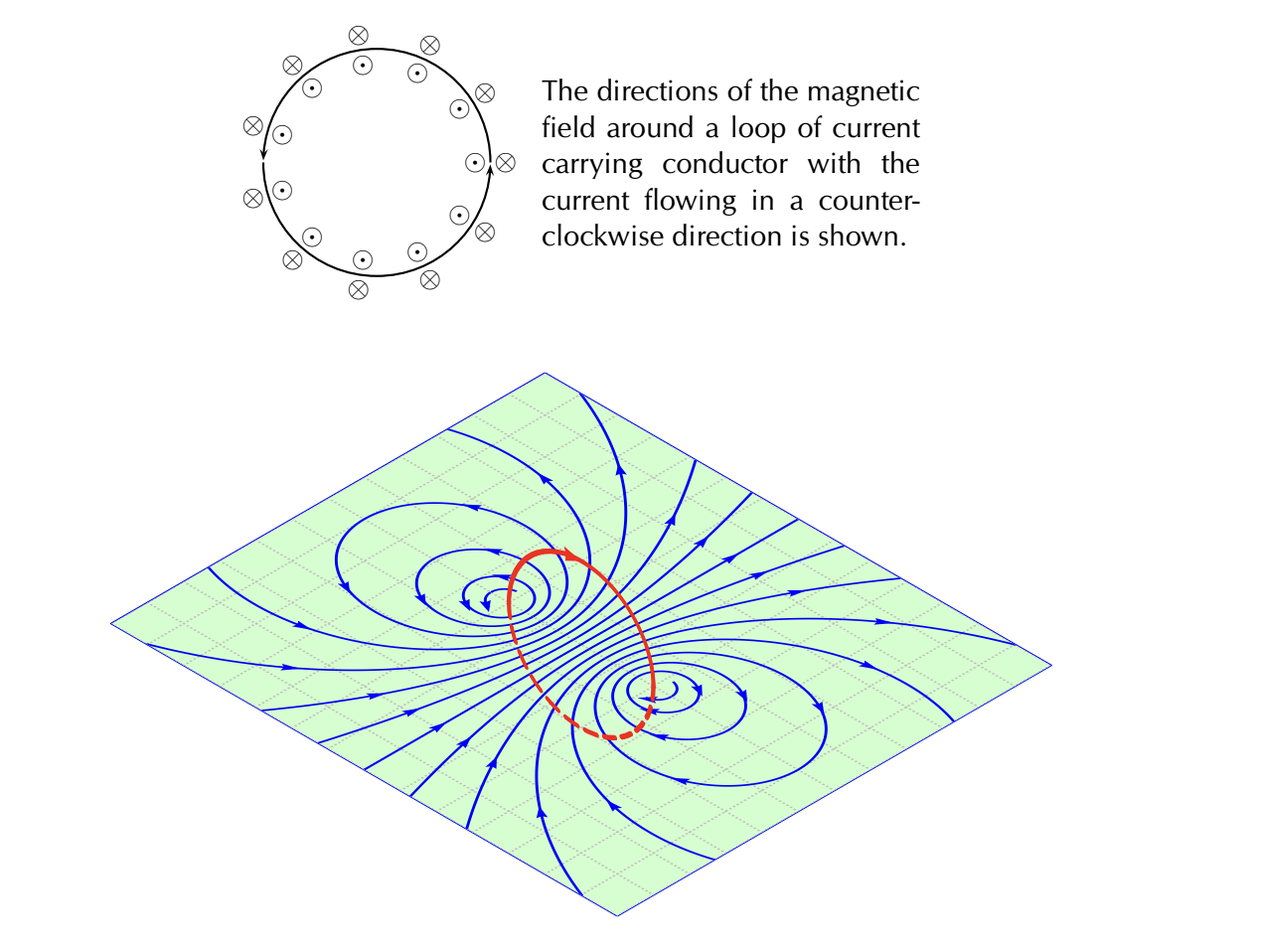
When you bend a current-carrying conductor into a loop, the magnetic field pattern becomes more complex and useful. Using the Right Hand Rule at different points around the loop shows that the field lines emerge from one side of the loop and enter the other side.
The magnetic field around a single current loop resembles the field pattern of a bar magnet, with field lines emerging from one face (north pole equivalent) and entering the other face (south pole equivalent).
Note
Modified Right Hand Rule for loops: If you make your right hand fingers follow the direction of current flow in the loop, your thumb points toward the direction where field lines emerge (similar to the north pole where field lines emerge from a bar magnet).
Magnetic field around a solenoid
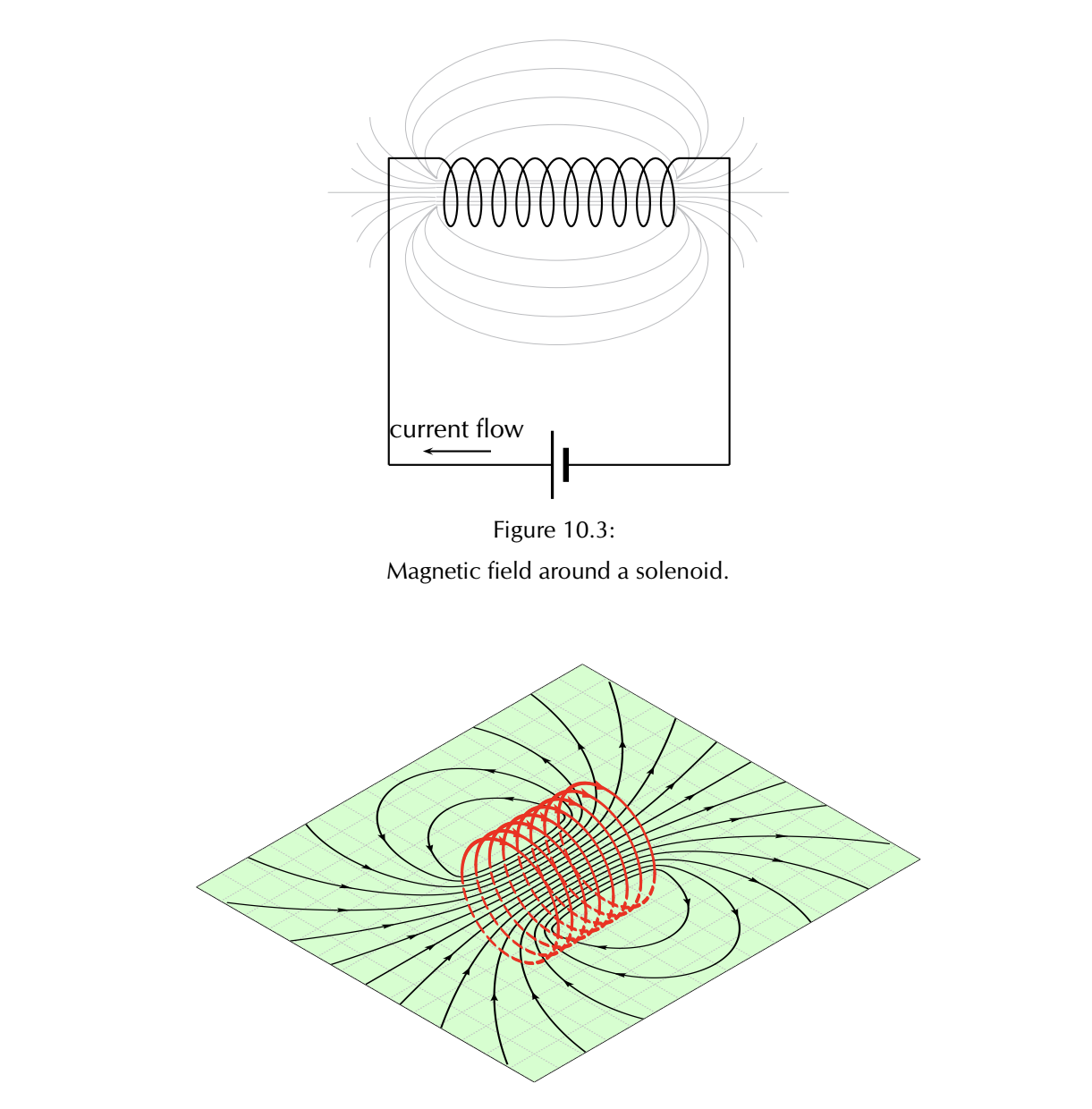
When you add multiple current loops together with current flowing in the same direction, the magnetic fields from each loop combine to create a stronger magnetic field. A coil of many such loops is called a solenoid.
Solenoid: A cylindrical coil of wire that acts as a magnet when electric current flows through it.
The magnetic field pattern around a solenoid is very similar to the magnetic field pattern around a bar magnet that you studied in Grade 10. It has a definite north and south pole, with field lines running from north to south outside the solenoid and from south to north inside the solenoid.
Real-world applications
Electromagnets
An electromagnet is a piece of wire designed to generate a magnetic field when electric current passes through it. While all current-carrying conductors produce magnetic fields, electromagnets are specifically constructed to maximise the strength of the magnetic field for particular purposes.
Common applications of electromagnets:
- Security doors (automatic opening systems in shops)
- Electric motors (which will be described in detail in Grade 12)
- Electric bells and relays
- Loudspeakers
- Scrapyard cranes for lifting metal
- MRI machines in hospitals
As electrically-controllable magnets, electromagnets are essential components in electromechanical devices - machines that convert electrical power into mechanical force or motion.
Factors affecting electromagnet strength
Note
Experimental findings show:
- Number of coils: Increasing the number of coils increases magnetic field strength
- Iron core: Adding an iron core significantly increases magnetic field strength compared to air core
- Current magnitude: Higher current produces stronger magnetic fields
Example
Worked Example: Electromagnet experiment
Aim: A magnetic field is created when electric current flows through a wire. A single wire does not produce a strong magnetic field, but a wire coiled around an iron core does. Investigate this behaviour.
Apparatus:
- Battery and holder
- Length of wire
- Compass
- Few nails
Method:
- First, complete the previous experiment to establish baseline magnetic field from straight wire
- Bend wire into series of coils before attaching to battery. Observe deflection of compass needle - has it grown stronger?
- Repeat experiment by changing number and size of coils in wire. Observe compass deflection
- Coil wire around iron nail, then attach coil to battery. Observe compass needle deflection
Conclusions:
- Does number of coils affect magnetic field strength? Yes - more coils create stronger deflection
- Does iron nail increase or decrease magnetic field strength? Increases - iron core significantly strengthens the magnetic field
Summary
Key Points to Remember:
- Electric current always produces a magnetic field - this is the fundamental principle of electromagnetism
- The Right Hand Rule helps determine field direction - thumb shows current direction, fingers curl in field direction (always use your right hand!)
- Magnetic field strength increases with more current, more coils, and iron cores
- Field patterns are circular around straight wires but become more complex around loops and solenoids
- Electromagnets are practical applications found in motors, speakers, security systems and medical equipment