Geometrical Optics (Grade 11 NSC Matric Physical Sciences): Revision Notes
📚Revision Notes
Critical Angles and Total Internal Reflection
What is total internal reflection?
When you experiment with light and glass blocks, you might notice something interesting happens at certain angles. Sometimes, instead of the light passing through and bending (refracting), it gets completely reflected back into the material. This phenomenon is called total internal reflection.
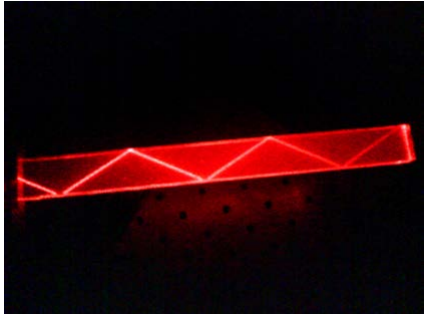
Total internal reflection occurs when light travelling through an optically denser medium hits the boundary with a less dense medium, but instead of passing through, the entire light ray reflects back into the original medium.
Note
This is different from regular reflection that happens at mirrors. In total internal reflection, no light escapes into the second medium - it's all reflected back, making it 100% efficient.
Understanding the critical angle
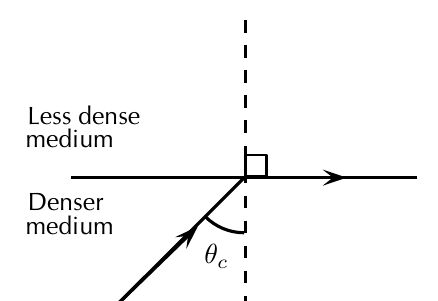
Before total internal reflection can happen, there's a special angle we need to understand. As we increase the angle of incidence gradually, we reach a point where the refracted ray travels exactly along the boundary between the two materials - this means the angle of refraction becomes 90°. This special angle of incidence is called the critical angle.
Important
Critical angle: The angle of incidence where the angle of refraction is 90°. Light must travel from an optically denser medium to an optically less dense medium for this to occur.
Conditions for total internal reflection
For total internal reflection to happen, two conditions must be met:
Important
Two Essential Conditions:
-
Direction condition: Light must travel from an optically denser medium (higher refractive index) to an optically less dense medium (lower refractive index)
-
Angle condition: The angle of incidence must be greater than the critical angle
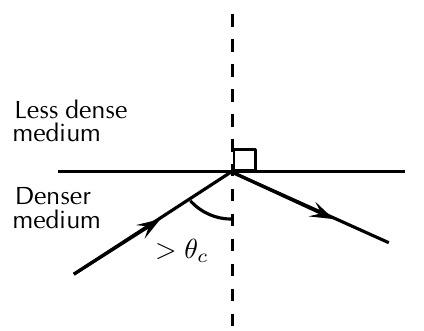
When the angle of incidence exceeds the critical angle, no refracted ray emerges from the medium. Instead, the light ray is completely reflected back into the denser medium.
Calculating the critical angle
Instead of always measuring critical angles experimentally, we can calculate them using Snell's Law. Remember that Snell's Law states:
Where:
- is the refractive index of the first material
- is the refractive index of the second material
- is the angle of incidence
- is the angle of refraction
At the critical angle, we know that:
- (the critical angle)
Since , we can write:
Solving for the critical angle:
Therefore:
Note
Notice that for this formula to work, must be less than (less dense medium has lower refractive index). This automatically ensures we're going from denser to less dense medium.
Worked example: calculating critical angle
Example
Worked Example: Finding Critical Angle for Water-Air Boundary
Question: Given that the refractive indices of air and water are 1.00 and 1.33 respectively, find the critical angle.
Solution:
Step 1: Determine the approach We can use Snell's Law to find the critical angle since we know that when the angle of incidence equals the critical angle, the angle of refraction is 90°.
Step 2: Apply the formula
Step 3: State the final answer
- The critical angle for light travelling from water to air is 48.8°.
Understanding different scenarios
Let's examine what happens at different angles when light travels from water to air.
The table below shows how the angle of refraction changes with the angle of incidence:
| Angle of incidence | Angle of refraction |
|---|---|
| 0° | 0.00° |
| 30° | 22.1° |
| 45° | 32.1° |
| 48.8° | 90° |
| 50° | No refraction (total internal reflection) |
Note
When the angle of incidence reaches 48.8° (the critical angle for water-air boundary), the refracted ray travels along the surface. For any angle greater than 48.8°, total internal reflection occurs.
Practical experiment: finding the critical angle
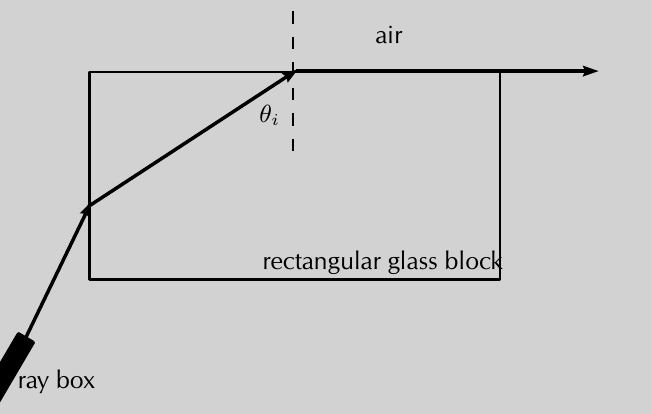
Aim: To determine the critical angle for a rectangular glass block.
Apparatus: Rectangular glass block, ray box, 360° protractor, paper, pencil, ruler
Method:
- Place the glass block on paper and trace its outline
- Turn on the ray box and direct light into the side of the glass block
- Adjust the angle until you see the refracted ray travelling along the top edge of the block (angle of refraction = 90°)
- Mark the points where light enters and exits the block
- Remove the glass block and draw a line between the marked points
- Use the protractor to measure the angle of incidence - this is your critical angle
Important
Important tip: Remember that for total internal reflection, the incident ray must always be in the denser medium (the glass block in this case).
Applications: fibre optics
Total internal reflection has many practical applications, with fibre optics being one of the most important. Optical fibres are thin strands of glass or plastic used to transmit light signals over long distances.
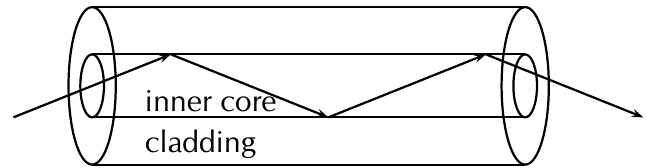
Structure of optical fibres
An optical fibre consists of two main parts:
- Inner core: The central region through which light travels
- Cladding: The outer layer with a lower refractive index than the core
How fibre optics work
Light signals enter the fibre at angles greater than the critical angle. As the light travels down the fibre, it repeatedly undergoes total internal reflection at the core-cladding boundary. This keeps the light trapped inside the core, allowing it to travel long distances with minimal loss.
Note
The clever design ensures that light can only escape when it reaches the end of the fibre, making it incredibly efficient for transmitting information over vast distances.
Applications of fibre optics
Telecommunications: Optical fibres can transmit thousands of signals simultaneously over long distances. The information travels at the speed of light, making fibre optic cables much faster than traditional copper cables.
Medicine: Endoscopes use optical fibres to allow doctors to see inside the human body. Light travels down one set of fibres to illuminate internal organs, while another set carries the reflected light back to create an image.
Important
Common Exam Tips:
- Always check the direction: total internal reflection only occurs when light travels from a denser to a less dense medium
- Remember that at the critical angle, the angle of refraction is exactly 90°
- For angles greater than the critical angle, there is no refracted ray - only reflection
- Each pair of materials has their own unique critical angle (e.g., glass to air = 42°, water to air = 48.8°)
Summary
Key Points to Remember:
- Total internal reflection occurs when light is completely reflected at a boundary instead of being refracted
- The critical angle is the angle of incidence where the angle of refraction equals 90°
- Two conditions must be met: light travels from denser to less dense medium, and angle of incidence exceeds the critical angle
- The critical angle formula is where
- Fibre optics use total internal reflection to transmit light signals in telecommunications and medical equipment