Forces Between Masses (Grade 11 NSC Matric Physical Sciences): Revision Notes
📚Revision Notes
Forces Between Masses
Understanding gravitational forces
Gravity is probably the first force we experience in everyday life, though we rarely think about it consciously. When babies learn to crawl or walk, they're working against gravity. Games involving jumping, climbing, or throwing balls all demonstrate gravity's effects. The common saying "what goes up, must come down" describes gravity's influence.
Gravity is the attractive force that exists between objects because of their mass. It is always attractive and acts as a non-contact force over distances. This gravitational force is responsible for keeping the Moon in orbit around Earth and causes ocean tides through the Moon's gravitational pull on Earth.
Note
Sir Isaac Newton was the first scientist to mathematically define gravitational force and show how it explains both falling objects and astronomical motions. His work revealed that gravity follows predictable patterns based on mass and distance, revolutionizing our understanding of both terrestrial and celestial mechanics.
Newton's law of universal gravitation
Newton's law of universal gravitation states that every point mass attracts every other point mass with a force that acts along the line connecting them. This attractive force is directly proportional to the product of their masses and inversely proportional to the square of the distance between them.
The mathematical formula for gravitational force between two point masses is:
Where:
- F = gravitational force (measured in newtons, N)
- G = gravitational constant = 6.67 × 10⁻¹¹ N⋅m²⋅kg⁻²
- m₁ and m₂ = masses of the two objects (in kilograms, kg)
- d = distance between the centres of the objects (in metres, m)
Key points about gravitational force
- The force is always attractive - objects pull towards each other
- It depends only on the masses involved and the distance between them
- For large objects like planets, we measure distance from their centres
- We use vectors to show both the magnitude and direction of the force
Example
Worked Example: Gravitational Force Between People
Consider a man with mass 80 kg standing 10 m from a woman with mass 65 kg. The gravitational force between them would be:
If they move closer to 1 m apart:
These forces are extremely small, which explains why we don't notice gravitational attraction between everyday objects.
Example
Worked Example: Earth-Moon System
For comparison, consider the gravitational force between Earth and the Moon:
- Earth's mass: 5.98 × 10²⁴ kg
- Moon's mass: 7.35 × 10²² kg
- Earth-Moon distance: 3.8 × 10⁸ m
This enormous force demonstrates how mass and distance affect gravitational attraction. Larger masses create stronger forces, while greater distances significantly reduce the force (due to the d² factor).
Understanding gravitational acceleration
Every object on Earth experiences the same gravitational acceleration, regardless of its mass. Using Newton's second law (F = ma) with the gravitational force formula:
Setting these equal:
Simplifying:
Important
Since the object's mass (m₀) cancels out, all objects experience the same gravitational acceleration on Earth's surface. This explains why a feather and hammer dropped together (in a vacuum) hit the ground simultaneously.
Weight and mass
Many people confuse weight and mass, but they are fundamentally different:
- Mass is a scalar quantity measuring how much matter an object contains. Mass remains constant regardless of location (Earth, Moon, or space).
- Weight is a vector quantity measuring the gravitational force acting on an object. Weight changes depending on the local gravitational field strength.
Mass is measured in kilograms (kg), while weight is a force measured in newtons (N).
Calculating weight
Weight is calculated using: 𝐅⃗ = m𝐠
where 𝐠 represents gravitational acceleration (9.8 m·s⁻² on Earth).
When people "weigh themselves" on a scale, they're actually measuring the gravitational force acting on their mass. If your mass decreases through diet or exercise, the scale reading (your weight) will also decrease.
Example
Worked Example: Lift Forces
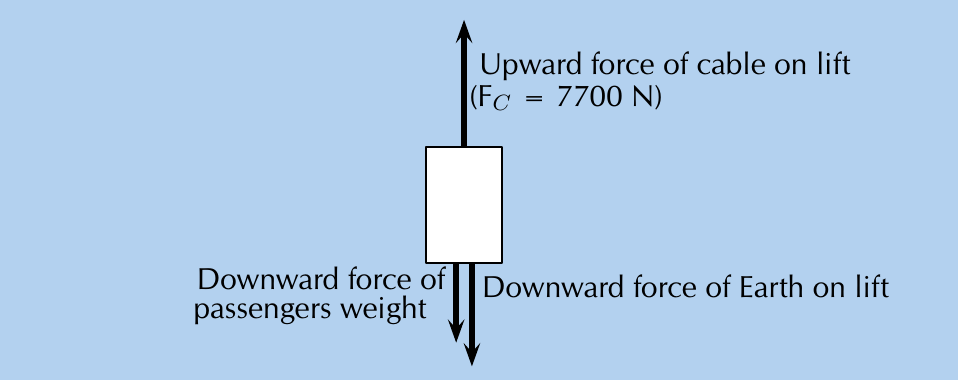
Question: A lift with mass 250 kg carries passengers with unknown total mass m. The lift accelerates upwards at 1.6 m⋅s⁻². The cable supporting the lift exerts a constant upward force of 7700 N. What is the maximum passenger mass for this acceleration?
Solution:
Step 1: Draw a force diagram Choose upwards as positive direction. The forces acting on the system are:
- Upward cable force: F_C = 7700 N
- Downward gravitational force on lift and passengers: F_g = (250 + m) × 9.8 m⋅s⁻²
Step 2: Apply Newton's second law
- For the lift system (lift + passengers):
Step 3: Solve for passenger mass
The maximum passenger mass is approximately 421 kg.
Understanding weightlessness
Weightlessness occurs when objects experience no normal force, not when gravitational force disappears. In a falling lift or orbiting spacecraft, occupants feel weightless because they're accelerating at the same rate as their surroundings.
Note
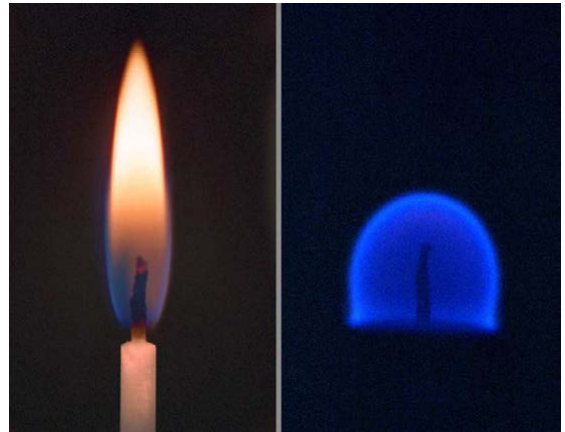
In space, weightlessness affects many phenomena. For example, candle flames become spherical instead of teardrop-shaped because hot gases cannot rise when there's no gravitational "up" direction.
Comparative problems
Comparative problems involve calculating quantities under different gravitational conditions. The method involves:
- Write equations for both situations
- Identify relationships between variables
- Substitute known relationships
- Solve for the unknown quantity
Example
Worked Example: Comparing Planetary Weights
Question: A man has mass 70 kg. Planet Zirgon has the same size as Earth but twice Earth's mass. What would the man weigh on Zirgon if Earth's gravitational acceleration is 9.8 m⋅s⁻²?
Solution:
Step 1: Identify given information
- Man's mass: m = 70 kg
- Zirgon's mass: m_Z = 2M_Earth
- Zirgon's radius: r_Z = r_Earth
- Earth's gravitational acceleration: g_E = 9.8 m⋅s⁻²
Step 2: Calculate weight on Earth
Step 3: Calculate weight on Zirgon
The man weighs 1372 N on Zirgon - twice his Earth weight because Zirgon has twice Earth's mass but the same radius.
Summary
Key Points to Remember:
- Gravitational force is always attractive and depends only on masses and distance between them
- Newton's universal law: F = Gm₁m₂/d² - force increases with larger masses and decreases with greater distance (squared)
- Mass vs weight: Mass is constant everywhere; weight varies with local gravitational field strength
- All objects experience the same gravitational acceleration (9.8 m⋅s⁻² on Earth) regardless of their mass
- Comparative problems: Use ratios and relationships between different planetary conditions to solve for unknowns