Newton’s First Law (Grade 11 NSC Matric Physical Sciences): Revision Notes
📚Revision Notes
Newton's First Law
Introduction
Sir Isaac Newton was an English scientist who lived from 1642 to 1727. He was fascinated by how objects behave under different conditions. Newton observed that stationary objects tend to stay still unless something pushes or pulls them, while moving objects keep moving unless something stops them or changes their direction. From these observations, he developed what we now know as Newton's First Law of Motion.
Note
Newton was one of the most influential scientists in history, making groundbreaking contributions to physics, mathematics, and astronomy. His three laws of motion form the foundation of classical mechanics.
Definition of Newton's first law
Important
Newton's First Law of Motion states that an object will continue in a state of rest or uniform motion (moving at constant velocity) unless it is acted upon by an unbalanced force.
This means:
- Objects at rest stay at rest
- Objects in motion continue moving at the same speed and in the same direction
- Only an unbalanced force can change an object's state of motion
Understanding inertia
The tendency of objects to resist changes in their motion is called inertia. This is a fundamental property of matter that explains why objects "prefer" to keep doing what they're already doing.
Note
Think of inertia as an object's "stubbornness" - it doesn't want to change its current state of motion unless forced to do so by an external influence.
Real-world examples
Ice skating
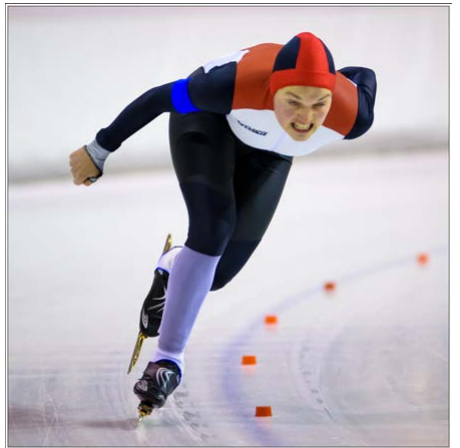
When an ice skater pushes off from the side of the rink, she glides across the ice in a straight line. According to Newton's First Law, she should continue moving forever in that straight line. However, in reality, she eventually slows down and stops.
This happens because Newton's First Law applies perfectly only when there are no external forces acting on the object. In the ice skating example, there is a small amount of friction between the skates and the ice, plus air resistance. These forces gradually slow the skater down.
Football on grass
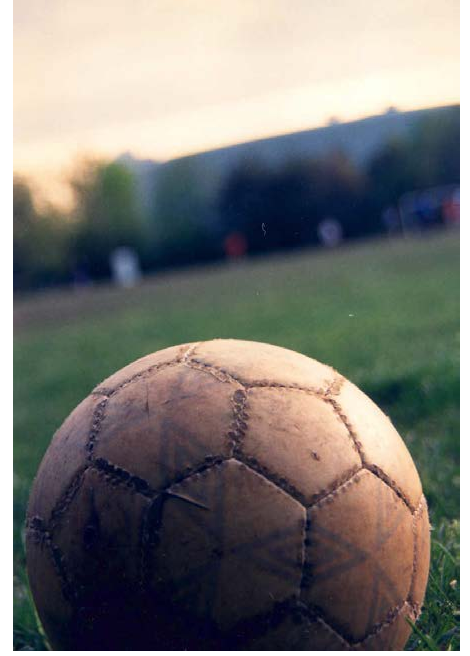
Similarly, when we kick a football across a field, it should theoretically keep rolling forever according to Newton's First Law. However, the ball eventually stops because:
- Air resistance acts against the ball's motion
- Friction between the ball and grass opposes its movement
- These forces gradually reduce the ball's speed until it stops
Newton's first law in action
Seat belts in cars
Seat belts are a perfect example of Newton's First Law in everyday life. When a car travels at 120 km/h, the passengers inside are also moving at 120 km/h. If the car suddenly stops due to an accident, the car experiences a force that brings it to a halt, but the passengers continue moving forward at 120 km/h due to their inertia.
Note
Seat belts provide the necessary force to stop the passengers and prevent them from being thrown forward, potentially saving their lives. This is a direct application of Newton's First Law in safety engineering.
Rockets in space
When a rocket is launched into space, the exploding gases create a force that propels it through the atmosphere. Once the rocket reaches space and the engines are turned off, it continues moving at constant velocity indefinitely. This is because there's no air resistance or friction in the vacuum of space to slow it down.
If astronauts want to change the rocket's direction, they must fire engines to apply a force that will alter its motion.
Worked example: Passengers in a turning car
Example
Worked Example: Why Passengers Get Thrown to the Side in Turning Cars
Question: Why do passengers get thrown to the side when the car they are travelling in goes around a corner?
Solution:
Step 1: What happens before the car turns Before the car starts turning, both the passengers and the car are travelling at the same velocity.
Step 2: What happens while the car turns The driver turns the wheels of the car, which creates a force on the car that makes it turn. This force acts on the car but not directly on the passengers. According to Newton's First Law, the passengers continue moving with their original velocity.
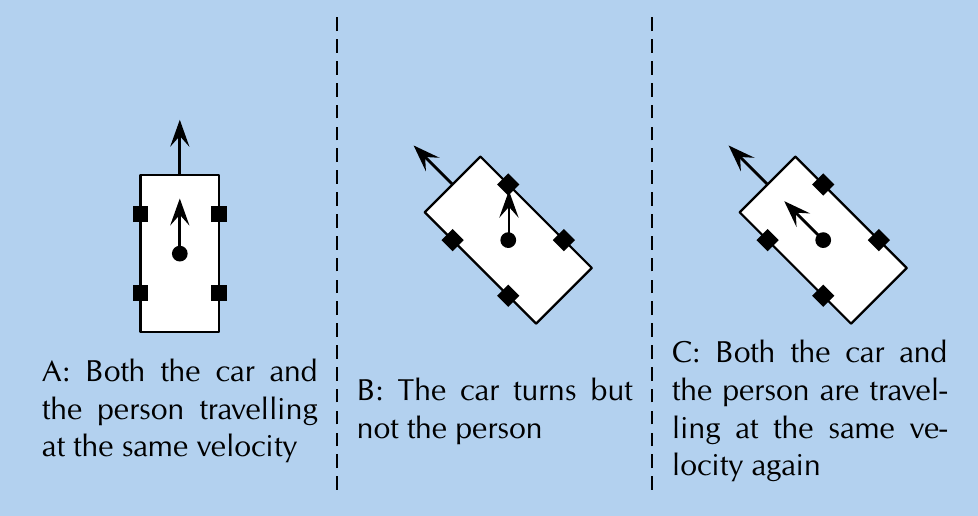
Step 3: Why passengers get thrown to the side Since passengers have inertia, they resist the change in direction and continue moving in their original straight-line path. If passengers are wearing seat belts, the belts exert a force on them until their velocity matches that of the car. Without seat belts, passengers would continue in their original direction and hit the side of the car.
The diagram shows three scenarios:
- Scenario A: Both car and person moving at the same velocity
- Scenario B: Car turns but person maintains original direction due to inertia
- Scenario C: Both car and person moving at the same velocity again (after seat belt force acts)
Common misconceptions
Important
Common Mistake to Avoid:
Students often think Newton's First Law is "wrong" because moving objects always seem to stop eventually. Remember that the law applies perfectly when no external forces are present. In real life, forces like friction and air resistance are nearly always acting on moving objects, which is why they slow down and stop.
Remember!
Summary
Key Points to Remember:
- Newton's First Law: Objects at rest stay at rest, and objects in motion stay in motion at constant velocity, unless acted upon by an unbalanced force
- Inertia is an object's resistance to changes in its state of motion
- The law applies perfectly only when no external forces are acting on the object
- Real-world examples include seat belts preventing injury and rockets moving through space
- Forces like friction and air resistance explain why moving objects eventually stop in everyday situations