Newton’s Second Law (Grade 11 NSC Matric Physical Sciences): Revision Notes
📚Revision Notes
Newton's Second Law
Introduction
Newton's Second Law explains how objects respond when forces are applied to them. While Newton's First Law tells us that objects at rest stay at rest and moving objects continue moving in straight lines, the Second Law answers the crucial question: what happens when we apply a force to make stationary objects start moving?
Consider a simple example: if you push lightly on a 10 kg box on a table, it won't move because friction prevents motion. However, if you push hard enough to overcome friction, the box will start to accelerate. The Second Law helps us understand and calculate exactly how much acceleration occurs based on the applied force and the object's mass.
Definition and mathematical formula
Important
Newton's Second Law states that if a resultant force acts on a body, it will cause the body to accelerate in the direction of the resultant force. The acceleration of the body will be directly proportional to the resultant force and inversely proportional to the mass of the body.
The mathematical representation is:
Where:
- is the net resultant force (in Newtons, N)
- is the mass of the object (in kilograms, kg)
- is the acceleration (in metres per second squared, m·s⁻²)
Key relationships
From experimental investigations, we discover two important relationships:
-
Acceleration is directly proportional to resultant force: When mass stays constant but force increases, acceleration increases proportionally ()
-
Acceleration is inversely proportional to mass: When force stays constant but mass increases, acceleration decreases ()
Note
Remember that both force and acceleration are vector quantities, meaning they have both magnitude and direction. The acceleration always occurs in the same direction as the resultant force.
Experimental investigation
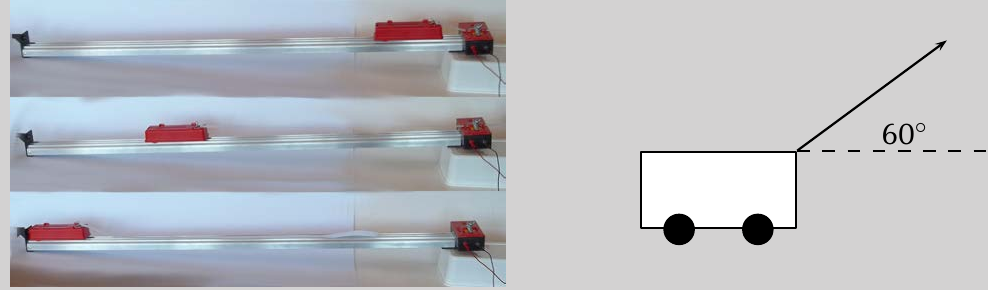
Scientists verify Newton's Second Law through controlled experiments. Here's how the relationship between force, mass, and acceleration is demonstrated:
Example
Experimental Investigation: Verifying Newton's Second Law
Aim: To investigate the relationship between the acceleration of objects and the application of a constant resultant force.
Method:
- A constant force of 20 N acts at 60° to the horizontal on a dynamics trolley
- Ticker tape attached to the trolley runs through a ticker timer at 20 Hz frequency
- The experiment repeats 4 times with different masses:
- Case 1: 6.25 kg
- Case 2: 3.57 kg
- Case 3: 2.27 kg
- Case 4: 1.67 kg
Results analysis: Students calculate instantaneous velocities from ticker tape distances, then determine acceleration values. When plotting acceleration vs mass, the graph shows that acceleration is inversely proportional to mass, confirming that .
When similar experiments vary the applied force while keeping mass constant, results show that acceleration is directly proportional to force ().
Problem-solving methodology
Successfully solving Newton's Second Law problems requires a systematic approach:
Note
Step 1: Draw a force diagram
Always start by drawing a clear force diagram showing all forces acting on the object or system. This visual representation helps identify which forces to include in calculations.
Note
Step 2: Choose coordinate system
Select positive directions for x and y axes. This choice affects the signs in your calculations but not the final answer.
Note
Step 3: Apply Newton's Second Law
Use separately for x and y directions if needed. Remember to consider only forces parallel to the direction of motion when analyzing horizontal movement.
Note
Step 4: Solve systematically
For problems with multiple objects, write separate equations for each object, then solve the system of equations simultaneously.
Applications and worked examples
Objects on horizontal surfaces
The most basic application involves objects moving horizontally with friction present.
Example
Worked Example: Box on Horizontal Surface
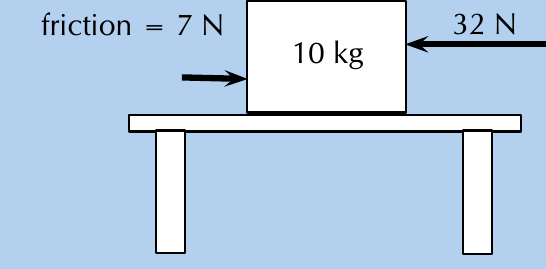
A 10 kg box experiences a 32 N horizontal force and 7 N friction force.
Solution approach:
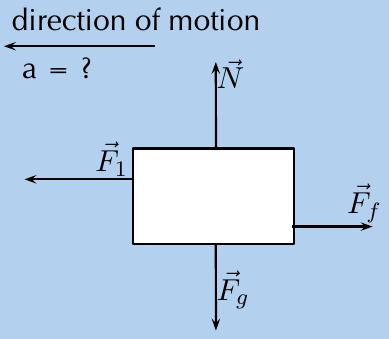
- Draw force diagram showing all horizontal forces
- Calculate net force:
- Apply Newton's Second Law:
- Solve for acceleration: in the direction of motion
Connected objects and systems
More complex problems involve multiple objects connected by ropes or in contact.
Example
Worked Example: Connected Objects System
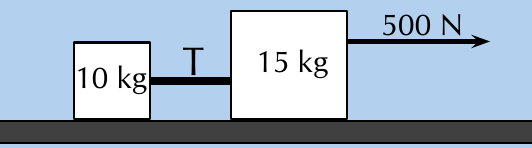
Two crates (10 kg and 15 kg) connected by rope with 500 N applied force and friction present.
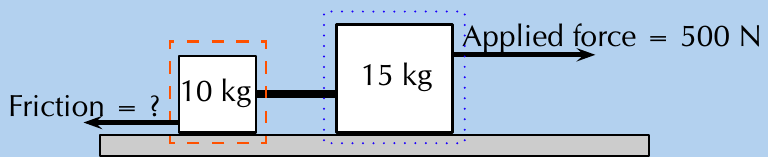
Solution strategy:
-
Draw separate force diagrams for each object
-
Apply Newton's Second Law to each object separately:
- For 10 kg crate:
- For 15 kg crate:
-
Solve simultaneously to find tension T and acceleration a
This systematic approach works for any connected system, regardless of complexity.
Forces at angles
When forces act at angles, we must resolve them into components before applying Newton's Second Law.
Example
Worked Example: Forces at Angles

A person pulls a 20 kg box with 150 N force at 60° above horizontal, with 15 N friction present.
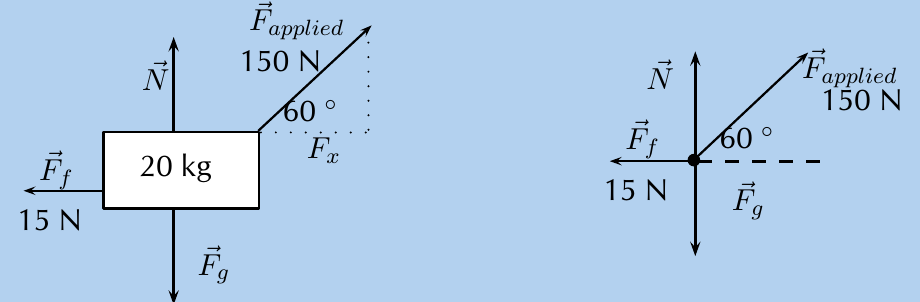
Solution process:
- Calculate horizontal component:
- Apply Newton's Second Law horizontally:
- Solve: , so
Truck and trailer systems
Real-world applications include vehicles pulling trailers at angles.
Example
Worked Example: Truck and Trailer System
A 2000 kg truck pulls a 500 kg trailer with 10,000 N engine force, connected at 25° angle.
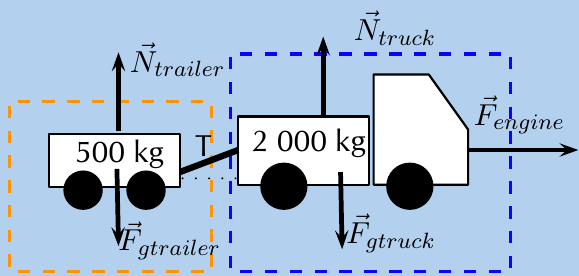
Key insight: The connection angle affects how tension force components contribute to each vehicle's acceleration. Use trigonometry to resolve the tension into horizontal components for both truck and trailer.
Objects on inclined planes
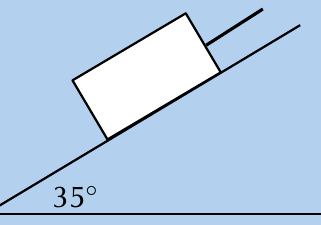
Inclined plane problems require careful consideration of gravitational force components.
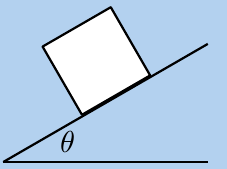
For objects on slopes, weight resolves into:
- Parallel component: - acts down the slope
- Perpendicular component: - balanced by normal force
Example
Worked Example: Object on Inclined Plane
Object on 35° incline
Analysis approach:
- Resolve weight into slope-parallel and slope-perpendicular components
- Apply Newton's Second Law parallel to slope surface
- Consider friction force opposing motion direction
Vertical motion applications
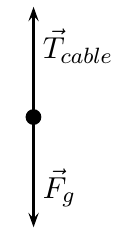
Newton's Second Law also governs vertical motion in lifts, rockets, and falling objects.
Example
Worked Example: Lift Scenarios
Lift scenarios:
- Stationary lift: (tension equals weight)
- Accelerating upward: (tension exceeds weight)
- Constant velocity: (no net force)
- Decelerating: (tension less than weight)
Rocket motion: Engine thrust must overcome weight to produce upward acceleration:
Common exam tips and pitfalls
Essential exam strategies
Here are the key strategies for successful problem solving:
-
Always draw force diagrams first - this prevents missed forces and sign errors
-
Clearly define positive directions - state your chosen positive direction explicitly
-
Consider each direction separately - horizontal and vertical motions are independent
-
Use consistent sign conventions - stick to your chosen positive directions throughout
-
Check answer reasonableness - does the acceleration direction make physical sense?
Important
Common mistakes to avoid
-
Confusing motion with acceleration: An object moving at constant velocity has zero acceleration, even though it's moving
-
Forgetting friction forces: Always consider whether friction acts in problems involving surfaces
-
Mixing up force components: When forces act at angles, only components parallel to motion affect acceleration in that direction
-
Sign errors in connected systems: Tension forces act in opposite directions on connected objects
-
Assuming moving objects need net forces: Objects at constant velocity have zero net force (Newton's First Law)
Summary
Key Points to Remember:
- Newton's Second Law formula: links net force, mass, and acceleration
- Force diagrams are essential for visualizing all forces acting on objects
- Acceleration is directly proportional to net force and inversely proportional to mass
- Vector nature matters - always consider force directions and components
- Systematic problem-solving prevents errors in complex multi-object systems