Graphical and Algebraic Methods (Grade 11 NSC Matric Physical Sciences): Revision Notes
📚Revision Notes
Graphical and Algebraic Methods
When working with vectors in two dimensions, there are two main approaches you can use to find the resultant of multiple vectors: graphical methods and algebraic methods. Both methods will give you the same answer, but they use different techniques to reach that result.
Note
The resultant vector is the single vector that has the same effect as multiple vectors combined. Think of it as the "net effect" of all forces acting together.
Graphical methods
Graphical methods involve drawing vectors to scale and using measurements to find the resultant vector. This visual approach helps you understand what's happening physically when vectors combine.
Important
Graphical methods require careful measurement and accurate scale drawings. While they provide excellent visualization of vector problems, algebraic methods are often more precise for calculations.
The tail-to-head method
The tail-to-head method is the fundamental technique for adding vectors graphically. Here's how it works:
- Choose an appropriate scale - Select a scale that allows your diagram to fit on the page while being large enough to measure accurately
- Draw coordinate axes - Set up x and y axes to provide a reference frame
- Draw the first vector - Start from the origin and draw the vector to scale
- Draw the second vector - Place the tail of the second vector at the head (tip) of the first vector
- Continue for additional vectors - Keep connecting tail-to-head for all remaining vectors
- Draw the resultant - The resultant vector goes from the tail of the first vector directly to the head of the last vector
- Measure the resultant - Use your scale to convert the measured length back to the actual magnitude
Note
Remember the key principle: In the tail-to-head method, you connect the tail of each new vector to the head of the previous vector. The resultant always goes from the very first tail to the very last head.
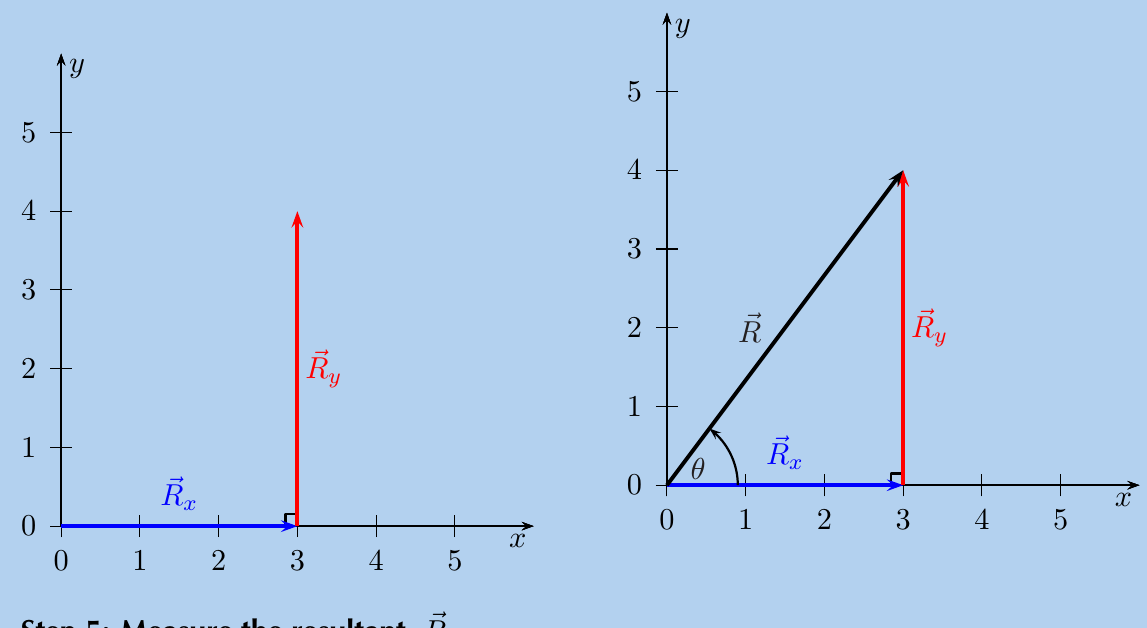
The diagram above shows how a vector can be broken down into its horizontal component (Rx) and vertical component (Ry), which then combine to form the resultant vector (R) at angle θ.
Worked example: Two perpendicular vectors
Example
Worked Example: Finding Resultant of Perpendicular Vectors
Given: Vector Ry = 4 N in the positive y-direction and vector Rx = 3 N in the positive x-direction
Solution:
Step 1: Choose scale and draw axes We'll use a scale of 1 N : 1 cm for our drawing. Since our largest vector is 4 N, we need our axes to extend at least 4 units in each direction.
Step 2: Draw the first vector (Rx) Draw a horizontal arrow 3 cm long pointing in the positive x-direction.
Step 3: Draw the second vector (Ry) Using the tail-to-head method, place the tail of Ry at the head of Rx. Draw a vertical arrow 4 cm long pointing in the positive y-direction.
Step 4: Draw the resultant vector Draw a line from the origin (tail of the first vector) directly to the head of the last vector.
Step 5: Measure and calculate Measuring the resultant vector gives us 5 cm. Using our scale (1 N : 1 cm), the magnitude is 5 N. The angle with the x-axis is 53°.
Final answer: R = 5 N at 53° from the positive x-direction
Worked example: Multiple force vectors
Example
Worked Example: Multiple Force Vector Addition
Given:
- F₁ = 2.3 N in the positive x-direction
- F₂ = 4 N in the positive y-direction
- F₃ = 3.3 N in the negative y-direction
- F₄ = 2.1 N in the negative y-direction
Solution:
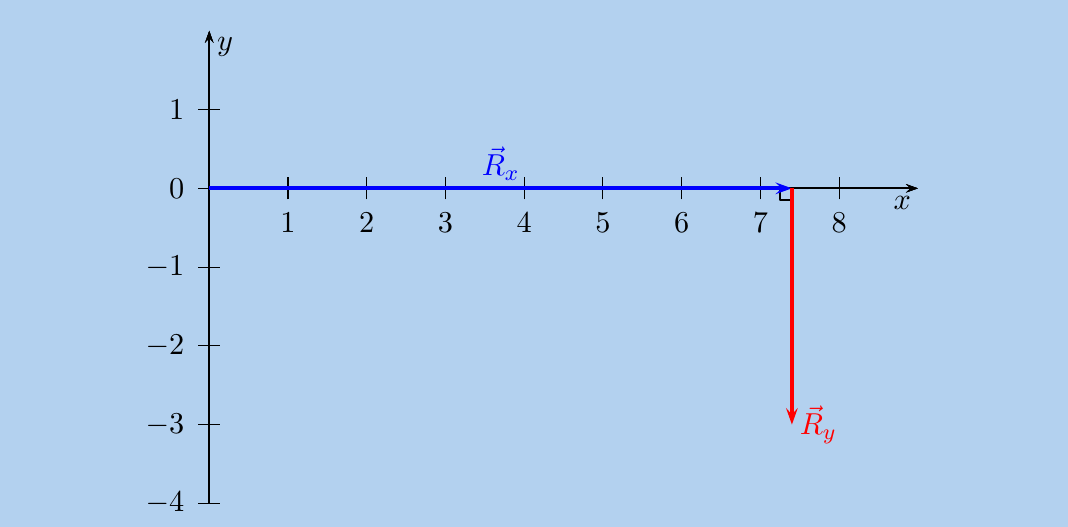
Step 1: Determine components Since F₁ is the only x-component: Rx = F₁ = 2.3 N
For the y-components, we add the vectors parallel to the y-axis:
- Positive y-direction: F₂ = 4 N
- Negative y-direction: F₃ + F₄ = 3.3 N + 2.1 N = 5.4 N
- Net y-component: Ry = 4 N - 5.4 N = -1.4 N
Step 2: Choose scale and draw axes Using a scale of 1 N : 1 cm, we need our axes to extend 2.3 cm in the positive x-direction and 1.4 cm in the negative y-direction.
Step 3: Draw the component vectors Draw Rx = 2.3 cm horizontally and Ry = 1.4 cm downward (negative y-direction).
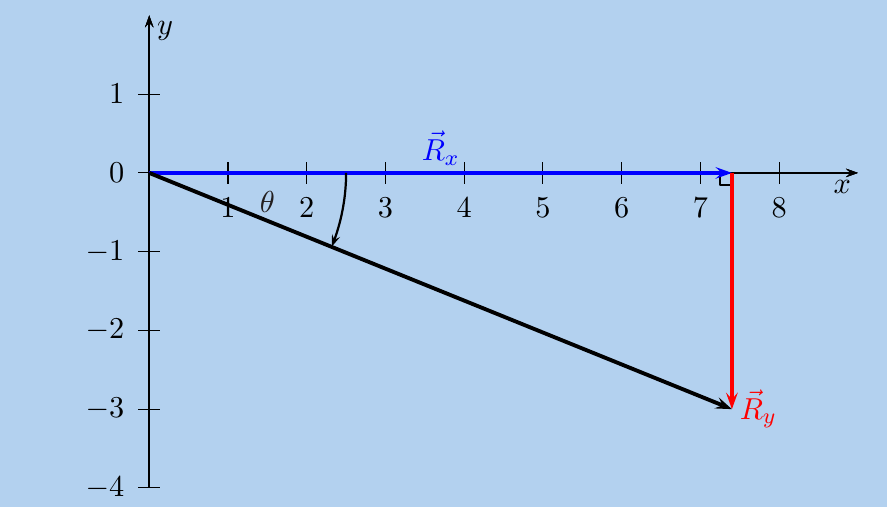
Step 4: Draw the resultant Connect from the origin to the head of the final vector.
Step 5: Measure the resultant The measured length is 2.7 cm, giving us a magnitude of 2.7 N. The angle below the positive x-axis is 31°.
Final answer: R = 2.7 N at -31° from the positive x-direction
Algebraic methods
Algebraic methods use mathematical calculations instead of scale drawings. This approach is often more accurate and doesn't require careful measurement.
One-dimensional vector addition
For vectors along the same line, algebraic addition is straightforward:
- Choose a positive direction - Decide which way is positive
- Assign signs - Vectors in the positive direction get a plus sign, those in the negative direction get a minus sign
- Add algebraically - Simply add the values, keeping track of signs

Note
Sign Convention: Always establish your positive direction first. This prevents confusion when dealing with opposite forces.
Example: A 5 N force to the right and a 2 N force to the left
- Choose right as positive: F₁ = +5 N, F₂ = -2 N
- Resultant = F₁ + F₂ = 5 N + (-2 N) = 3 N to the right
Two-dimensional vector addition
For vectors in two dimensions, we use the Pythagorean theorem to find the magnitude and trigonometry to find the direction.
Finding magnitude
When you have perpendicular components Rx and Ry, the magnitude of the resultant is:
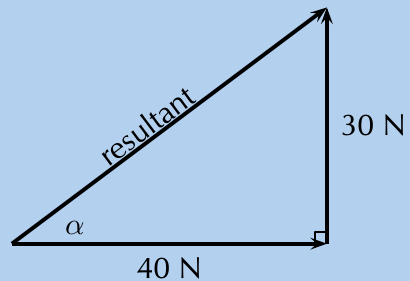
Example: For a 40 N horizontal force and a 30 N vertical force:
Finding direction
The direction angle α is found using trigonometry:
For our example above:
Example
Worked Example: Complete Algebraic Solution in Two Dimensions
Given: A 40 N force in the positive x-direction acts simultaneously with a 30 N force in the positive y-direction.
Solution:
Step 1: Identify components
- Rx = 40 N
- Ry = 30 N
Step 2: Calculate magnitude
Step 3: Calculate direction
Final answer: The resultant force is 50 N at 36.9° to the positive x-axis
Key formulas and relationships
Important
Essential Formulas for Vector Analysis
- Pythagorean theorem:
- Magnitude:
- Direction:
- Unit conversion: 1 kN = 1000 N, so N = ×10⁻³ kN
Important Relationships:
- The resultant vector is the single vector that produces the same effect as all the individual vectors combined
- Components are perpendicular parts of a vector (horizontal and vertical)
- The tail-to-head method works for any number of vectors
- Graphical and algebraic methods should give the same answer when done correctly
Exam tips and common mistakes
What examiners look for
Examiners expect to see systematic approaches and clear working. They specifically look for:
- Correct scale selection - Choose a scale that makes your diagram measurable
- Accurate drawings - Use a ruler and protractor for precision
- Clear labelling - Label all vectors, components, and angles
- Consistent units - Convert all measurements to the same units before calculating
- Correct significant figures - Match the precision given in the question
Important
Common Mistakes to Avoid
- Forgetting to convert units - Always check that all forces are in the same units
- Incorrect scale application - Remember to convert your measured values back using your chosen scale
- Wrong vector placement - In tail-to-head method, make sure you place the tail at the head, not tail-to-tail
- Sign errors - Pay careful attention to positive and negative directions
- Rounding too early - Keep extra decimal places during calculations and round only at the end
Problem-solving strategy
Note
Systematic Problem-Solving Approach
- Draw a sketch - Always start with a rough diagram to understand the problem
- Choose your method - Graphical for visualization, algebraic for precision
- Set up coordinates - Define your positive directions clearly
- Work systematically - Follow the steps in order, don't skip ahead
- Check your answer - Does the magnitude and direction make physical sense?
Remember!
Summary
Key Points to Remember
- Graphical methods use scale drawings and the tail-to-head technique to find resultants visually
- Algebraic methods use the Pythagorean theorem for magnitude and trigonometry for direction
- Both methods should give the same answer when performed correctly
- Always convert to consistent units before starting any calculations
- The resultant vector represents the combined effect of all individual vectors acting together
- Use for magnitude and for direction