Magnetic Bearing (Grade 12 NSC Matric Geography): Revision Notes
📚Revision Notes
Magnetic Bearing
What is magnetic bearing?
Magnetic bearing is a crucial concept in mapwork that helps us determine direction using a magnetic compass. Unlike true bearing, which uses true north as its reference point, magnetic bearing uses magnetic north as its starting point for measurements.
The key difference between these two types of bearings lies in their reference points. When we measure a true bearing, we start from true north (which points to the geographical North Pole) and measure clockwise to our target. However, when measuring magnetic bearing, we start from magnetic north (where a compass needle points) and measure clockwise from there.
Note
The distinction between magnetic north and true north is fundamental to understanding navigation. While true north is fixed (pointing to the geographical North Pole), magnetic north is where your compass needle actually points, and this location varies by geographical position and changes over time.
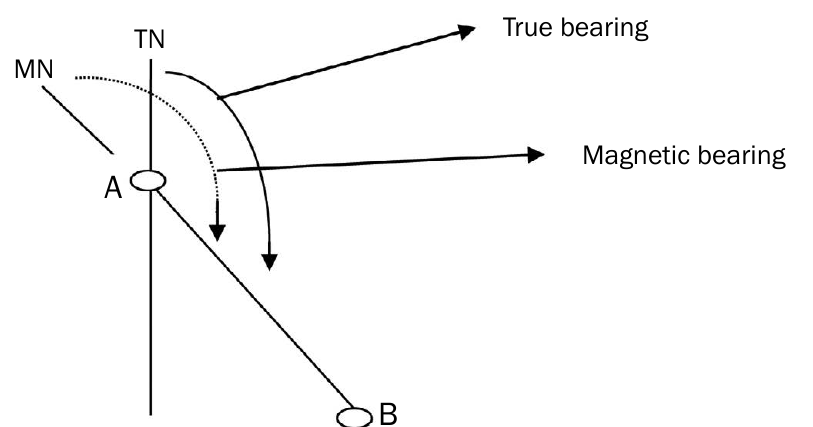
This distinction is important because magnetic north and true north are not in the same location. The angle between these two reference points is called magnetic declination, and this creates the need for calculations when converting between true bearings and magnetic bearings.
Understanding magnetic declination
Magnetic declination represents the angular difference between true north and magnetic north at any given location. This declination varies depending on where you are on Earth and also changes over time. In South Africa, magnetic declination is typically described as being "west of true north," meaning magnetic north lies to the west of true north.
Important
The declination is not constant - it changes annually due to the movement of Earth's magnetic field. This annual change is usually small (measured in minutes) but accumulates over years, making it necessary to update magnetic declination values for accurate navigation and mapping.
The magnetic bearing formula
The relationship between magnetic bearing, true bearing, and magnetic declination follows a straightforward mathematical relationship:
Where:
- MB = Magnetic Bearing
- TB = True Bearing
- MD = Magnetic Declination
Important
This formula is essential for converting between true bearings (which you can measure directly from a map) and magnetic bearings (which you would get from a compass reading). Understanding and applying this formula correctly is crucial for accurate navigation and mapwork calculations.
Step-by-step calculation method
Calculating magnetic bearing involves several systematic steps that ensure accuracy and help you avoid common mistakes. Here's the complete process:
Step 1: Determine the true bearing
First, you need to measure the true bearing from your starting point to your destination. This involves drawing a straight line between the two points on your map, then drawing a north line through the starting point. Using a protractor, measure the angle clockwise from the north line to your connecting line.
Step 2: Calculate the current magnetic declination
Magnetic declination changes over time, so you need to update the given declination to the current year. Start by finding the difference in years between the current year and the year when the declination was recorded. Then multiply this difference by the annual change rate.
If the annual change is eastward, you subtract the calculated change from the given declination. If the annual change is westward, you add the calculated change to the given declination. Remember that magnetic declination in South Africa is typically west of true north.
Step 3: Apply the formula
Once you have both the true bearing and the current magnetic declination, simply add them together using the formula . Your final answer should be expressed only in degrees and minutes, without directional terms like "north" or "south."
Worked examples
Example
Worked Example: Post office to dipping tank calculation
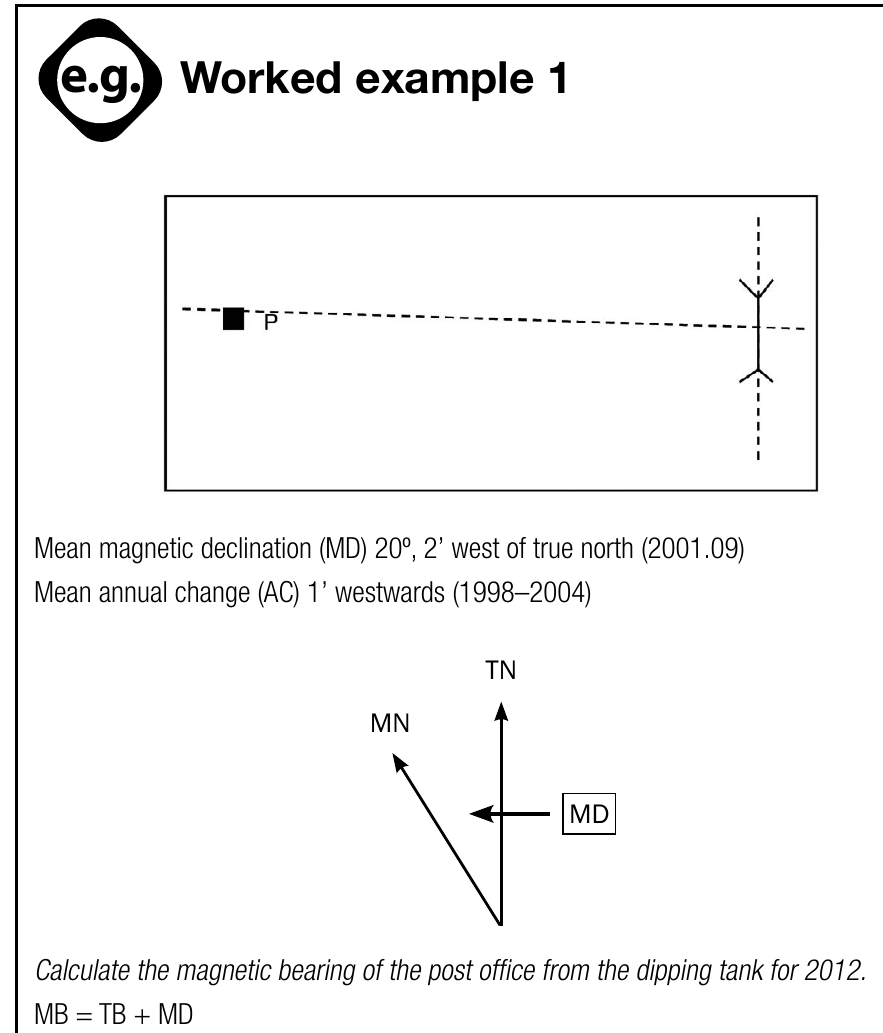
Let's work through a practical example where we need to find the magnetic bearing from a dipping tank to a post office in 2012.
Given information:
- Mean magnetic declination: 20° 2' west of true north (from 2001.09)
- Mean annual change: 1' westwards (1998-2004)
- True bearing: 272° (measured from the map)
Step 1: Calculate the updated magnetic declination for 2012
- Years difference: 2012 - 2001 = 11 years
- Change since 2001: 11 × 1' = 11' westward
- Updated declination: 20° 2' + 11' = 20° 13' west of true north
Step 2: Apply the formula
Example
Worked Example: Triangulation beacon to spot height
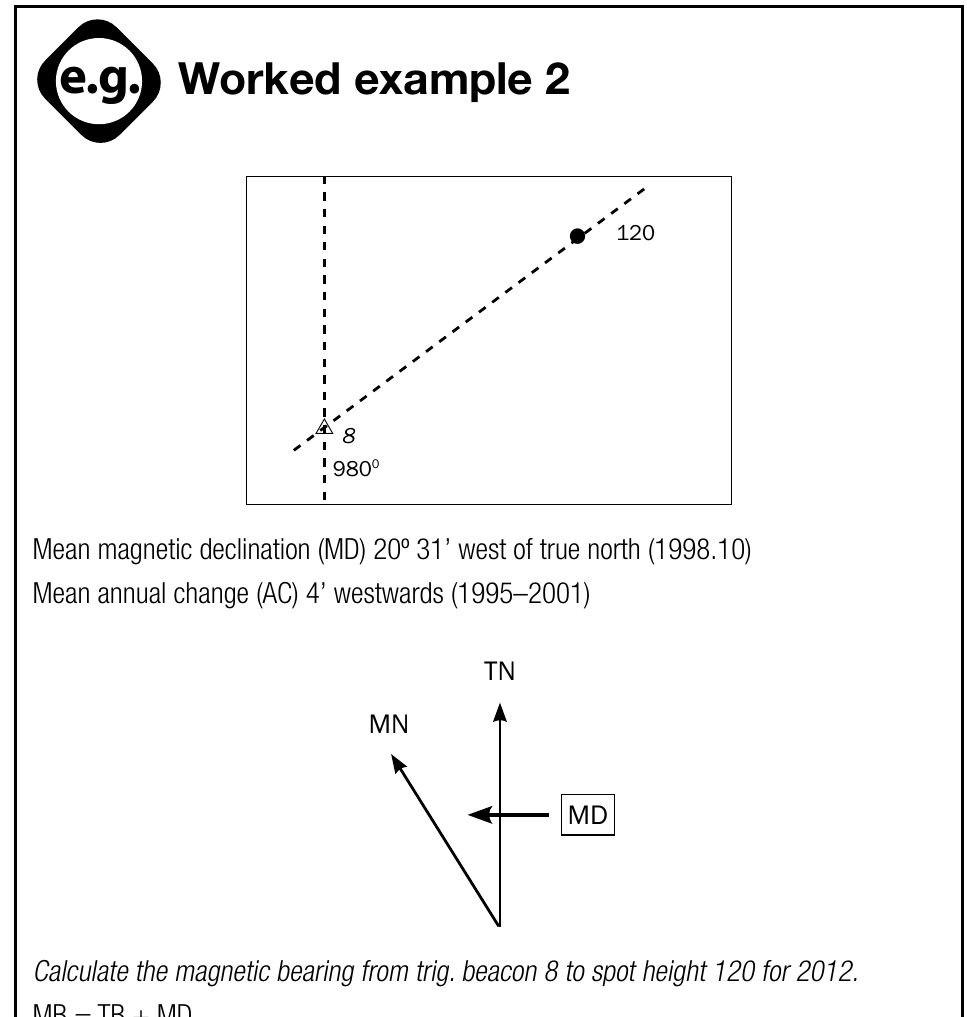
In this example, we calculate the magnetic bearing from triangulation beacon 8 to spot height 120 for the year 2012.
Given information:
- Mean magnetic declination: 20° 31' west of true north (from 1998.10)
- Mean annual change: 4' westwards (1995-2001)
- True bearing: 57° (measured as 56° to 58°)
Step 1: Calculate the updated magnetic declination
- Years difference: 2012 - 1998 = 14 years
- Change since 1998: 14 × 4' = 56' westward
- Updated declination: 20° 31' + 56' = 21° 27' west of true north
Step 2: Apply the formula
Important exam tips
Important
Essential Exam Strategies:
When solving magnetic bearing problems in exams, always remember to write out the formula clearly in your working. This demonstrates your understanding of the concept and often earns you marks even if you make small calculation errors.
Pay careful attention to whether the annual change is described as eastward or westward, as this determines whether you add or subtract the change from the given declination. Also, remember that your final answer should be expressed only in degrees and minutes without directional indicators.
Double-check your arithmetic, especially when converting between degrees and minutes. Small errors in these conversions can significantly affect your final answer.
Remember!
Summary
Key Points to Remember:
- Magnetic bearing uses magnetic north as its reference point, while true bearing uses true north
- The formula is essential for all magnetic bearing calculations
- Magnetic declination changes over time, so always update it to the required year
- In South Africa, magnetic declination is typically west of true north
- Always show your working clearly and write the formula to earn maximum marks in exams