Rural Settlements (Grade 12 NSC Matric Geography): Revision Notes
📚Revision Notes
Reasons for the Location of Rural Settlements
Introduction to rural settlements
Rural settlements represent the smallest type of human settlements and are characterised by their unifunctional nature. This means they focus primarily on one main type of economic activity. These settlements include farmsteads, hamlets, and villages, where people engage in primary economic activities such as farming, fishing, forestry, or mining.

Note
Understanding rural settlements is essential because they form the foundation of food production and resource extraction that supports larger urban areas. This relationship between rural and urban areas creates an interdependent system where rural communities provide essential resources while urban areas offer markets and services.
In South Africa, approximately 12.1% of the land is used for agricultural purposes, supporting both commercial and subsistence farming practices.
Land use in rural settlements
Rural communities utilise land in various ways depending on their specific needs and environmental conditions. The main types of farming found in rural settlements include:
Subsistence farming involves families growing crops and raising animals primarily to feed themselves rather than to sell products for profit. The goal is to produce enough food to sustain the household throughout the year.
Commercial farming focuses on producing crops or livestock specifically for sale to generate income. This type of farming can be further divided into:
- Stock farming: raising animals like cattle, sheep, pigs, and chickens
- Crop farming: growing plants such as maize, wheat, fruits, and vegetables
- Mixed farming: combining both stock and crop farming on the same property
Rural settlement patterns
The way buildings and farmsteads are arranged across the landscape creates different settlement patterns. Understanding these patterns helps geographers analyse how communities develop and function.
Nucleated settlement patterns
In nucleated settlements, farmsteads and buildings cluster together in a concentrated area. These settlements cannot grow larger than hamlets or small villages due to their rural nature and limited economic activities.
Dispersed settlement patterns
Dispersed settlements feature farmsteads spread far apart from one another. In extreme cases, a dispersed settlement might consist of just one isolated farmstead with its associated buildings, fields, and facilities.
Advantages and disadvantages of settlement patterns
Note
Nucleated settlements offer several benefits:
- Enhanced social interaction among community members
- Improved safety through proximity to neighbours
- Opportunities to collaborate on problem-solving
- Shared costs for expensive tools and machinery
However, nucleated settlements also present challenges:
- Reduced privacy due to close proximity
- Potential for conflicts requiring community consensus
- Need to share profits from collaborative efforts
- Limited access to shared equipment when others are using it
Note
Dispersed settlements provide different advantages:
- Greater privacy for families
- Complete independence in decision-making
- Retention of all profits from farming activities
- Unrestricted access to personal tools and machinery
The disadvantages of dispersed settlements include:
- Social isolation from other community members
- Reduced safety due to distance from potential help
- Individual responsibility for all equipment costs
- Difficulty accessing collaborative support for problem-solving
Important
When analysing settlement patterns, remember that advantages for one pattern often become disadvantages for the other, and vice versa. This creates a trade-off situation where communities must weigh the benefits and drawbacks of each pattern type.
Understanding site and situation
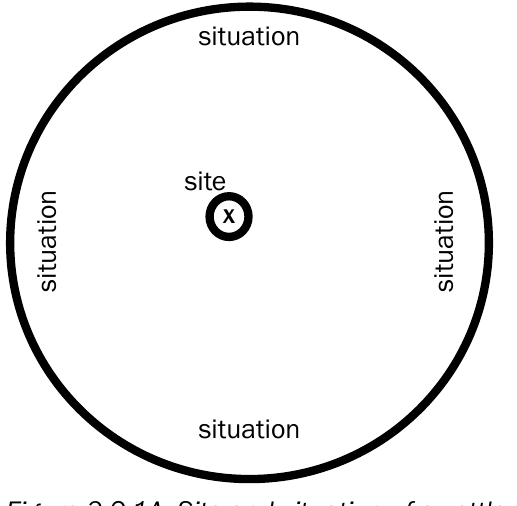
The location of rural settlements depends on two fundamental geographical concepts: site and situation. These factors work together to determine why settlements develop in specific places.
Important
Site refers to the exact piece of ground where a settlement is located. It involves the physical characteristics and features of the immediate area where buildings and activities take place.
Situation describes how a settlement relates to its surrounding environment and broader geographical context. It considers the settlement's position relative to other features in the landscape.
Site factors for rural settlements
When choosing locations for rural settlements, people historically considered several important site factors that provided essential resources for survival and economic activities.
Note
The following site factors were crucial for the survival and success of rural communities throughout history. Each factor provided specific resources or advantages that made settlement viable in particular locations.
Water availability represents the most critical site factor because human survival, livestock needs, and crop irrigation all depend on reliable water sources. Settlements often develop near rivers, springs, or areas with accessible groundwater.
Arable land provides fertile soil suitable for growing crops. Communities need access to land that can support agricultural production to ensure food security and economic sustainability.
Pastoral land offers grazing areas for livestock such as cattle, sheep, and goats. These areas might not be suitable for crop farming but provide essential grassland for animal husbandry.
Building materials must be locally available to construct homes, barns, and other necessary structures. Historically, communities relied on materials like stone, clay, timber, and thatch found in their immediate vicinity.
Fuel sources such as wood from forests provided energy for cooking, heating, and various industrial processes. Access to renewable fuel sources was crucial for daily survival and economic activities.
Situation factors for rural settlements
The situation of rural settlements considers their relationship to broader environmental and infrastructure features that affect their viability and connectivity.
Distance from flood lines ensures settlements remain safe from seasonal flooding while still maintaining access to water resources. Communities typically locate above flood-prone areas but close enough to benefit from fertile floodplain soils.
North-facing slopes in the Southern Hemisphere receive more direct sunlight, creating warmer microclimates that support better crop growth and more comfortable living conditions.
Thermal belt locations take advantage of temperature inversions where mid-slope areas remain warmer than valley floors or mountain tops. This positioning protects settlements from frost damage and creates more favourable growing conditions.
Road accessibility connects rural communities to markets, services, and other settlements. Proximity to transportation routes facilitates the movement of goods, people, and ideas between rural and urban areas.
Note
Modern rural settlements may place less emphasis on some traditional site and situation factors due to technological advances such as improved transportation, water pumping systems, and building materials. However, understanding these historical location principles remains important for geographical analysis and helps explain existing settlement patterns.
Remember!
Summary
Key Points to Remember:
- Rural settlements are unifunctional communities focused on primary economic activities like farming, fishing, forestry, and mining
- Settlement patterns can be either nucleated (clustered together) or dispersed (spread far apart), each with distinct advantages and disadvantages
- Site factors include the physical characteristics of the exact location: water, arable land, pastoral land, building materials, and fuel sources
- Situation factors consider the settlement's relationship to its surroundings: flood lines, slope orientation, thermal conditions, and transportation access
- Understanding both site and situation factors helps explain why rural settlements developed in specific locations and how they function within their environments