Structure of an Urban Area (Grade 12 NSC Matric Geography): Revision Notes
📚Revision Notes
Structure of an Urban Area
Understanding the structure of urban areas helps us analyse how cities are organised and why different activities locate in specific places. When studying urban areas, geographers focus on three main aspects: urban profiles, urban street patterns, and urban land use zones.
What is an urban profile?
An urban profile shows us what an urban area looks like when viewed from the side, similar to looking at someone's face in profile. This side view helps us understand the arrangement of different zones within a city and how building patterns change across the urban landscape.
Note
An urban profile is essentially a cross-sectional view of a city that reveals the spatial relationship between different urban zones and their physical characteristics.
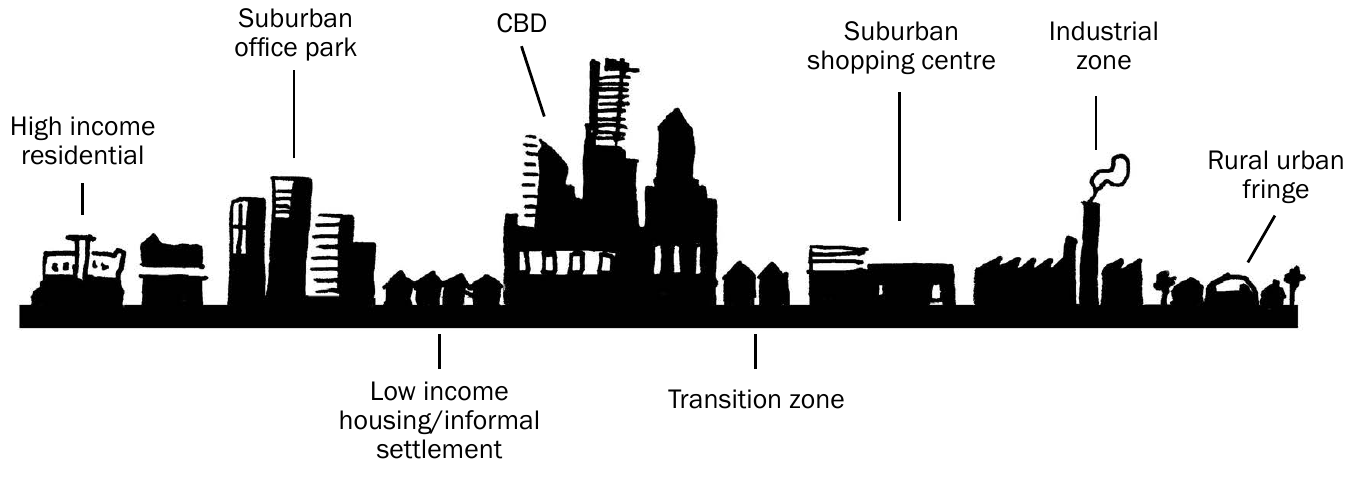
The urban profile reveals important patterns about how cities are structured, showing us the relationship between location, building height, population density, and land value.
Key patterns in urban profiles
Height and density patterns
When examining an urban profile, you'll notice clear patterns in building height and density:
From the city centre towards the outskirts:
- Building height decreases as you move further from the city centre
- Building density (how many buildings per area) also decreases
- This happens because land value decreases as you move away from the centre
From the outskirts towards the city centre:
- Building height increases as you approach the city centre
- Building density increases closer to the centre
- The closer to the centre, the more valuable the land becomes
Important
Critical Pattern to Remember: There is a direct relationship between distance from city centre and both building height and land value - as one increases, the other decreases, and vice versa.
Land value and its impact
Land value plays a crucial role in shaping urban structure and determines where different activities can afford to locate:
- City centre: Land value is extremely high because many people want to live or work there
- Away from centre: Land value decreases with distance from the city centre
- Maximum land use: In the city centre, people must make the best use of expensive land by building upwards
- Functional relocation: Due to high land costs, certain functions like factories and houses move to cheaper areas on the city's outskirts
Note
This economic principle of land value gradients explains why we see such dramatic differences in building types and land uses across different parts of a city.
Urban zones and their characteristics
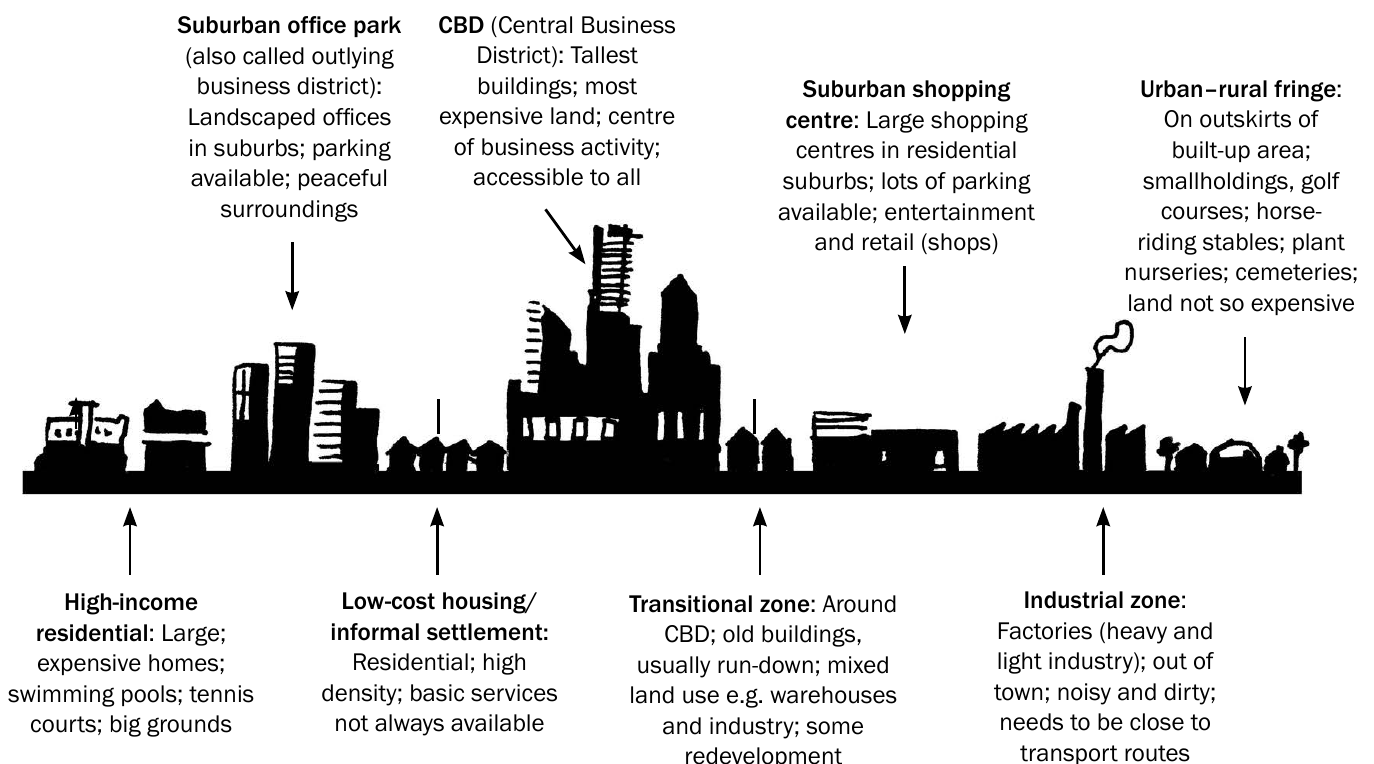
Each urban zone has distinct characteristics based on its location, function, and the economic principles governing land use:
Central Business District (CBD)
- Location: The heart of the city
- Buildings: Tallest buildings with the highest density
- Land cost: Most expensive land in the urban area
- Function: Centre of business activity, accessible to everyone
- Characteristics: Skyscrapers, office buildings, major retail stores
Note
The CBD represents the peak of urban intensity - it's where land values, building heights, and economic activity all reach their maximum levels within the urban area.
Suburban office park
- Location: Between residential areas and the CBD
- Function: Business district outside the main centre
- Features: Landscaped offices, modern business buildings
- Environment: Peaceful surroundings with parking available
High-income residential areas
- Location: Often on higher ground with good views
- Features: Large, expensive homes with big gardens
- Amenities: Swimming pools, tennis courts, well-maintained grounds
- Quality: High-quality housing with excellent infrastructure
Low-income housing and informal settlements
- Location: Often in less desirable areas
- Density: High population density
- Services: Basic services may not always be available
- Housing type: Smaller homes, informal structures, limited amenities
Suburban shopping centres
- Location: In residential suburbs
- Function: Large shopping centres serving local communities
- Features: Extensive parking areas
- Services: Entertainment and retail facilities for suburban residents
Industrial zones
- Location: Away from residential areas, often on city outskirts
- Function: Heavy and light industry, manufacturing
- Characteristics: Factories, warehouses, industrial facilities
- Requirements: Close to transport routes, often noisy and dirty operations
Note
Industrial zones locate on the periphery because they require large amounts of relatively cheap land and need to be separated from residential areas due to noise, pollution, and heavy vehicle traffic.
Urban-rural fringe
- Location: On the outskirts of the built-up area
- Land use: Mixed rural and urban activities
- Features: Smallholdings, golf courses, horse riding stables
- Cost: Land is less expensive than in the city centre
- Activities: Plant nurseries, cemeteries, recreational facilities
Understanding urban patterns
The structure of urban areas follows predictable patterns based on economic principles that govern how different activities compete for space:
- Land value gradient: Land becomes more expensive closer to the city centre
- Accessibility: Areas with better transport links command higher land values
- Competition for space: Different land uses compete for the best locations
- Economic sorting: Activities locate where they can afford the land and operate efficiently
Important
These economic forces create a predictable urban structure where activities sort themselves according to their ability to pay for land and their need for accessibility. This is why similar activities often cluster together in the same parts of the city.
These patterns help explain why we see tall buildings in city centres, why factories locate on the outskirts, and why different types of housing are found in different areas of the city.
Summary
Key Points to Remember:
- An urban profile is a side view of a city showing different zones and building patterns
- Building height and density are highest in the city centre and decrease towards the outskirts
- Land value follows the same pattern - highest in the centre, decreasing outwards
- Different urban zones have specific characteristics based on their function and location
- The CBD contains the tallest buildings and most expensive land due to high demand and accessibility