Growing Power of Trade Union Movement (Grade 12 NSC Matric History): Revision Notes
📚Revision Notes
Growing Power of Trade Union Movement
Black workers awaken to their collective strength
The year 1973 marked a crucial turning point in South African labour history when black workers began to rediscover their collective power. In Durban, over 60,000 black workers participated in 160 separate strikes, demanding better wages and improved working conditions. These strikes represented a spontaneous eruption of worker frustration caused by several factors: extremely low wages that failed to meet basic needs, the continuously rising cost of living that made survival increasingly difficult, and the persistent racism displayed by employers in their treatment of black workers.
The significance of these Durban strikes extended far beyond the immediate workplace grievances. They demonstrated that black workers possessed substantial economic power when they acted together, and this realisation would fundamentally reshape the landscape of resistance against apartheid. The strikes caught both the government and business leaders off guard, forcing them to acknowledge that some form of organised worker representation was necessary for maintaining industrial stability.
Example
The 1973 Durban Strikes: A Turning Point
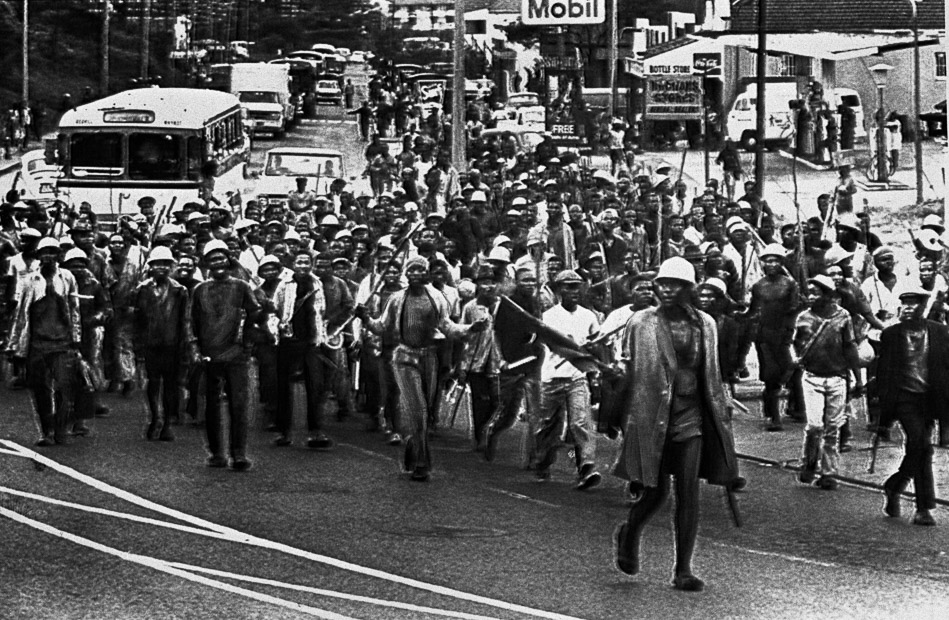
The Scale: Over 60,000 workers across 160 separate strikes The Causes:
- Extremely low wages insufficient for basic survival
- Rising cost of living making conditions worse
- Racist treatment by employers
The Impact: Demonstrated the collective economic power of black workers and forced the government to reconsider labour laws
Government response and unintended consequences
Recognising the need to manage this growing worker militancy, the apartheid government introduced new legislation that permitted black workers to establish trade unions. However, these unions had to register with the government and were restricted to focusing solely on workplace matters rather than broader political issues. The government's strategy was to channel worker discontent into controllable, apolitical organisations that would negotiate only on wages and working conditions.
This attempt at control, however, created unexpected opportunities for black workers to develop crucial organisational skills. While the reforms were designed to limit trade union activity, they inadvertently provided a legal framework within which workers could learn the art of independent organisation, negotiation, and collective action. These skills would prove invaluable as the trade union movement evolved beyond purely workplace concerns.
Important
Unintended Consequences of Government Strategy
The government's attempt to control worker militancy through restricted trade unions backfired. Instead of creating puppet organisations, they provided black workers with:
- Legal framework for organisation
- Opportunity to develop negotiation skills
- Platform for building collective strength
- Foundation for future political engagement
The formation of strong, independent trade unions was also supported by some white democratic student organisations and activities on black university campuses, where students were mobilising around Black Consciousness ideas. This cross-sector support helped establish unions that were genuinely representative of worker interests rather than government puppets.
Evolution towards political engagement
Initially, most newly formed trade unions concentrated primarily on traditional labour issues - negotiating better wages, improved working conditions, and basic worker rights for their members. They deliberately avoided political involvement, partly due to government restrictions and partly to establish their credibility as legitimate workplace representatives.
However, by 1984, the situation had fundamentally changed. The apartheid system's repression had reached new heights of brutality and ruthlessness, making it increasingly impossible for unions to remain politically neutral. Union members and leaders began to realise that workplace issues were inseparable from the broader political system that oppressed black South Africans. How could they secure fair wages and decent working conditions when the entire political system was designed to exploit black labour?
This realisation led to a significant shift in trade union strategy. Striking workers began calling for community-wide boycotts of products from companies that refused to meet their demands. When violent police repression occurred in townships and communities, workers demonstrated solidarity by staying away from work in protest. The state responded predictably, acting ruthlessly against union leaders they perceived as too 'political', with many facing detention or being served with banning orders that severely restricted their activities.
Note
The Shift from Economic to Political Focus
The transformation from workplace-only concerns to political engagement was not planned but inevitable. As unions grew stronger, they discovered that economic justice was impossible without political freedom. This led to creative tactics like consumer boycotts and solidarity strikes that linked workplace struggles to community resistance.
Formation of COSATU
The growing political awareness and confidence of trade unions culminated in 1985 with the formation of the Congress of South African Trade Unions (COSATU). This organisation represented a watershed moment in South African labour history, as it brought together the economic power of organised workers with the broader popular struggle against apartheid.
COSATU formally affiliated itself with the United Democratic Front (UDF) and began coordinating its activities with the wider mass democratic movement. This alliance transformed trade unions from workplace-focused organisations into one of the most effective and powerful forms of resistance against apartheid. The economic leverage that workers possessed through their labour became a crucial weapon in the anti-apartheid arsenal.
The National Union of Mineworkers (NUM), which was re-established in 1982, exemplified this new approach. While most independent union members were urban residents, NUM successfully organised over 100,000 members, many of whom were migrant workers living in the so-called 'homelands'. This demonstrated the trade union movement's ability to organise across the artificial boundaries created by apartheid.
Note
COSATU's Strategic Alliance
COSATU's affiliation with the UDF was crucial because it:
- Combined economic power with political strategy
- Linked workplace struggles to broader community resistance
- Created a unified mass democratic movement
- Gave workers a voice in the liberation struggle beyond their immediate workplace concerns
COSATU's major campaigns and impact
COSATU's influence extended far beyond South Africa's borders through its international connections and campaigns. The organisation successfully mobilised the global trade union movement to support calls for companies and governments to disinvest from South Africa. This international pressure campaign became one of the most effective tools in isolating the apartheid regime economically and politically.
Domestically, COSATU actively supported UDF campaigns that called for the release of Nelson Mandela and other political prisoners, as well as the unbanning of liberation movements like the ANC and South African Communist Party. The organisation demonstrated its massive mobilising power in May 1986 when it organised what became the largest strike in South African history. An extraordinary 1.5 million workers stayed away from work for three consecutive days, demanding that the government recognise May Day (International Worker's Day) as a public holiday.
Example
The Historic May 1986 Strike
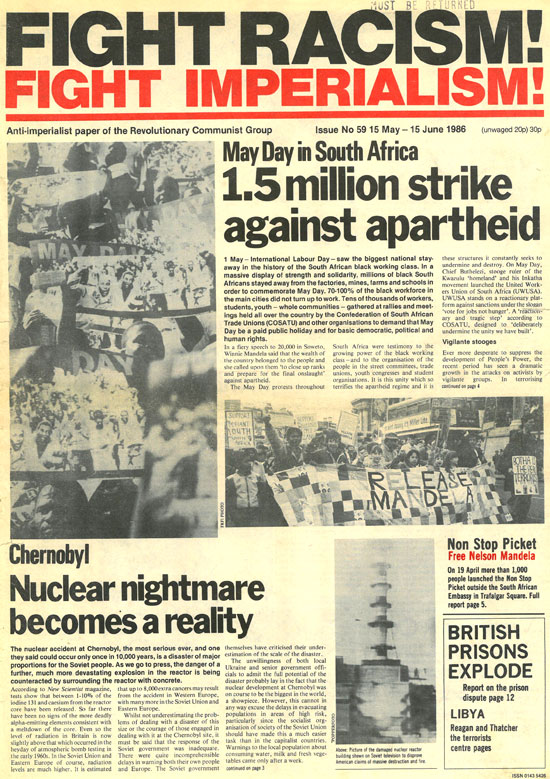
The Scale: 1.5 million workers participated for three consecutive days The Demand: Recognition of May Day as a public holiday The Significance:
- Largest strike in South African history
- Demonstrated COSATU's massive organisational capacity
- Connected South African workers to international labour movement
- Proved economic power could be used for political demands
This massive strike served multiple purposes: it demonstrated the enormous economic power that organised black workers possessed, showed international solidarity with workers worldwide, and proved that COSATU could coordinate resistance on an unprecedented scale. The demand for May Day recognition was particularly symbolic, as it connected South African workers with the global labour movement and asserted their right to commemorate their struggles and achievements.
State repression and continued resistance
The apartheid government's response to COSATU's growing influence was swift and harsh. Under the state of emergency, authorities detained key union leaders including COSATU President Elijah Barayi and Secretary-General Jay Naidoo, along with approximately 200 other union officials. The government hoped that removing leadership would cripple the organisation and reduce its effectiveness in coordinating resistance activities.
However, this strategy of repression ultimately failed to break the trade union movement's momentum. COSATU had been built on strong organisational foundations with broad-based membership support, making it resilient against leadership targeting. The organisation continued to play a major and influential role in the mass democratic struggle throughout the remaining years of apartheid and beyond into the 1990s, proving that the power of organised workers could not be easily suppressed through detention and intimidation.
Important
Why State Repression Failed
The government's strategy of detaining union leaders failed because:
- COSATU was built on strong grassroots foundations
- Broad-based membership support continued without top leadership
- Organisational structures were designed to survive repression
- The movement had become too large and widespread to control through arrests alone
The trade union movement's evolution from workplace-focused organisations to major political players represented one of the most significant developments in the anti-apartheid struggle during the 1980s, demonstrating how economic power could be effectively channelled into political resistance.
Summary
Key Points to Remember:
- 1973 Durban strikes marked the beginning of organised black worker resistance, with 60,000 workers participating in 160 strikes for better conditions
- Trade unions evolved from focusing only on workplace issues to engaging in political resistance by 1984 due to increasing apartheid repression
- COSATU formed in 1985 unified the trade union movement and allied with the UDF, becoming one of the most effective forms of resistance organisation
- The May 1986 strike involved 1.5 million workers for three days, representing the largest industrial action in South African history
- Despite state of emergency detentions of leaders like Elijah Barayi and Jay Naidoo, COSATU continued its crucial role in the mass democratic struggle into the 1990s