The United Democratic Front (Grade 12 NSC Matric History): Revision Notes
📚Revision Notes
The United Democratic Front
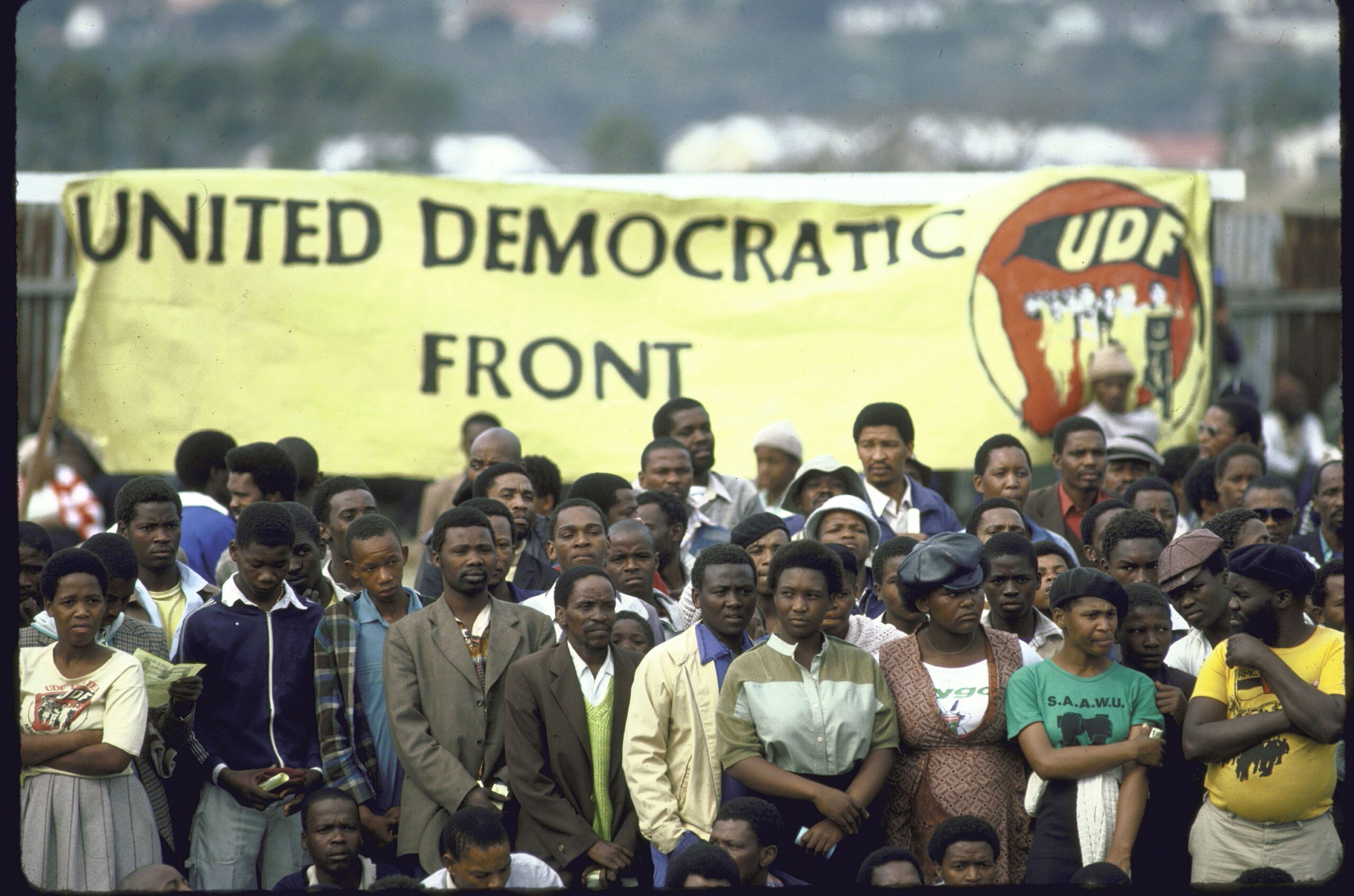
Formation and aims of the UDF
The United Democratic Front (UDF) was established in August 1983 when more than 600 different organisations came together at Mitchell's Plain in Cape Town. This historic gathering brought together youth groups, student organisations, churches, civic associations, women's groups, and trade unions under one umbrella movement.
Key characteristics of the UDF
The UDF was designed as a "front" rather than a traditional political party. Its main purpose was to work towards establishing a non-racial democratic government in South Africa. This approach offered several important advantages:
Note
Strategic Advantages of the Front Structure:
- It could operate openly whilst the ANC remained banned and underground
- It united existing community organisations into a broad, powerful movement for democracy
- It focused on bringing together all racial groups committed to democratic change
New forms of organisation in the 1980s
The repressive climate of the early 1980s led to the emergence of innovative organisational structures that were harder for the apartheid state to suppress than traditional national organisations.
Types of organisations that joined the UDF
Youth and student organisations
The Congress of South African Students (COSAS) was formed in 1979 and later affiliated to the UDF in 1984. Unlike earlier student groups, COSAS deliberately created connections with trade unions and civic associations. This networking approach made it much stronger and more resilient.
Note
Elected Civic Associations
These emerged when government services broke down in many communities. They organised parents and township residents around local issues such as housing, rent increases, municipal services, and forced removals. They provided alternative leadership structures at grassroots level.
Note
Special Interest and Service Organisations
These groups shared a commitment to creating a non-racial democratic society that protected human rights. They included organisations focused on women's rights, education, children's welfare, monitoring government repression, environmental protection, legal aid, and opposing military conscription.
Important
Strategic Impact of Decentralised Organisation
This organisational strategy meant that the apartheid state could not simply destroy the resistance movement by arresting a few national leaders. Instead, they faced hundreds of democratic community-based organisations spread across the country.
Methods of resistance used by the UDF
Boycotts as a primary weapon
The UDF developed boycotts as their main form of protest action. These campaigns linked local community issues with broader national political goals.
Example
How Boycotts Worked:
Step 1: Communities organised consumer boycotts of specific products
Step 2: These boycotts supported workers who were on strike at factories producing those goods
Step 3: The campaigns spread rapidly across UDF affiliate organisations throughout the country
Results of boycott campaigns:
- They exposed the tri-cameral parliamentary system as a sham by demonstrating real grassroots opposition
- They seriously disrupted black education when youth organisations boycotted schools to protest against inferior Bantu education
- As UDF member organisations gained confidence, they began adopting ANC policy documents, slogans, and symbols of struggle
- The Freedom Charter was adopted by hundreds of organisations and became the foundation for envisioning a new South Africa
Moving towards insurrection
By 1984, a new and more militant language emerged among UDF affiliates. They spoke about escalating all forms of resistance and making South Africa "ungovernable".
Example
Key Events in the Escalation:
September 1984: Police opened fire on a rent protest march in the Vaal Triangle township of Sebokeng, causing the Vaal townships to erupt in violence
State Response: The government declared a state of emergency over all unrest-affected areas, with troops occupying townships
January 1985: ANC president Oliver Tambo echoed the call to make South Africa ungovernable in his New Year message
June 1986: The emergency was extended across the entire country to prevent planned 'Soweto Day' celebrations - 25,000 activists were detained
1987: The UDF and many other organisations were banned completely
Important
Under emergency laws, police and army forces gained extraordinary powers to deal with the crisis without any accountability to courts or parliament.
Opposition to the UDF
Inkatha resistance
Inkatha was a Zulu cultural movement led by Chief Mangosuthu Buthelezi that became the most significant non-UDF organisation with genuine grassroots support.
Note
Inkatha's Position and Methods
- Most of its support came from rural KwaZulu 'homeland' areas
- In the 1980s, it transformed into the Inkatha Freedom Party (IFP), positioning itself as an alternative to both the UDF and ANC
- Inkatha used violence to control communities, leading to civil war conditions in KwaZulu
- This represented a major challenge to the UDF's goal of united resistance
Black consciousness opposition
Some black organisations remained committed to Black Consciousness (BC) philosophy and opposed the UDF's non-racial approach:
Note
Black Consciousness Opposition Groups
- Whilst many BC leaders joined the UDF, an important minority remained committed to BC ideology and radical socialism
- They formed the National Forum and criticised the UDF's non-racialism and commitment to the Freedom Charter
- The Pan Africanist Congress (PAC) aligned itself with this group
- Organisations like AZAPO (Azanian People's Organisation) remained narrowly committed to BC principles rather than joining the broader UDF coalition
Expansion of the movement
The Black Sash
The UDF's commitment to non-racialism led them to welcome white organisations dedicated to democracy and human rights.
The Black Sash became an important affiliate. Originally formed in 1955 by Sheena Duncan and other white women to protest apartheid laws, during the 1980s, Black Sash volunteers established legal advice offices throughout the country. They publicised acts of police violence and provided crucial support to detainees, political prisoners, and their families.
End Conscription Campaign (ECC)
The End Conscription Campaign was launched in 1983 by a group of conscientious objectors who encouraged young white men to refuse military service in the South African Defence Force (SADF).
Note
ECC Methods and Impact
- The ECC argued that the state was using the SADF to suppress opposition to apartheid rather than defend the country
- It affiliated to the UDF and worked to build an anti-war culture among white South Africans
- They used creative methods like wall murals, T-shirts, posters, and musical concerts and festivals to spread their message
The Mass Democratic Movement
After the UDF was banned in 1987, the resistance movement adapted by forming the Mass Democratic Movement (MDM). Jay Naidoo, General Secretary of COSATU, described the MDM's characteristics in 1989:
Note
Key Features of the MDM:
- It was a movement rather than an organisation, bringing together mass-based groups including youth, workers, students, women, and civic associations
- It represented the strategic alliance between COSATU and the UDF
- It remained committed to non-racialism, democratic practices, and grassroots accountability
- It recognised African leadership whilst supporting working-class leadership
- It acknowledged the ANC's central role in finding solutions for the country
- It was united by a programme of mass action aimed at destroying apartheid and rebuilding South Africa according to Freedom Charter principles
The MDM's formation demonstrated the resilience and adaptability of the democratic movement - even when specific organisations were banned, the broader struggle for democracy continued through new structures.
Impact and significance
The UDF and its successor, the Mass Democratic Movement, succeeded in making South Africa "ungovernable" by the late 1980s. Through their combination of grassroots organisation, strategic boycotts, and sustained resistance, they created a crisis that the apartheid government could not resolve through repression alone.
Summary
Key Points to Remember:
- The UDF was formed in August 1983 at Mitchell's Plain, Cape Town, bringing together over 600 organisations under a non-racial democratic platform
- It operated as a "front" rather than a political party, allowing it to function openly while the ANC remained banned
- The UDF used boycotts as their primary weapon, linking local community issues with national political campaigns and successfully disrupting apartheid governance
- Opposition came from Inkatha (representing Zulu nationalism) and some Black Consciousness organisations that rejected non-racial approaches
- When banned in 1987, the movement continued as the Mass Democratic Movement, demonstrating the resilience of grassroots democratic organisation in making South Africa ungovernable