Case Study 1: The US Civil Rights Movement (Grade 12 NSC Matric History): Revision Notes
📚Revision Notes
Civil Disobedience, Campaigns, and Marches
Understanding civil disobedience as a strategy
Civil disobedience became the cornerstone of the American Civil Rights Movement, providing a powerful yet peaceful method to challenge unjust segregation laws. This approach involved deliberately breaking discriminatory laws whilst accepting the legal consequences, demonstrating moral opposition to injustice.
Note
The strategy of civil disobedience was revolutionary because it combined moral authority with practical resistance. By willingly accepting legal consequences for breaking unjust laws, activists demonstrated both their respect for the rule of law and their commitment to justice.
Gandhi's influence on Martin Luther King Jr.
Martin Luther King Jr. drew profound inspiration from Mohandas Gandhi's philosophy of passive resistance. Gandhi had successfully used non-violent methods as a political tool against British colonial rule in India. King recognised how Gandhi's approach combined Christian ethics of love with strategic social change.
King became convinced that non-violence represented the only viable path for African-Americans to achieve freedom in the United States. This philosophy shaped every aspect of his leadership, influencing all his speeches and actions throughout the Civil Rights Movement. The concept of passive resistance meant opposing injustice without using violence, even when faced with violent opposition.
Forms of protest through civil disobedience
The Civil Rights Movement employed four main types of non-violent protest:
- Bus boycotts - Refusing to use segregated public transport
- Freedom rides - Integrated groups travelling together on public transport
- Sit-ins - Occupying "whites-only" spaces until served or arrested
- Peaceful marches - Mass demonstrations for civil rights
Important
These non-violent actions typically provoked violent responses from white supremacists. However, civil rights activists were specifically trained not to retaliate, even though they were often unfairly blamed for inciting violence. This deliberate non-retaliation was crucial to maintaining moral authority and public sympathy.
Key early campaigns and events
Montgomery bus boycotts (1955-1956)
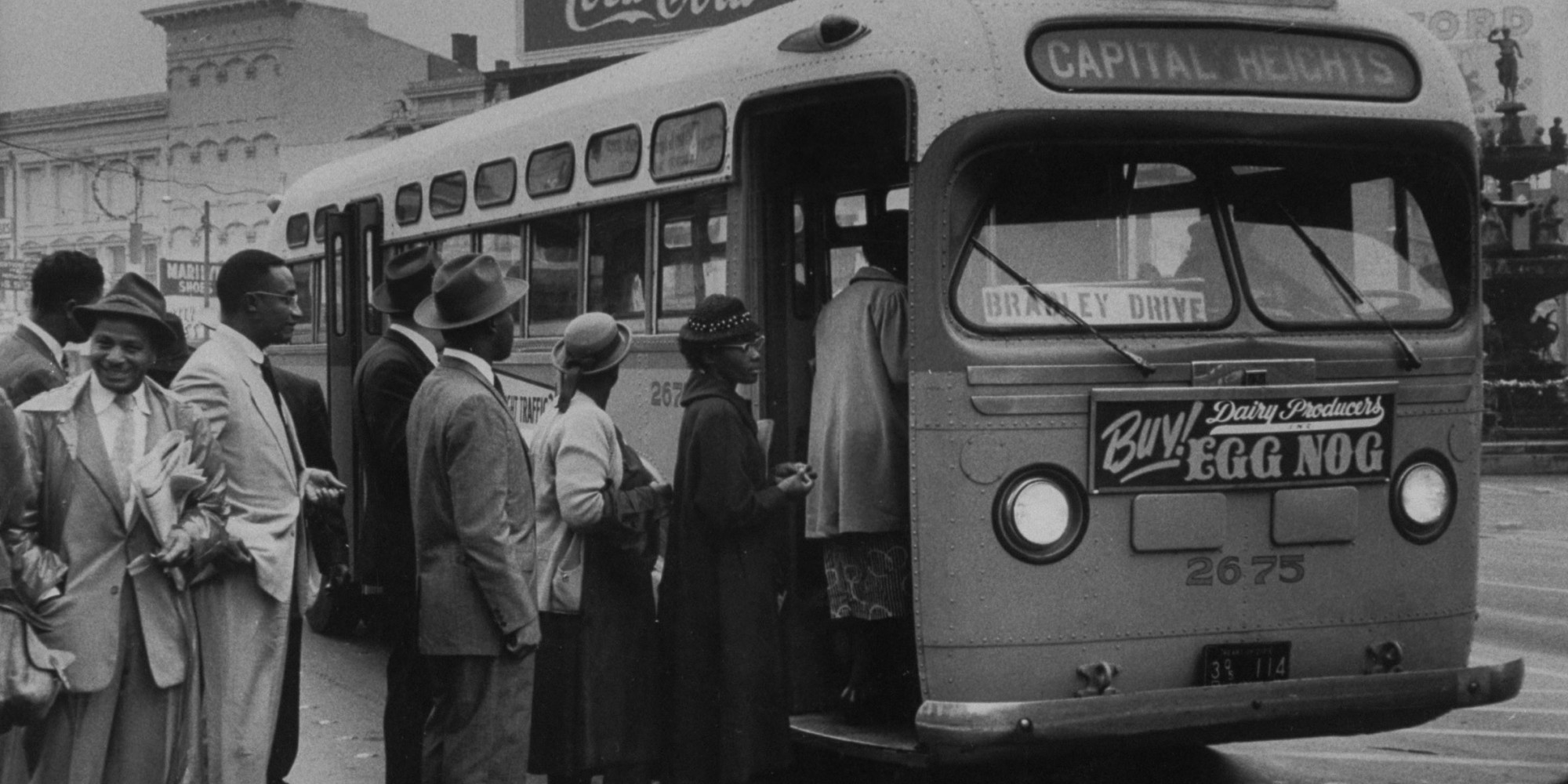
Montgomery, Alabama became a crucial battleground due to its strong segregation laws during the 1950s. The campaign began when Rosa Parks, Secretary to the NAACP, was arrested on 1st December 1955 for refusing to give up her bus seat to a white passenger.
Following Parks' arrest, the NAACP and King organised a comprehensive boycott of Montgomery's city buses. This boycott proved remarkably effective, lasting for 381 days and creating severe financial pressure on the public transport system. The campaign finally succeeded on 20th December 1956 when the Supreme Court ruled that segregation on public buses was unconstitutional.
Note
The Montgomery Bus Boycott demonstrated the economic power of the African-American community. By refusing to use public transport, they showed how segregation was not only morally wrong but also economically unsustainable for cities dependent on African-American customers.
Greensboro sit-in (1960)
King's writings and philosophy inspired four students in Greensboro, North Carolina to take direct action. On 1st February 1960, these brave students sat at a "whites only" lunch counter in Woolworths and ordered coffee. When refused service, they remained in their seats until closing time.
This simple act of defiance sparked a movement that spread rapidly. Each day, more students joined the protest, and the sit-in movement expanded to other restaurants throughout the South. The protests continued for over a year, with businesses ultimately losing more than a third of their income. By summer 1961, Greensboro businesses decided to desegregate.

The success of these sit-ins also led to the establishment of the Student Nonviolent Coordinating Committee (SNCC), which became vital in organising future civil rights activities.
Freedom rides (1961)
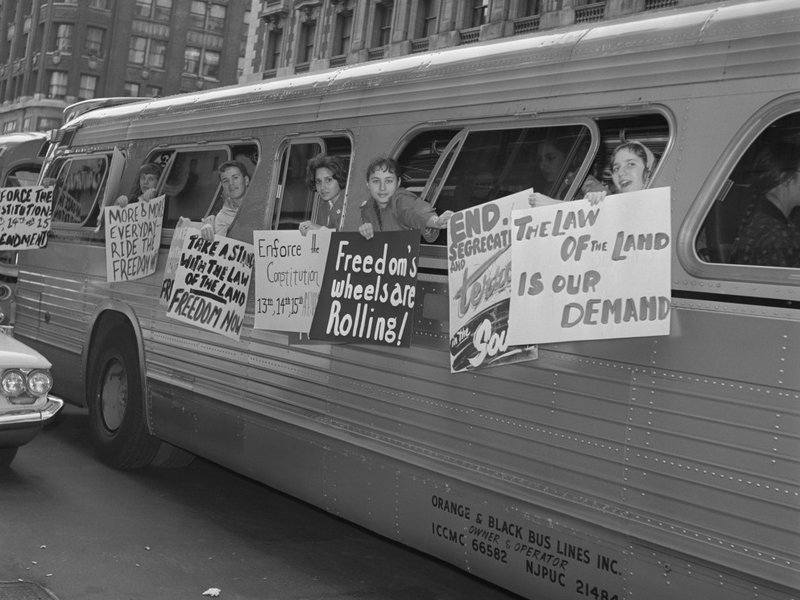
The Congress of Racial Equality (CORE) and SNCC organised the Freedom Rides to test whether bus desegregation laws were being properly enforced. In May 1961, mixed groups of African-American and white volunteers travelled together on public buses from the North to the South.
Important
When the Freedom Riders reached Alabama, they encountered extreme violence. White mobs burned one of their buses whilst police stood by and watched. This deliberate inaction by law enforcement highlighted the complicity of local authorities in maintaining segregation through intimidation.
Despite many Freedom Riders being imprisoned, the violent treatment did not discourage them. Over the following six months, more than a thousand people joined the campaign.
The international media coverage of this brutality embarrassed the Kennedy administration. As a result, President Kennedy intervened, and the Interstate Commerce Commission banned segregation on all interstate transport. Kennedy also delivered a Civil Rights address to the nation on 11th June 1963, calling on all Americans to recognise the movement as a moral cause deserving universal support.
Major campaigns and marches
The Birmingham campaign (1963)
Birmingham became the centre of civil rights activity in 1963, with numerous marches, sit-ins and boycotts organised throughout the city. The local authorities, led by Commander Eugene Connor, responded with extreme police violence, using fire hoses, police dogs and prison sentences to disperse peaceful marchers.
Example
The Children's Crusade: A Turning Point

On 2nd May, one thousand children participated in the "Children's Crusade". The strategy was revolutionary - using children as protesters to highlight the injustice of segregation.
What happened:
- 600 children were arrested and imprisoned
- Fire hoses and police dogs were used against young marchers
- The day became known as "Double-D day"
- International media broadcast these disturbing images worldwide
The impact: These shocking images of violence against children generated widespread sympathy for the movement and international condemnation of segregation.
On 10th May, it was announced that segregation would end in Birmingham. However, segregationists retaliated with terrible violence, bombing King's brother's home, bombing a 16th Street Baptist Church, and murdering four African-American girls. Despite this tragic loss of life, the Birmingham Campaign succeeded as a mass movement demanding fundamental economic and social change, and helped spread the movement to the North.
The march to Lincoln Memorial (1963)
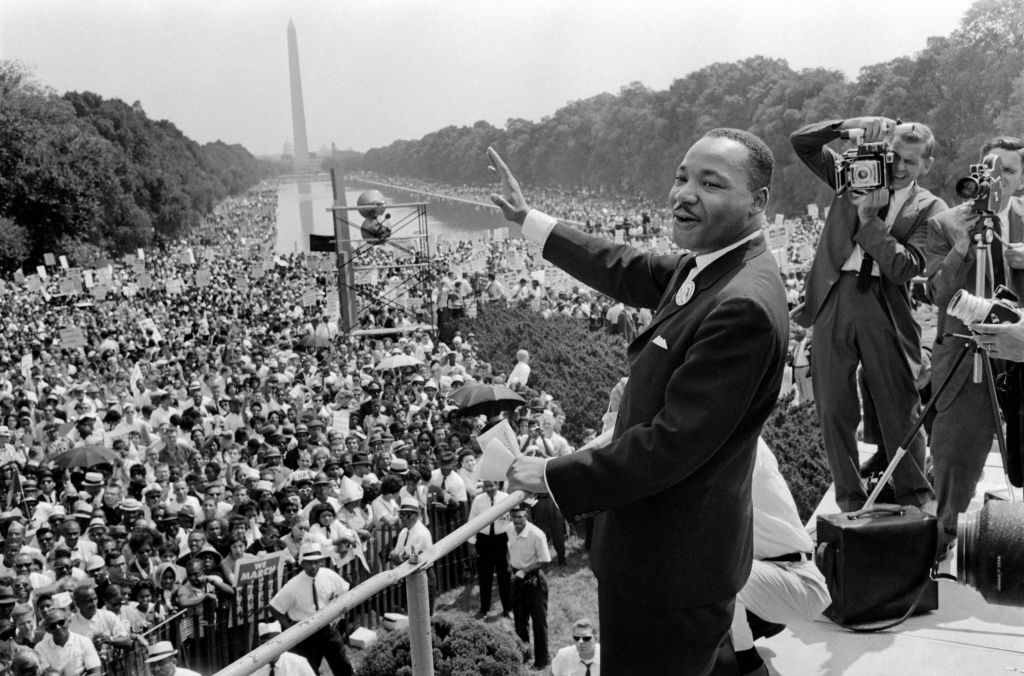
The March to Lincoln Memorial in August 1963 became the largest political gathering in US history. This massive demonstration had six clear goals: civil rights legislation, federal works programmes, voting rights, integrated education, better housing, and improved employment opportunities.
Between 250,000 and 400,000 people joined the march, where King delivered his famous "I Have a Dream" speech. Whilst many contemporaries viewed the march as a positive development for the Civil Rights Movement, others criticised it as a "sanitised" middle-class version of the more radical Black Power Movement.
Freedom summer (1964)
The tragic assassination of President Kennedy on 22nd November 1963 marked a turning point. On 2nd July 1964, Congress accepted the Civil Rights Act, which banned segregation and discrimination throughout the United States.
During the "Freedom Summer" of 1964, thousands of volunteers launched a voter registration drive across the South. Civil rights workers faced serious threats and harassment, with three young activists being murdered. However, Freedom Summer attracted significant national attention, ultimately leading to the 1965 Voting Rights Act.
The Selma-Montgomery marches (1965)

In early 1965, Selma, Alabama became the focus for voter registration and demonstrations. On 18th February, white segregationists attacked a group of demonstrators and killed a young African-American protester. King and the movement responded by planning a march from Selma to Montgomery.
On Sunday 7th March, approximately 600 people began the march but were violently attacked with whips, batons and tear gas. Television coverage of this violence drew even more demonstrators to Selma. On 9th March, the marchers encountered more resistance, and James Reeb, a young white minister, was beaten to death.
President Johnson backed the march and pledged his support, even sending US army troops to protect the marchers. They finally reached Montgomery on 25th March, achieving their goal of highlighting voting rights issues and securing federal protection for civil rights activists.
Summary
Key Points to Remember:
- Gandhi's philosophy of non-violence profoundly shaped MLK's approach - passive resistance became the foundation of the entire Civil Rights Movement
- Four main forms of civil disobedience were used: bus boycotts, sit-ins, freedom rides, and peaceful marches - all deliberately non-violent
- The Montgomery Bus Boycott (1955-1956) lasted 381 days and ended with the Supreme Court ruling bus segregation unconstitutional
- Television coverage was crucial - images of violence against peaceful protesters, especially children, generated international sympathy and political pressure
- Major legislative victories followed key campaigns - the 1964 Civil Rights Act and 1965 Voting Rights Act resulted from sustained civil disobedience campaigns