School Desegregation: Little Rock, Arkansas (Grade 12 NSC Matric History): Revision Notes
📚Revision Notes
School Desegregation: Little Rock, Arkansas

Background to the crisis
The fight for school integration became a central battleground in the American civil rights movement during the 1950s. The legal foundation for this struggle was established through a series of court cases that challenged the long-standing principle of "separate but equal" education.
Note
The concept of "separate but equal" had been the legal justification for racial segregation since the 1896 Plessy v. Ferguson Supreme Court decision, which allowed for segregated facilities as long as they were supposedly equal in quality.
In 1952, five important legal challenges were brought together in what became known as Brown versus Board of Education. These cases directly attacked the constitutional basis of racial segregation in American schools. The legal victory came in May 1954 when the Supreme Court made a landmark ruling that racial segregation in schools was unconstitutional, effectively overturning decades of legal discrimination.
Important
The Brown v. Board decision didn't automatically integrate schools - it merely declared segregation unconstitutional. The actual process of integration would prove to be a long and difficult struggle, often requiring federal intervention to enforce.
The Little Rock Nine
Initial selection and preparation
Following the Supreme Court's decision, the process of school integration began across the American South. In Little Rock, Arkansas, local civil rights organisers identified 17 African-American students who would be selected to integrate the all-white Central High School. This represented a carefully planned strategy to break down the barriers of educational segregation.
However, the reality proved more challenging than expected. Due to intense pressure and threats from the white community, some parents became frightened about their children's safety and decided to withdraw them from the programme. This reduced the number from 17 to just 9 students, who would later become known as the Little Rock Nine.
The crisis unfolds
Day one: Governor's intervention
The situation escalated dramatically on the day before school was due to begin. The Governor of Arkansas made the controversial decision to call in the National Guard to surround Central High School. He publicly stated that he feared attacks from white supremacists, but his real intention was to prevent the African-American students from entering the school. As a direct result of this military intervention, none of the nine students attended school on the first day.
NAACP organises response
Daisy Bates, a prominent member of the NAACP (National Association for the Advancement of Coloured People), took immediate action to support the students. She organised a meeting at her house where all nine students would gather and then walk to school together as a group. This strategy was designed to provide mutual support and ensure their safety through solidarity.
Elizabeth Eckford's ordeal
Example
Elizabeth Eckford's Brave Stand
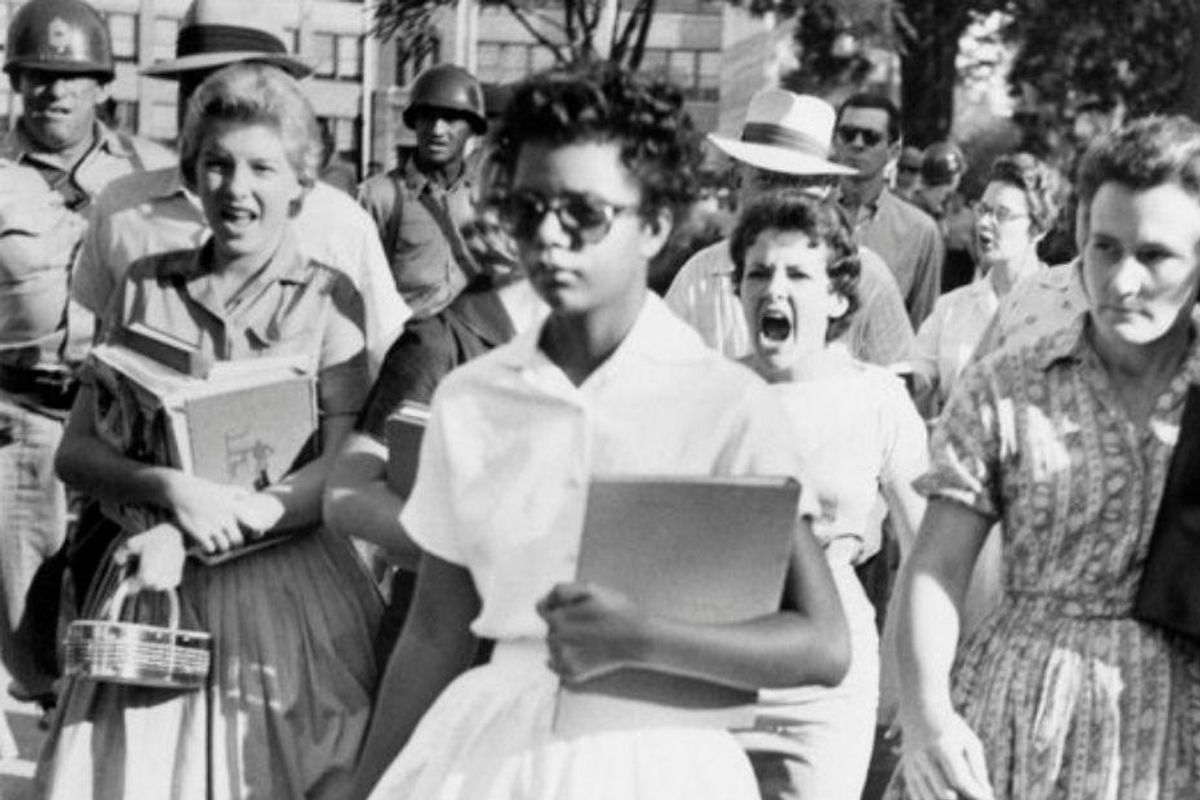
Unfortunately, one student, Elizabeth Eckford, did not receive the message about the group meeting. She arrived at Central High School alone and was immediately surrounded by an angry white mob.
The images of this 15-year-old girl walking through screaming crowds while maintaining her dignity became one of the most iconic photographs of the civil rights movement. Her courage in the face of such intimidation highlighted both the bravery of the students and the ugliness of racial hatred.
Federal intervention
Seventeen days of exclusion
For the next 17 days, the National Guard continued to prevent the Little Rock Nine from entering Central High School. This created a constitutional crisis as state authorities were directly defying federal law and Supreme Court rulings.
NAACP legal victory
The NAACP lawyers successfully challenged the Governor's actions in court. They won a legal case that forced the Governor to withdraw the National Guard and allow the students to enter the school. However, this legal victory created new problems rather than solving the crisis.
Escalating violence
When the National Guard was removed, it was replaced by more than a thousand angry white protesters who surrounded the school. The students managed to enter the building through a side door, but the situation outside became increasingly violent and dangerous. Fearing that the violence would escalate further and potentially result in serious injury or death, the students were quickly rushed home for their safety.
Important
This moment demonstrated a crucial lesson: legal victories alone were insufficient to guarantee civil rights. Without proper enforcement and protection, court decisions could be rendered meaningless by mob violence and local resistance.
President Eisenhower's response
The crisis reached the highest levels of American government when President Eisenhower was asked to intervene. He addressed the entire American nation, making it clear that mob rule would not be tolerated in the United States. This was a significant moment as it demonstrated federal commitment to enforcing civil rights law.
To protect the Little Rock Nine, the National Guard was placed under federal control and tasked with ensuring the students' safety. The students were protected by federal troops for the entire duration of the school year, making their education possible but highlighting the extreme measures needed to enforce basic civil rights.
Ongoing challenges and resistance
Continued harassment
Even with federal protection, the students faced daily harassment and intimidation throughout their school experience. The psychological and physical toll of constant threats created an environment where simply attending school became an act of extraordinary courage.
Example
Melba Patillo's Experience
The experience of Melba Patillo, one of the Nine, illustrates the extreme nature of this persecution. Despite federal military protection, she was stabbed and had acid sprayed in her eyes by fellow students.
This demonstrates that even with military protection, the students endured constant threats to their physical safety and had to navigate a hostile environment every single day.
School closures
Rather than accept integration, the Arkansas Governor, with support from much of the white population, chose an extreme response. Before schools opened in 1958, all schools in Little Rock were closed rather than proceeding with desegregation. This meant that all students, both black and white, were denied education rather than allowing integrated schooling.
Supreme Court forces reopening
The school closure strategy was challenged in court, and in June 1959, the Supreme Court ruled that the school board must reopen the schools and continue the process of desegregation. This demonstrated that the federal government would not allow local authorities to simply avoid their constitutional obligations.
Gradual progress
When schools reopened in August 1959, there were still significant protests. 250 protesters marched to Central High, but this time the police responded more effectively, arresting 21 people. This showed that local law enforcement was beginning to take federal civil rights law more seriously.
Long-term impact
The complete integration of Little Rock's public schools was a gradual process that required sustained effort and continued federal oversight. The timeline reveals the gap between legal mandates and social change.
Note
It's important to understand that the Little Rock crisis was not an isolated incident. Similar confrontations occurred across the South as communities grappled with the implications of the Brown v. Board decision. The federal government's response in Little Rock set important precedents for future civil rights enforcement.
It was not until 1972 that all grades in the Little Rock public schools were fully integrated. This timeline demonstrates that the legal victory in Brown versus Board of Education was just the beginning of a long struggle to achieve actual educational equality.
The Little Rock crisis became a powerful symbol of both the resistance to civil rights progress and the determination of African-American families to secure equal educational opportunities for their children. The courage of the Little Rock Nine inspired civil rights activists across the nation and demonstrated the federal government's willingness to enforce constitutional rights against local opposition.
Summary
Key Points to Remember:
- Brown versus Board of Education (1954) established that school segregation was unconstitutional, providing the legal foundation for integration efforts
- The Little Rock Nine were brave students who faced extreme danger to integrate Central High School in Arkansas
- State authorities initially defied federal law by using the National Guard to prevent integration, creating a constitutional crisis
- Federal intervention by President Eisenhower was necessary to enforce civil rights law and protect the students
- Full school integration took nearly two decades to achieve, showing that legal victories required sustained effort to implement in practice