How Has the Struggle Against Apartheid Been Remembered? (Grade 12 NSC Matric History): Revision Notes
📚Revision Notes
How Has the Struggle Against Apartheid Been Remembered?
The challenge of remembering the liberation struggle
After apartheid ended in 1994, South Africa faced a significant challenge in deciding how to remember and commemorate the struggle for liberation. This was not simply about preserving history, but about creating a memory that would promote reconciliation and help build a unified nation.
The process of remembering the past became deeply connected to the goal of bringing different communities together and healing the divisions created by apartheid. However, this goal created tensions about whose stories would be told and how they would be presented.
Note
The challenge of remembering apartheid was particularly complex because it involved balancing the need to acknowledge past injustices while promoting unity among previously divided communities. This delicate balance continues to influence how South Africa commemorates its liberation struggle today.
Understanding monuments and memorials as selective storytellers
When studying how South Africa has remembered the struggle against apartheid, it's crucial to understand a key concept: monuments and memorials act as a lens on the past and cannot tell the complete story. This means that one side or perspective often dominates as the perceived 'truth', whilst other viewpoints may be excluded or minimised.
Critical questions for analysing monuments
When examining any monument or memorial, historians and students should ask four essential questions:
Note
Essential Questions for Monument Analysis:
- What part of the story is being told? - Which events or experiences are highlighted?
- Whose story is being told? - Which groups or individuals are being commemorated?
- Whose point of view and values are reflected? - What perspective shapes the narrative?
- What part of the story has been left out? - Which voices or experiences are missing?
These questions help us understand that memorialisation is always a political process that involves making choices about how to interpret history and experiences.
Heritage, monuments and nation building
South Africa has constructed both national and local monuments to remember the struggle against apartheid whilst attempting to promote reconciliation and nation building. These efforts represent different approaches to commemorating the past and addressing the diverse experiences of South African communities.
National monuments: Freedom Park
Freedom Park serves as South Africa's most important national monument commemorating past conflicts and the liberation struggle. Located near Pretoria, this monument was constructed after the end of apartheid and officially opened to the public in December 2007.

Purpose and symbolism
Freedom Park expresses South Africa's history and the values of human dignity, rights and freedom through carefully chosen symbolic elements that guide visitors through the nation's historical journey. The monument aims to honour those who died in various conflicts whilst promoting national unity and reconciliation.
The Wall of Names
One of Freedom Park's most significant features is The Wall of Names, which commemorates those who died during various conflicts throughout South African history. This includes casualties from pre-colonial wars, slavery, frontier wars, the South African War, both World Wars, and the struggle for liberation.
However, the Wall of Names has generated considerable controversy due to decisions about whose names to include or exclude.
The Wall of Names controversy: exclusion and inclusion debates
Important
A Controversial Decision with Lasting Impact
The creators of Freedom Park made a controversial decision to omit the names of white soldiers who died during the Border War, as these soldiers were fighting on behalf of the apartheid government. This decision aimed to avoid commemorating those who defended the apartheid system.
This exclusion created significant problems and illustrated the challenges of memorialisation in post-apartheid South Africa:
- Many people viewed this as a one-sided, subjective account of history
- White South Africans felt hurt that their sacrifices and service as conscripted soldiers were not acknowledged
- Many white men believed their military service, even if compulsory, deserved recognition
Alternative commemorations
The controversy highlighted how memorialisation remains a political process. A separate wall commemorating 2,000 SADF (South African Defence Force) soldiers was erected near a 1979 memorial statue at Fort Klapperkop, close to Freedom Park. However, this site has not received adequate acknowledgement in post-1994 South Africa, demonstrating ongoing tensions about how to remember different aspects of the past.
Local monuments: the Thokoza Monument
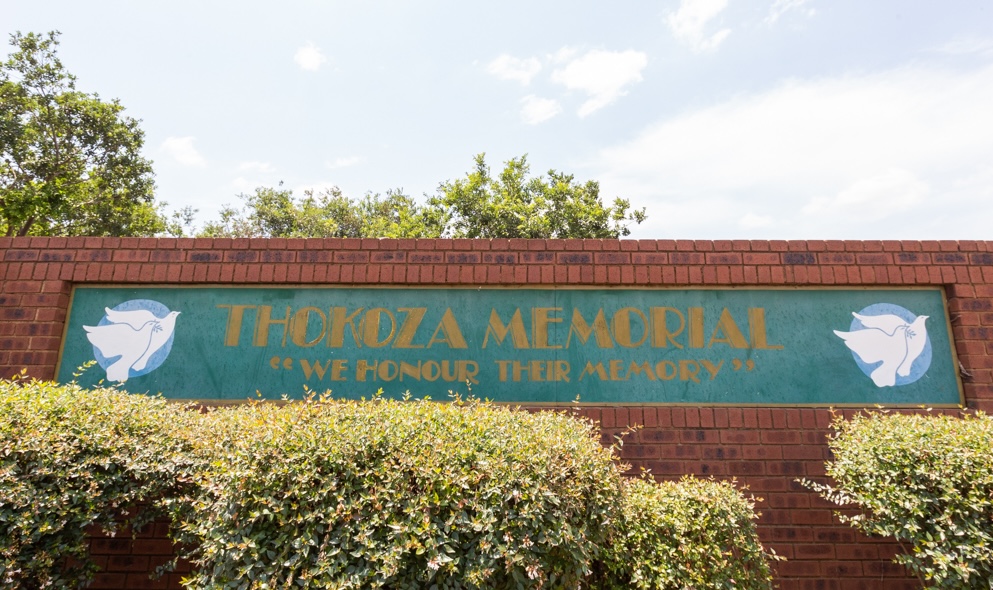
In contrast to Freedom Park's national approach, The Thokoza Monument represents a local, community-driven initiative that opened in October 1999. This monument demonstrates a different philosophy about remembering conflict and promoting reconciliation.
Note
The Thokoza Monument offers an important contrast to national monuments like Freedom Park. While national monuments must balance competing national narratives, local monuments can focus more specifically on community healing and inclusive remembrance.
Community-based reconciliation
The Thokoza Monument emerged as a community project designed to bring together former opposing sides from the political violence that occurred between 1990 and 1994. During this period, Khumalo Street in Thokoza township became a battleground where violence erupted between supporters of the IFP (Inkatha Freedom Party) and the ANC (African National Congress).
Post-1994 developments
After the 1994 general elections brought relative stability to the area, relationships between the IFP and ANC began to improve. This created an opportunity to develop a memorial that would acknowledge all victims of the violence and promote healing within the community.
Collaborative approach
The monument's development involved over 28 organisations that committed themselves to the project. These groups chose to locate the monument on Khumalo Street, strategically positioned between the stadium and the youth centre - both significant community spaces.
Inclusive commemoration
Unlike the selective approach seen in some national monuments, the Thokoza Monument remembers all those who died in the political violence, regardless of which side they supported. The monument's purpose is to ensure that the lessons of this tragic period are not forgotten and that such violence is not repeated in the future.
Comparing approaches to commemoration
The examples of Freedom Park and the Thokoza Monument reveal different approaches to remembering the struggle against apartheid and related conflicts:
National vs local perspectives
- National monuments like Freedom Park face greater pressure to represent an official version of history that supports nation-building goals
- Local monuments like Thokoza can adopt more inclusive approaches that reflect community-specific experiences and needs
Selective vs inclusive memory
- Some national commemorations exclude certain groups (like white soldiers) to avoid legitimising apartheid
- Local initiatives may choose to remember all victims to promote community healing and reconciliation
Summary
Key Points to Remember:
- Monuments are selective storytellers - they present one perspective on the past, not the complete story
- Always ask critical questions about what stories are included, whose voices are heard, and what has been left out
- Freedom Park represents the national approach to commemoration, opening in 2007 but excluding white soldiers from the Border War
- The Wall of Names controversy shows how decisions about inclusion and exclusion can create ongoing tensions
- Local monuments like Thokoza can take different approaches, sometimes being more inclusive of all victims to promote community reconciliation
- Memorialisation is always political - it involves making choices about how to interpret and present historical experiences