The Vietnam War (Grade 12 NSC Matric History): Revision Notes
📚Revision Notes
The Vietnam War

Background and early involvement
Following France's defeat at Dien Bien Phu and the Geneva Accords, French forces withdrew from Vietnam to focus on fighting anti-colonial movements in Algeria. This created a power vacuum that drew the United States into Vietnamese affairs. President Diem of South Vietnam requested American assistance to combat the People's Liberation Armed Forces (PLAF), commonly known as the Viet Cong, who were communist forces receiving support from North Vietnam.
Note
The withdrawal of French colonial forces created a critical power vacuum in Southeast Asia, setting the stage for Cold War superpowers to become involved in Vietnamese internal affairs.
The communist North provided the Viet Cong with essential military supplies, guidance, and reinforcements through what became known as the Ho Chi Minh Trail. This supply route proved crucial in sustaining the communist insurgency in South Vietnam.
Phase 1: Internal struggle in South Vietnam (1957-1963)
Early communist campaign and US response
The first phase of the Vietnam War began in October 1957 when Ho Chi Minh launched a devastating campaign against the South Vietnamese government. This included bombings, assassinations, and widespread destruction throughout South Vietnam. The USSR had proposed dividing Vietnam into two separate parts in January 1957, but the United States rejected this plan.
Initially, the Viet Cong found themselves outmatched by US-backed South Vietnamese forces, which led Ho Chi Minh to adapt his military strategy. He shifted from conventional warfare to guerrilla tactics, which proved far more effective against the better-equipped enemy forces.
Important
Strategic Shift to Guerrilla Warfare
Ho Chi Minh's decision to abandon conventional military tactics in favour of guerrilla warfare became the defining characteristic of the entire Vietnam conflict. This tactical shift would ultimately prove decisive in defeating superior military technology and resources.
Escalating US involvement
The Ho Chi Minh Trail became the primary supply route connecting North and South Vietnam, with guerrilla fighters sometimes crossing borders into Laos and Cambodia. Several factors contributed to growing Viet Cong support within South Vietnam:
- Corruption and authoritarianism under Diem's government alienated many citizens
- Low morale among South Vietnamese forces
- Rising opposition from intellectuals, Buddhists, peasants, and students who opposed Diem's repressive policies
President Kennedy responded to these challenges by significantly increasing American military presence. After two unsuccessful attempts to overthrow Diem's government, Kennedy sent over 11,000 US troops to Vietnam by 1962 to shore up the South Vietnamese regime. Simultaneously, the Soviet Union began providing air support and supplies to Ho Chi Minh's forces in North Vietnam.
The 1963 crisis year
A major turning point occurred in 1963 when Diem's government launched a severe crackdown on the Buddhist community. The government denied Buddhists religious freedom, targeted Buddhist marchers, and raided religious sites. In protest, a Buddhist monk dramatically set himself on fire, creating international outcry.
Example
Case Study: The Buddhist Crisis of 1963

The Buddhist crisis demonstrated how religious persecution could destabilise a government during wartime:
Step 1: Diem's government restricts Buddhist religious practices and targets peaceful protesters
Step 2: Buddhist monk's self-immolation creates international media attention and condemnation
Step 3: US attempts diplomatic intervention fail as government troops continue raids
Result: Crisis severely damages Diem's legitimacy and US support, leading directly to the military coup
The United States attempted to intervene diplomatically to restore Buddhist rights, but South Vietnamese government troops continued their raids on religious sites. This crisis severely damaged Diem's legitimacy and US support for his regime.
The crisis culminated when some of Diem's own generals, with US consent, launched a military coup against his government. Both President Diem and his brother were assassinated in November 1963, ending the first phase of the Vietnam War.
Phase 2: Direct US-North Vietnamese conflict (1964-1967)
Gulf of Tonkin Resolution
After President Kennedy's assassination in Dallas, Lyndon B. Johnson became the US President and dramatically escalated American involvement in Vietnam. The pivotal moment came in August 1964 when North Vietnamese forces allegedly attacked an American naval vessel in the Gulf of Tonkin.
Note
The Gulf of Tonkin incident remains controversial, with many historians questioning whether the attacks occurred as officially reported. Regardless, it provided the justification for massive US military escalation.
The US Congress responded by passing the Gulf of Tonkin Resolution, which gave President Johnson broad powers to use military force in Vietnam. Johnson justified this escalation using the Domino Theory - the belief that if South Vietnam fell to communism, other Southeast Asian countries would follow like falling dominoes.

Following the Gulf of Tonkin incident, the US bombed North Vietnamese targets in retaliation, marking the beginning of direct American military engagement with North Vietnam.
Major military escalation
Multiple military juntas succeeded Diem's government until Nguyen van Thieu became president of South Vietnam in 1965. During this period, the conflict intensified dramatically:
Communist support and strategy:
- China and the USSR provided substantial arms and support to North Vietnam
- 3,500 US Marines arrived in South Vietnam in March 1965
American military response: The USA faced a significant challenge as they lacked sufficient volunteer soldiers and had to introduce conscription (the draught). Following another attack on US bases in the south during 1965, Johnson ordered Operation Rolling Thunder to bomb communist forces into submission.
This massive bombing campaign lasted three years and saw the US drop over one million tonnes of bombs on Vietnam, Laos, and Cambodia. Despite this enormous destruction of military targets, North Vietnamese forces refused to surrender.
Chemical warfare tactics
In 1967, South Vietnam established a new constitution creating a civilian government under President Thieu. That same year, the US introduced Operation Ranch Hand, a controversial chemical warfare programme designed to remove jungle cover and expose the Ho Chi Minh Trail.
Important
Chemical Warfare and Long-term Consequences
The use of chemical weapons in Vietnam had devastating effects that extended far beyond the war itself:
Agent Orange was a powerful chemical that caused defoliation of forests and also resulted in severe chromosomal damage in humans exposed to it

Agent Blue was specifically designed to destroy crops, aiming to starve Viet Cong forces by eliminating their food sources
These chemical weapons caused birth defects and serious health problems that persisted for decades, affecting both Vietnamese civilians and American veterans.
The Tet Offensive: Turning point of the war (1968)
The communist gamble
The Tet Offensive of 1968 marked the climax and turning point of the Vietnam War. This massive coordinated attack was launched by North Vietnamese forces and the National Liberation Front (NLF) with a clear strategic objective: to capture Saigon and force both the South Vietnamese government to surrender and US forces to withdraw completely.
The offensive involved simultaneous attacks launched across 17 degrees North into South Vietnam, reaching as far south as Saigon itself. The scale and coordination of these attacks shocked American forces and the South Vietnamese government.
Immediate consequences
Military impact: President Thieu responded by introducing conscription to resist the massive communist assault. The fighting was brutal, with thousands of non-communists in South Vietnam murdered by communist forces from the North. US troops also suffered significant casualties and psychological trauma as communist forces had successfully infiltrated deep into South Vietnamese territory.
Important
The My Lai Massacre: War's Moral Cost
During this chaotic period, one of the war's most horrific incidents occurred - the My Lai Massacre. US troops deliberately killed innocent villagers during what was described as a "mad killing spree." This atrocity illustrated how the war had brutalised participants and highlighted the moral cost of the conflict.
Growing opposition in America
The Tet Offensive had profound effects on American public opinion:
Media impact: Television coverage and photojournalism brought the reality of the war into American homes for the first time. Images of killing and destruction, including the execution of an NLF officer by General Ngoc Loan, shocked the American public.
Anti-war movement: Student groups, anti-war activists, and disarmament organisations increasingly called for an end to the war. Women and students led many opposition movements, and public marches and protests became more frequent and larger.
Cost concerns: The enormous financial and human cost of the war made its continuation increasingly difficult to justify. Many Americans began questioning whether the war was morally justifiable, leading to significant polarisation in US society.
Path to peace negotiations
By May 1968, peace talks began in Paris, with Russian approval but without Chinese support. President Johnson ordered a halt to bombing raids as negotiations progressed. However, the peace process would prove long and difficult.
In 1969, Johnson's successor, President Nixon, developed the Nixon Doctrine to end American involvement in Vietnam. This policy introduced "Vietnamisation" - a strategy of training South Vietnamese troops and officials to replace American personnel gradually.
Note
Vietnamisation represented a fundamental shift in US strategy from direct military engagement to supporting local forces, a approach that would be attempted in later conflicts with mixed results.
The anti-war movement continued to grow, culminating in 1971 when thousands of war veterans marched to the White House and symbolically threw their medals and military decorations on the steps to protest against the war.
The official ending of the war (1973-1975)
Peace negotiations and agreements
Secretary of State Henry Kissinger adopted a direct negotiation approach with North Vietnamese leaders. By 1972, he had successfully brokered an agreement with Xuab Thuy and Le Duc Tho from North Vietnam. However, President Thieu and other South Vietnamese leaders, along with the NLF, rejected this initial peace agreement.
Nixon responded to the rejection by authorising intensified bombing raids against major cities in North Vietnam in December 1972. These attacks drew widespread international condemnation but eventually forced all parties back to the negotiation table.
On 23 January 1973, the final peace treaty was signed after the United States promised to provide assistance to South Vietnam. This agreement ended direct hostilities between the USA and North Vietnam, though it did not end the civil war between North and South Vietnam.
Final communist victory
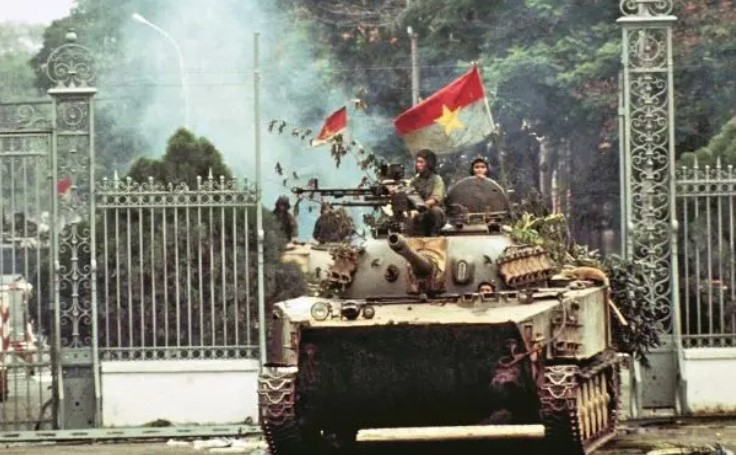
Despite the peace agreement between the superpowers, fighting continued between Vietnamese forces. The civil war finally ended on 30 April 1975 when North Vietnamese troops successfully occupied Saigon and captured the presidential palace, achieving complete victory and reunifying Vietnam under communist rule.
Why the United States failed in Vietnam
Strategic and tactical failures
Several key factors explain why the world's most powerful military could not defeat North Vietnam:
Important
Fundamental Strategic Errors
Terrain and knowledge: American forces fundamentally misjudged the war environment and had limited understanding of the difficult terrain where they were fighting. The dense jungles and complex geography of Vietnam favoured local forces who knew the landscape intimately.
Overconfidence: The US military leadership believed they could not lose the war, leading to strategic miscalculations and inadequate preparation for the type of conflict they faced.
Guerrilla warfare: Ho Chi Minh's guerrilla tactics proved highly effective against conventional American military strategies. The communists avoided direct confrontation with superior US forces, instead using hit-and-run tactics, ambushes, and local knowledge to their advantage.
Political miscalculations
Cuban Missile Crisis effect: President Johnson initially believed that North Vietnamese leaders would back down when threatened, similar to how the Soviet Union had responded during the Cuban Missile Crisis. This miscalculation led to escalation strategies that ultimately failed.
Domestic opposition: Growing opposition within the United States undermined the war effort and made sustained military action politically impossible.
Summary
Key Points to Remember:
-
The Vietnam War developed in two distinct phases: first as a civil war between South Vietnamese forces and the Viet Cong (1957-1963), then as a direct conflict between the US and North Vietnam (1964-1975)
-
Key turning points included the 1963 assassination of President Diem, the 1964 Gulf of Tonkin Resolution that escalated US involvement, and the 1968 Tet Offensive that turned American public opinion against the war
-
The US used massive military force including over one million tonnes of bombs and controversial chemical weapons like Agent Orange and Agent Blue, but still could not defeat North Vietnamese guerrilla tactics
-
American failure resulted from unfamiliarity with Vietnamese terrain, overconfidence in military superiority, effective communist guerrilla warfare, and growing domestic opposition to the war
-
The war officially ended in 1975 when North Vietnamese forces captured Saigon, despite the US-North Vietnam peace agreement signed in 1973