Bills (Grade 12 NSC Matric Mathematical Literacy): Revision Notes
📚Revision Notes
Bills
Bills are official documents that show amounts owed for services or utilities used during a specific period. Understanding how to read different types of bills is essential for managing your finances and ensuring you pay the correct amounts on time.
Municipal bills
Municipal bills are invoices sent by local government councils to property owners for essential services provided to households and businesses.
Services covered by municipal bills
Municipal bills typically include charges for:
- Rates - property taxes based on your property's value
- Water supply - consumption charges and basic service fees
- Electricity - power consumption and connection fees
- Refuse collection - waste removal services
- Sewerage - wastewater treatment services
Note
Municipal services are essential utilities that local councils provide to ensure communities have access to clean water, electricity, waste management, and proper infrastructure maintenance.
Key components of municipal bills
Understanding the main sections of your municipal bill helps you manage payments effectively:
Account information:
- Account number - unique identifier for your property
- Customer details - property address and contact information
- Tax invoice number - reference for official records
Payment summary:
- Previous account balance - any outstanding amount from earlier bills
- Payments received - money paid during the current period
- Current charges - new costs for this billing period
- Total amount due - complete sum you must pay
Important dates:
- Due date - deadline for payment to avoid penalties
- Account summary date - when the bill was prepared
Understanding arrears and credits
Arrears represent overdue amounts that should have been paid by previous due dates. When the bill shows:
- Payable immediately - these are arrears requiring urgent payment
- Current amount due - charges for the present billing period
Credits appear as negative amounts when you have overpaid or received refunds. These credits reduce your total liability.
Important
Avoiding Arrears
Arrears can lead to service disconnection and additional penalty fees. Always prioritise paying at least the minimum amount due by the due date to prevent accumulating arrears.
Example
Worked Example: Municipal Bill Calculation
From a typical Cape Town municipal bill:
- Previous balance: R2032.67
- Payment received: R349.67 (shown as negative/credit)
- Arrears remaining: R1683.00
- Current charges: R393.72
- Total liability: R2076.72
Step 1: Previous balance - Payment received R2032.67 - R349.67 = R1683.00 (arrears)
Step 2: Arrears + Current charges R1683.00 + R393.72 = R2076.72 (total amount due)
Payment can be made at various locations including ABSA, Checkers, Shoprite, and Post Office branches.
Electricity bills
Electricity bills provide detailed information about your power consumption and energy costs. These bills help you track usage patterns and manage electricity expenses effectively.
Understanding electricity consumption
Electricity usage is measured in kilowatt hours (kWh). Your bill displays:
- Meter readings - previous and current metre numbers
- Consumption - difference between readings (kWh used)
- Billing period - number of days covered
- Tariff rates - cost per kWh for different usage levels
Note
Understanding kWh
One kilowatt hour (kWh) represents the energy consumed by using 1000 watts of power for one hour. For example, a 100-watt light bulb running for 10 hours uses 1 kWh of electricity.
Key features of electricity bills
Account details:
- Customer information - name, address, account number
- Metre numbers - identifies specific metres on your property
- Billing dates - period covered by the invoice
Consumption breakdown:
- Energy charges - costs for actual electricity used
- Service charges - fixed monthly connection fees
- Demand charges - costs based on peak usage periods
- VAT - 14% tax added to applicable charges
Reading consumption graphs
Many electricity bills include graphs showing your usage over the past 12 months. These graphs help you:
- Identify seasonal consumption patterns
- Compare current usage with previous periods
- Spot unusually high consumption months
- Track energy-saving improvements
Spikes in the graph often indicate increased usage during winter months (heating) or summer months (cooling), while flat periods might show when the property was vacant.
Example
Worked Example: Eskom Electricity Bill
Using an Eskom bill example:
- Billing period: 61 days (longer than standard month)
- Previous balance: R2520.23
- Current charges: R4353.85
- VAT included: R609.54
- Total amount due: R4963.42
Calculation breakdown: Current charges + Previous balance = Total due R4353.85 + R2520.23 = R6874.08
Note: The consumption summary shows usage across three different metres, with varying consumption levels depending on the type of accommodation (main house vs. smaller units).
Cell phone bills
Cell phone bills detail costs for mobile services during a billing period. These bills vary significantly based on contract type, usage patterns, and selected packages.
Types of cell phone contracts
Contract accounts:
- Fixed monthly subscription fees
- Additional charges for usage beyond package limits
- Monthly billing with payment terms
Prepaid accounts:
- Pay-in-advance system
- No monthly bills (top-up as needed)
- Usage tracked through account balance
Key components of cell phone bills
Subscription services:
- Monthly contract fee - fixed cost for your package
- Data packages - internet usage allowances
- Call packages - voice call allowances
- SMS packages - text message allowances
Usage charges:
- Out-of-bundle calls - calls exceeding package limits
- International calls - calls to foreign numbers
- Premium services - special features or content
- Roaming charges - costs when using phone abroad
Billing calculations:
- Subtotal - total before VAT
- VAT at 14% - tax on applicable services
- Total amount - final amount due
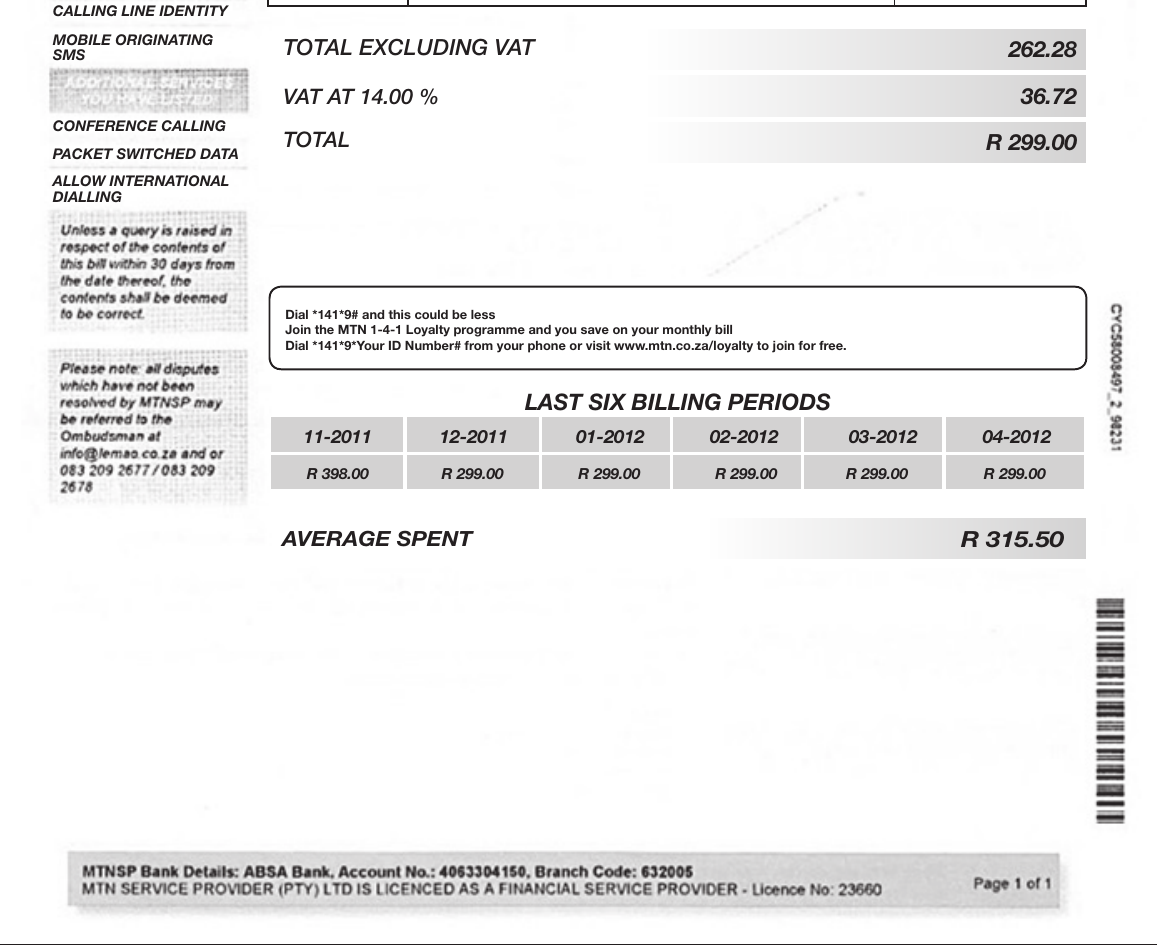
Understanding billing periods and payment history
Cell phone bills typically show:
- Current billing period - dates covered by this bill
- Last six billing periods - history of previous months
- Average spent - typical monthly cost over recent periods
Note
Using Billing History
Payment history information helps you budget for future months, identify spending trends, and compare current charges with historical patterns. Look for unusual spikes that might indicate billing errors or unexpected usage.
VAT calculations on cell phone bills
Most cell phone services include VAT at 14%. The calculation works as follows:
Formula:
Important
VAT Calculation Method
Always verify VAT calculations on your bills. The standard VAT rate in South Africa is 14%, and this should be applied to most telecommunications services. If the calculation appears incorrect, contact your service provider immediately.
Example
Worked Example: VAT Calculation
Example calculation:
- Amount excluding VAT: R262.28
- VAT calculation:
- Total including VAT:
Step-by-step process:
- Identify the amount excluding VAT
- Multiply by 14 and divide by 100
- Add VAT amount to original amount for total
Cell phone bill worked examples
Example
Worked Example: MTN Contract Bill
MTN contract example:
- Monthly subscription: R175.44 (MTN 200 TopUp)
- Additional services: Various data and calling features
- Total excluding VAT: R262.28
- VAT (14%): R36.72
- Final total: R299.00
The bill shows consistent R299.00 monthly charges across six billing periods, with average spending of R315.50 (including one higher month of R398.00).
Example
Worked Example: Vodacom Contract Bill
Vodacom contract example:
- Balance brought forwards: R99.00
- Current month charges: R86.84
- VAT on current charges: R12.16
- Total invoice amount: R99.00
Calculation verification: VAT check: ✓ Correct
Query and reference information
When contacting service providers about bills, useful reference numbers include:
- Account number - identifies your specific account
- Invoice number - references this particular bill
- Cell phone number - your mobile number
- Payment reference numbers - for tracking payments made
Note
Most providers allow 30 days to query invoice details after the bill date. Keep all reference numbers handy when making inquiries.
Important billing terminology
Note
Essential Billing Terms
- Balance brought forward - outstanding amount from previous bills
- Billing period - timeframe covered by the bill (usually monthly)
- Due date - payment deadline to avoid late fees
- Tax invoice - official VAT-compliant billing document
- Total amount due - complete sum requiring payment
- VAT - Value Added Tax charged at 14% on most services
- Arrears - overdue amounts from missed previous payments
- Current charges - new costs for the present billing period
Summary
Key Points to Remember:
- Always check the due date carefully to avoid late payment penalties and service interruptions
- Verify VAT calculations are correct by applying the 14% rate to applicable charges using
- Keep your account numbers and reference details handy for easy payment and query processes
- Compare monthly usage with previous periods to identify unusual consumption patterns or billing errors
- Understand that arrears (overdue amounts) are treated separately from current month charges and require immediate attention
- Use payment history and graphs to track your spending patterns and budget effectively
- Contact service providers within 30 days if you notice any billing discrepancies or have questions about charges