Payslips, Deductions, and Tax (Grade 12 NSC Matric Mathematical Literacy): Revision Notes
📚Revision Notes
Payslips, Deductions, and Tax
Understanding payslips
A payslip is a document that employees receive each month showing their earnings, deductions, and final take-home pay. Every South African employee must receive a payslip by law, as it provides a clear breakdown of how their salary is calculated and what amounts have been deducted.
Note
By law, every South African employee must receive a payslip each month. This legal requirement protects both employees and employers by ensuring transparency in salary calculations and providing essential documentation for financial and tax purposes.
The payslip serves several important purposes. It acts as proof of income for loans or credit applications, helps employees understand their tax obligations, and provides a record for annual tax submissions to SARS (South African Revenue Service). Understanding your payslip is essential for managing your personal finances effectively.
A typical South African payslip contains several key sections. The header includes employee details such as name, employee number, job title, and banking information. The earnings section shows basic salary, overtime, and any additional payments. The deductions section lists all amounts removed from gross pay, including tax, UIF, and other contributions. Finally, the net pay section shows the actual amount paid into the employee's bank account.
Earnings and income calculations
Gross income represents the total amount earned before any deductions are made. This includes basic salary, overtime payments, bonuses, and any other compensation. The gross income figure is crucial because it determines how much tax and other deductions will be calculated.
Example
Daily Earnings Calculation
When calculating daily earnings, you divide the monthly salary by the number of working days in that month.
Formula: Daily Earnings = Monthly Salary ÷ Days Worked
Example: If someone earns R10,000 per month and worked 21.67 days:
Overtime is typically calculated at a higher rate than normal working hours. The rate depends on company policy and employment contracts, but it's commonly calculated at time-and-a-half or double-time rates. If an employee's normal hourly rate is R85, their overtime might be calculated at R127.50 per hour .
Key deductions explained
PAYE (Pay As You Earn)
PAYE stands for "Pay As You Earn" and represents the income tax that employers deduct directly from employees' salaries each month. This system ensures that tax is collected throughout the year rather than in one lump sum at year-end.
Important
PAYE is calculated based on your projected annual income using the current tax tables. The employer estimates what you'll earn for the full year, calculates the total tax due, then divides this by 12 months. This means your PAYE amount should remain relatively consistent throughout the year unless your salary changes significantly.
The tax is collected by SARS (South African Revenue Service) and contributes to government revenue for public services, infrastructure, and social programmes. PAYE is compulsory for all employees earning above the tax threshold amounts.
UIF (Unemployment Insurance Fund)
UIF stands for "Unemployment Insurance Fund" and provides a safety net for workers who lose their jobs. Both employees and employers contribute to this fund, creating a shared responsibility system.
Employees contribute 1% of their monthly salary to UIF, while employers match this with their own 1% contribution. This means the total UIF contribution is 2% of the employee's salary, split equally between worker and employer.
Example
UIF Contribution Calculation
For someone earning R10,000 per month:
- Employee contribution:
- Employer contribution:
- Total UIF contribution:
UIF benefits can be claimed if you become unemployed, and the amount depends on how long you've been contributing and your previous salary. The fund also provides benefits for maternity leave, adoption leave, and illness benefits in certain circumstances.
Other deductions
Medical aid contributions are deducted if you belong to a medical scheme. These are typically shared between employee and employer, with the employee portion appearing as a deduction on the payslip. The amount varies depending on the medical aid provider and the type of cover selected.
Pension fund contributions help build retirement savings. Many employers offer pension or provident funds where both employee and employer contribute a percentage of the salary. These contributions are tax-deductible up to certain limits, making them an efficient way to save for retirement while reducing current tax liability.
South African tax system
South Africa uses a progressive tax system, meaning higher earners pay higher tax rates on their income. The system is designed to be more equitable, with those earning more contributing a larger percentage to government revenue.
Note
The tax year runs from 1 March to 28 February, and tax rates are announced annually in the budget speech. The progressive system ensures that higher earners contribute proportionally more to government revenue while protecting lower-income earners from excessive tax burdens.
Tax brackets and rates
The progressive tax system works by applying different rates to different portions of your income. For the 2013/14 tax year, the brackets were:
- R0 - R160,000: 18% of each R1
- R160,001 - R250,000: R28,800 + 25% of taxable income above R160,000
- R250,001 - R346,000: R51,300 + 30% of taxable income above R250,000
- R346,001 - R484,000: R81,100 + 35% of taxable income above R346,000
- R484,001 - R617,000: R128,400 + 38% of taxable income above R484,000
- R617,001 and above: R178,940 + 40% of taxable income above R617,000
Important
How Progressive Tax Works
If you earn R300,000 per year, you don't pay 30% on the entire amount. Instead:
- Pay 18% on the first R160,000
- Pay 25% on the amount from R160,001 to R250,000
- Pay 30% only on the portion from R250,001 to R300,000
This ensures that higher rates only apply to income above each bracket threshold.
Tax rebates and thresholds
Tax rebates are amounts subtracted from your calculated tax to reduce the final amount owed. South Africa provides age-based rebates to ensure that lower-income earners, particularly older citizens, pay less tax or no tax at all.
The rebate system includes three categories:
- Primary rebate (under 65 years): R11,440 per year
- Secondary rebate (65-75 years): Additional R6,390 per year
- Tertiary rebate (75+ years): Additional R2,130 per year
Tax thresholds represent the minimum income levels before tax becomes payable after applying rebates. For 2013/14, these were:
- Under 65 years: R63,550 per year
- 65-75 years: R99,056 per year
- 75+ years: R110,889 per year
Note
If your annual income falls below these thresholds, you won't pay any income tax. This system protects low-income earners and provides additional relief for older citizens who may be on fixed incomes.
Calculating net pay
Net pay is the amount actually deposited into your bank account after all deductions have been made.
Important
Net Pay Formula
The total deductions typically include PAYE, UIF, medical aid contributions, pension fund contributions, and any other authorised deductions such as union fees or loan repayments.
Understanding this calculation helps you verify that your payslip is correct and plan your monthly budget effectively. Any discrepancies should be discussed with your employer's payroll department immediately.
Worked examples
Example
Example 1: Joe Bloggs' Payslip Calculation
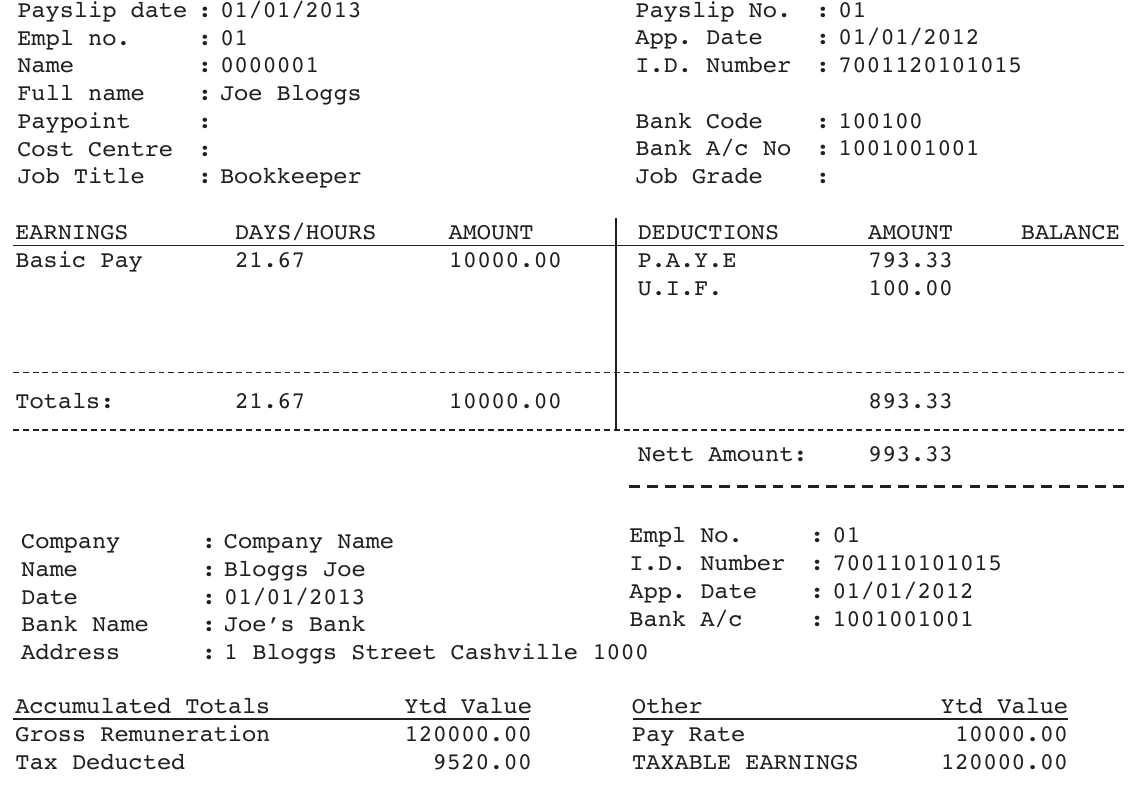
Joe Bloggs earns R10,000 per month as a bookkeeper and worked 21.67 days in January 2013.
Daily earnings calculation:
UIF calculation: Employer also contributes R100, making total UIF contribution R200
PAYE calculation:
- Joe's annual gross income =
- Since R120,000 falls in the 18% tax bracket:
- Annual tax =
- Less primary rebate =
- Monthly PAYE =
Note: The payslip shows R793.33, indicating additional calculations or different rates may apply.
Example
Example 2: Lucinda Adams' Payslip
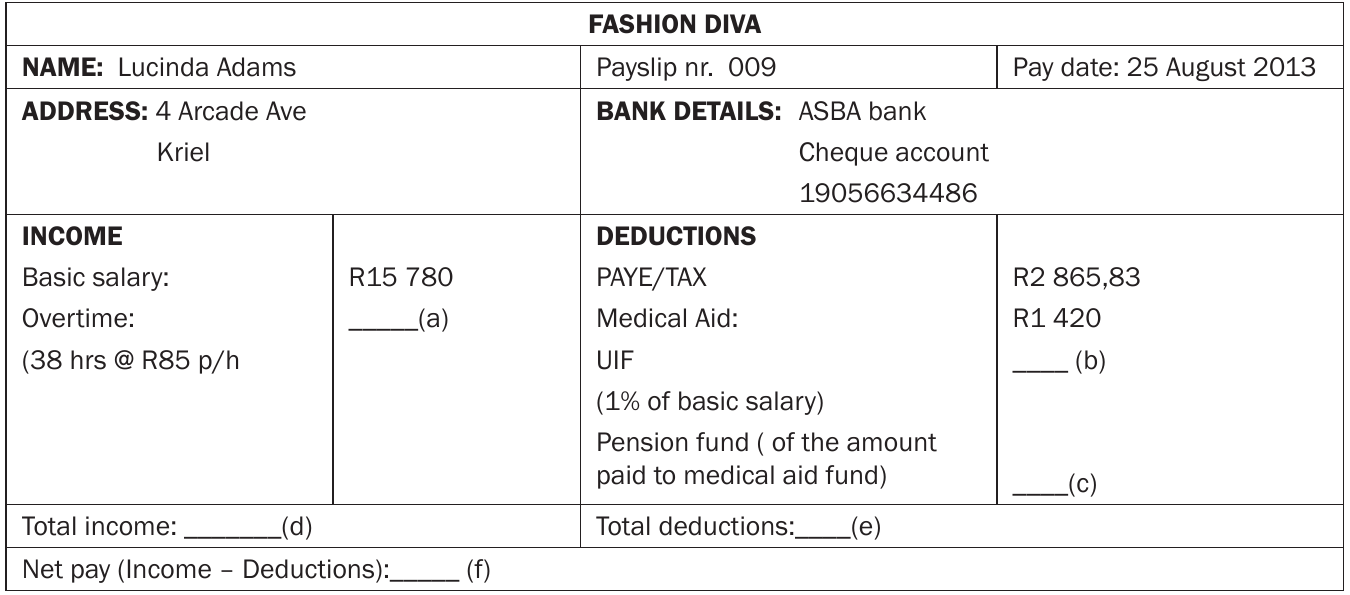
Lucinda works at Fashion Diva earning R15,780 basic salary plus overtime.
Overtime calculation:
Total gross income:
UIF calculation:
Total deductions:
Net pay:
Example
Example 3: Tax Calculation for Higher Earner
For someone earning R556,444 annually:
Tax calculation by brackets:
- R28,800 (18% on first R160,000)
- R22,500 (25% on R160,001-R250,000)
- R28,800 (30% on R250,001-R346,000)
- R64,388.72 (35% on R346,001-R556,444)
Final calculation:
- Total tax: R144,488.72 per year
- Less primary rebate:
- Monthly tax:
Summary
Key Points to Remember:
-
PAYE is calculated on annual income - your monthly deduction is based on what you're expected to earn for the whole year, divided by 12 months
-
UIF contributions are shared equally - you contribute 1% of your salary, and your employer matches this with another 1%
-
Tax brackets are progressive - you only pay the higher rate on income above each bracket threshold, not on your entire income
-
Tax rebates reduce your final tax bill - they're subtracted from your calculated tax, and older taxpayers get additional rebates
-
Net pay equals gross income minus all deductions - always check that your payslip calculations are correct by verifying this simple formula: