Measuring Length (Grade 12 NSC Matric Mathematical Literacy): Revision Notes
📚Revision Notes
Measuring Length
Understanding estimation in measurement
Estimation is a valuable technique used to find approximate values for measurements without using precise measuring tools. This skill is particularly useful in everyday situations where you need quick measurements or want to check if your precise measurements are reasonable.
Note
Estimation serves two main purposes in measurement:
- Providing quick approximations when precise tools aren't available
- Acting as a "reality check" to verify that your precise measurements are sensible
Common estimation references
When estimating length, you can use familiar body measurements and everyday objects as reference points:
- One metre is approximately the distance from your shoulder to your fingertips when you stand with your arm outstretched
- One metre is also roughly the distance of one large step or jump
- These references help you quickly estimate distances and lengths in practical situations
Practical measurement problems
Material and cost calculations
When working with materials that are sold by length, you need to calculate both the quantity required and the total cost.
Important
Basic Cost Formula:
This fundamental formula applies to all material purchasing problems.
However, real-world problems often involve multiple requirements and practical considerations such as:
- Materials sold only in full metre lengths
- Multiple items requiring different amounts
- Additional materials (like cotton for embroidery)
Worked examples
Example
Worked Example 1: Window Curtain Material
Carl needs to measure a window width to buy curtain material. The material costs R55 per metre and is sold only in full metres.
Problem setup:
- Carl estimates the window width as 1.9 metres using his arm measurement
- Later, he measures accurately and finds the window is actually 2.2 metres wide
Step-by-step solution:
Part A: Using the estimate (1.9 metres)
- Material needed: Since material is sold in full metres only, Carl needs 2 metres
- Cost calculation:
Part B: Using accurate measurement (2.2 metres)
- Material needed: Since material is sold in full metres only, Carl needs 3 metres
- Cost calculation:
Key insight: Accurate measurement showed Carl needed 1 metre more material, costing R55 extra.
Example
Worked Example 2: Dress-making Materials
Liz sews children's dresses with different material requirements and additional embroidery cotton.
Given information:
- Main material costs R89.50 per metre
- Material needed: 2.5m (7-year-old), 2m (4-year-old), 2m (4-year-old), 3m (10-year-old)
- Embroidery cotton costs R12.55 per roll of 3 metres
- Uses 2 rolls of cotton per dress
Step-by-step calculations:
Step 1: Total material needed
Step 2: Material cost
Step 3: Cotton per dress
Step 4: Total cotton cost
Step 5: Total cost for 10-year-old dress
Example
Worked Example 3: Table Decoration Project
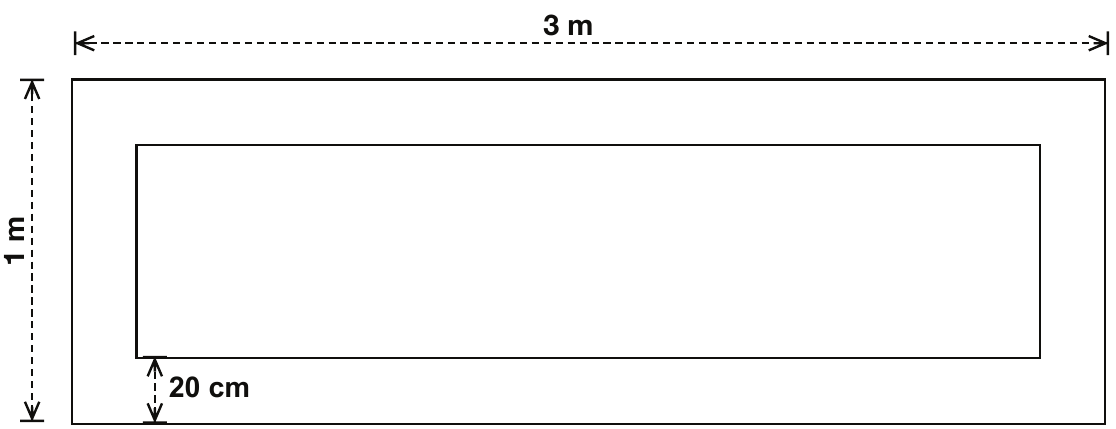
Jenny decorates rectangular tables (3m × 1m) with tablecloths that must hang 20cm over all edges.
Problem analysis:
- Table dimensions: 3m length × 1m width
- Overhang required: 20cm on all sides
- Fabric costs R75 per metre, sold in lengths smaller than 1 metre
- Fabric width: 1.4m
Step-by-step solution:
Step 1: Calculate total cloth dimensions
- Length needed:
- Width needed:
Step 2: Cost per table
Step 3: Total cost for 15 tables
Key measurement principles
Unit conversion reminders
Understanding unit relationships is crucial for accurate calculations:
Note
Essential Conversions:
- Always check what units are required in your final answer
- Convert between units carefully in multi-step problems
Problem-solving approach
Follow this systematic approach to tackle measurement problems effectively:
- Read carefully - identify what is being asked
- List known information - dimensions, prices, quantities
- Plan your calculation - break complex problems into steps
- Check reasonableness - do your answers make sense?
- Include units - always specify metres, centimetres, or currency
Common exam considerations
Important
Critical Points to Remember:
- Materials often sold in full units only (round up when necessary)
- Multiple calculations may be needed for complex problems
- Cost calculations typically involve multiplication of length and price
- Estimation can help check if precise answers are reasonable
Summary
Key Points to Remember:
- One metre equals the distance from shoulder to fingertips or one large step
- Estimation helps you quickly assess measurements and check precise calculations
- Always round up when materials are sold in full units only
- Total cost = Length of material × Price per unit
- Complex problems often require multiple calculation steps - break them down systematically