Area (Grade 12 NSC Matric Mathematical Literacy): Revision Notes
📚Revision Notes
Area
What is area?
Area is the measure of how much space is covered by a flat, two-dimensional shape. We measure area in square units such as cm², m², or mm². When calculating area, we are finding out how many unit squares fit inside a shape.
Note
Understanding area as "how many unit squares fit inside a shape" helps visualise what we're actually measuring when we calculate area.
Basic area formulas
Understanding the fundamental formulas for common shapes is essential for area calculations. Each shape has its own specific formula that must be memorised and applied correctly.
Important
Master These Three Formulas: These are the most commonly used area formulas that you must memorise and be able to apply instantly in exams and practical situations.
Rectangle area
For any rectangle, the area formula is:
This formula works because a rectangle can be divided into rows and columns of unit squares. When you multiply the number of units along the length by the number of units along the width, you get the total number of unit squares inside the rectangle.
Triangle area
For any triangle, the area formula is:
The perpendicular height is the distance from the base to the opposite vertex, measured at a right angle to the base. This formula works because a triangle is exactly half of a rectangle with the same base and height.
Circle area
For any circle, the area formula is:
The radius is the distance from the centre of the circle to any point on its edge. Remember that radius² means radius × radius, and π ≈ 3,142.
Worked example: Basic shapes
Let's work through calculations for three common shapes step by step.
Example
Worked Example: Calculating Areas of Basic Shapes
Example 1: Rectangle (Patio)
- Length = 5 cm, Width = 6 cm
- Area = length × width
- Area = 5 cm × 6 cm = 30 cm²
Example 2: Triangle
- Base = 4 cm, Perpendicular height = 12 cm
- Area = ½ × base × perpendicular height
- Area = ½ × 4 cm × 12 cm = 24 cm²
Example 3: Circle
- Radius = 1 cm
- Area = π × radius²
- Area = 3,142 × (1 cm)² = 3,142 × 1 cm² = 3,142 cm²
Combining areas of complex shapes
Many real-world problems involve calculating the area of complex shapes. The key strategy is to break these shapes down into simpler shapes that you can calculate individually.
Note
Method for Complex Shapes
- Identify the basic shapes within the complex shape
- Calculate the area of each basic shape separately
- Add all the individual areas together to get the total area
This systematic approach ensures you don't miss any sections and helps organise your working clearly.
Worked example: Table shape
Consider a table that consists of two identical triangles and one rectangle in the middle.
Example
Worked Example: Table Shape Area Calculation
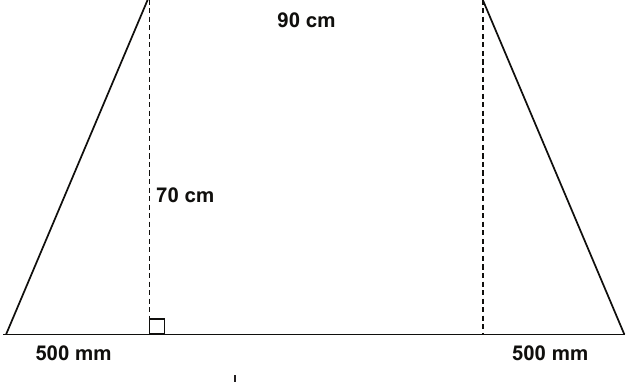
Given measurements:
- Triangle: base = 500 mm, height = 70 cm
- Rectangle: length = 90 cm, width = 70 cm
Step 1: Calculate the area of one triangle
- Convert units: 500 mm = 0,5 m, 70 cm = 0,7 m
- Area of triangle = ½ × 0,5 m × 0,7 m = 0,175 m²
Step 2: Calculate the area of the rectangle
- Convert units: 90 cm = 0,9 m, 70 cm = 0,7 m
- Area of rectangle = 0,9 m × 0,7 m = 0,63 m²
Step 3: Add all areas together
- Total area = triangle + rectangle + triangle
- Total area = 0,175 m² + 0,63 m² + 0,175 m² = 0,98 m²
Areas with cut-out sections
Sometimes you need to calculate the area of a shape that has another shape removed from it. This requires subtraction of areas.
Note
Method for Shapes with Cut-outs
- Calculate the area of the larger shape
- Calculate the area of the cut-out shape
- Subtract the cut-out area from the larger area
Think of this like calculating the area of material needed after removing a section - you need the total minus what's been taken away.
Worked example: Circle with square cut-out
Example
Worked Example: Circle with Square Cut-out
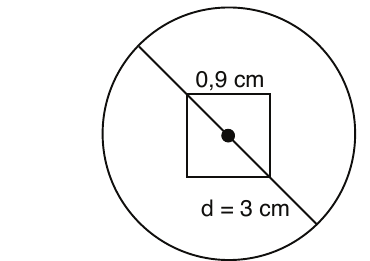
Given: Circle diameter = 3 cm, Square side = 0,9 cm
Step 1: Calculate the circle area
- Radius = 3 cm ÷ 2 = 1,5 cm
- Area of circle = π × (1,5 cm)² = 3,142 × 2,25 cm² = 7,0695 cm²
Step 2: Calculate the square area
- Area of square = (0,9 cm)² = 0,81 cm²
Step 3: Subtract to find remaining area
- Remaining area = 7,0695 cm² - 0,81 cm² = 6,2595 cm²
Exam tips for area calculations
Important
Essential Exam Strategy Tips
- Always check your units - convert to the same units before calculating
- Show all working steps clearly in your solutions
- Round only at the final answer unless instructed otherwise
- For complex shapes, break them down systematically into simpler shapes
- Double-check your formula - make sure you're using the correct one for each shape
- Remember the perpendicular height for triangles - it must be at right angles to the base
These tips can make the difference between losing marks for presentation and gaining full credit for your mathematical understanding.
Summary
Key Points to Remember:
-
Area measures the space inside a 2D shape and is always in square units (cm², m², mm²)
-
Master the three key formulas:
- Rectangle = length × width
- Triangle = ½ × base × height
- Circle = π × radius²
-
For complex shapes, break them into simpler shapes, calculate each area separately, then add them together
-
Always convert to the same units before performing calculations to avoid errors
-
Show all working steps clearly and only round your final answer unless told otherwise