Perimeter (Grade 12 NSC Matric Mathematical Literacy): Revision Notes
📚Revision Notes
Perimeter
What is perimeter?
Perimeter is the total distance around the outside edge of a shape. Think of it as the length of the boundary that encloses a closed geometric figure. When you walk around the edge of a garden, sports field, or any enclosed area, you are following the perimeter.
Perimeter is measured in units of length such as millimetres (mm), centimetres (cm), metres (m), or kilometres (km).
Note
Understanding perimeter helps you solve real-world problems like determining how much fencing is needed for a garden, how much paint is required for the outline of a wall, or calculating the distance around a running track.
Basic perimeter formulas
The method for calculating perimeter depends on the shape you are working with. Different shapes require different approaches, but the underlying concept remains the same - you're finding the total distance around the outside edge.
Important
Here are the essential formulas you need to memorise for your exams:
Rectangle
For a rectangle with length and width : Perimeter =
This works because a rectangle has two pairs of equal sides.
Square
For a square with side length : Perimeter =
Since all four sides of a square are equal, you multiply the side length by 4.
Triangle
For any triangle with sides of length , , and : Perimeter =
Simply add up the lengths of all three sides.
Circle (Circumference)
For a circle with radius : Circumference = or
Remember that circumference is the special name for the perimeter of a circle. Use for calculations unless told otherwise.
How to measure perimeter
There are two main approaches to finding perimeter, each suited to different situations:
Direct measurement method
For rectangles, squares, and triangles, you can measure each side using a ruler and add the lengths together. This method is practical when you have the actual object in front of you.
Note
For circles, direct measurement requires a different approach. You can place a piece of string along the curved edge of the circle, mark where the string completes one full revolution, then measure the length of that string with a ruler.
Using formulas
When you know the dimensions of a shape, using the appropriate formula is more efficient and accurate than direct measurement. This method is essential when working with scale drawings or when precise calculations are needed.
Scale drawings and perimeter
Scale drawings represent real objects at a reduced size. Understanding how to work with scales is crucial for real-world applications.
When working with scale drawings, follow this systematic approach:
- First measure the perimeter on the drawing
- Then multiply by the scale factor to find the actual perimeter
- Convert units if necessary
Important
For example, if a scale is 1:100, it means 1 cm on the drawing represents 100 cm in reality. Always check the scale carefully before making calculations.
Worked examples
The following examples demonstrate how to apply perimeter formulas in practical situations:
Example
Worked Example 1: Rectangular backyard
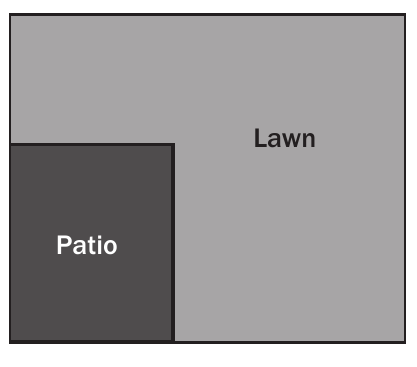
Mr and Mrs Dlamini's rectangular backyard measures 5 cm length and 4.2 cm width on a scale drawing.
Part A: Find the perimeter on the diagram Since the backyard is rectangular, opposite sides are equal in length. Perimeter = cm
Part B: If the scale is 1:100, find the actual perimeter in metres Using the scale: cm = 18.4 m
Example
Worked Example 2: Triangular garden
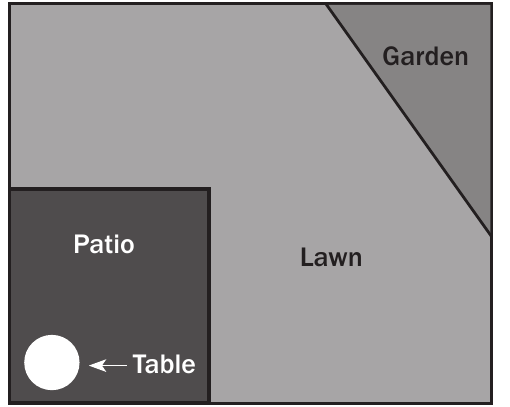
Mrs Dlamini wants to create a triangular vegetable garden. The triangle has sides measuring 1.7 cm, 5 cm, and 5.3 cm on the diagram.
Part A: Find the perimeter on the diagram For a triangle, add all three sides: Perimeter = cm
Part B: Using a scale of 1:100, find the actual perimeter in metres Actual perimeter = cm = 12 m
Example
Worked Example 3: Circular table
A circular table has a diameter of 0.8 cm on the diagram.
Calculate the circumference: Circumference = Circumference = cm ≈ 2.5 cm
Using a formula gives more accurate results than estimating with string measurement.
Example
Worked Example 4: Combined shapes
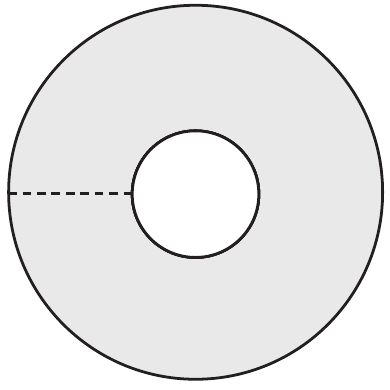
When calculating perimeter for combined shapes like this ring-shaped lampshade, you need to find the perimeter of each relevant boundary.
For the inner circle with radius 5 cm: Inner circumference = cm
For the outer circle with diameter 40 cm: Outer circumference = cm
Key exam tips
Success in perimeter questions requires attention to detail and systematic working. Here are essential strategies to help you achieve the best results:
- Always check units: Make sure your answer is in the correct units (mm, cm, m, km)
- Show your working: Write down the formula first, then substitute values
- Scale conversions: Remember to multiply diagram measurements by the scale factor
- Circle terminology: Circumference is the perimeter of a circle
- Rounding: Follow instructions for decimal places or significant figures
- Formula accuracy: You will be given perimeter formulas in exams, but knowing them helps with speed
Note
Practice identifying which formula applies to each shape quickly. This skill will save you valuable time during exams and reduce the chance of using the wrong approach.
Summary
Key Points to Remember:
- Perimeter is the total distance around the outside of any shape
- Rectangle: Perimeter =
- Square: Perimeter =
- Triangle: Add all three side lengths together
- Circle: Circumference = (use )
- Scale drawings: Multiply diagram measurement by scale factor to get actual size