Percentages (Grade 12 NSC Matric Mathematical Literacy): Revision Notes
📚Revision Notes
Percentages
Introduction to percentage problems
When solving percentage problems, you need to identify three key parts in every calculation. Two parts will be given to you, and you must calculate the third part. Understanding which part is missing helps you choose the correct method.
Note
The fundamental rule for all percentage calculations is:
percent × whole = new amount
This rule is the foundation for solving any percentage problem you encounter.
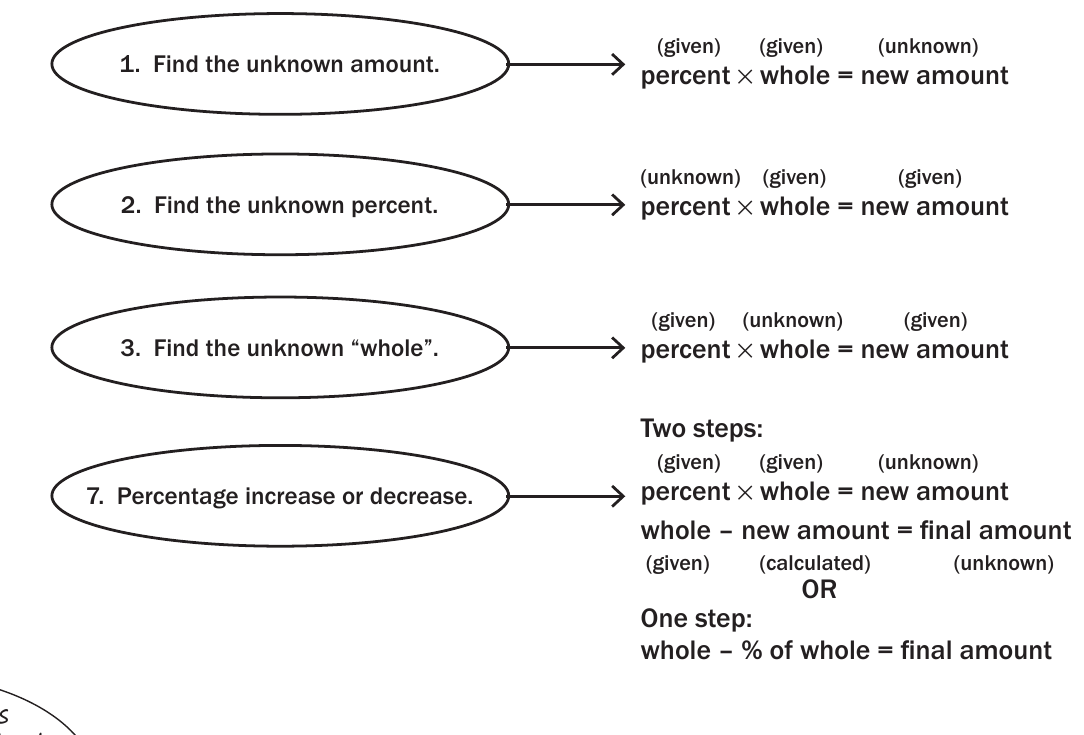
There are four main types of percentage problems you'll encounter:
- Find the unknown amount - when you know the percent and whole
- Find the unknown percent - when you know the amount and whole
- Find the unknown whole - when you know the amount and percent
- Percentage increase or decrease - when amounts change by a given percentage
Type 1: Find the unknown amount
This type occurs when you know both the whole amount and the percentage, and need to calculate what that percentage represents.
Method: Use the rule percent × whole = new amount
Example
Worked Example: Finding an Amount
Question: What is 18% of 300?
Solution:
- Write the equation: 18% × 300 = new amount
- Convert percentage to decimal: = new amount
- Calculate: 54 = new amount
Answer: 54
Note
Remember: The word "of" in mathematics means multiply.
Type 2: Find the unknown percent
This type occurs when you know the amount and the whole, and need to find what percentage the amount represents.
Important
Key points to remember:
- If the amount is less than the whole, the percent will be less than 100%
- If the amount is greater than the whole, the percent will be greater than 100%
Example
Worked Example: Finding a Percentage
Question: A group of 30 out of 150 learners represents the Grade 12s in athletics. What percentage is this?
Solution:
- We know: amount = 30, whole = 150, percent = unknown
- Write equation: percent × whole = amount
- Substitute: percent × 150 = 30
- Solve: percent = = 0.2
- Convert to percentage: 0.2 × 100 = 20%
Answer: 20%
Type 3: Find the unknown whole
This type occurs when you know the amount and the percentage, and need to find the original whole amount.
Example
Worked Example: Finding the Whole Amount
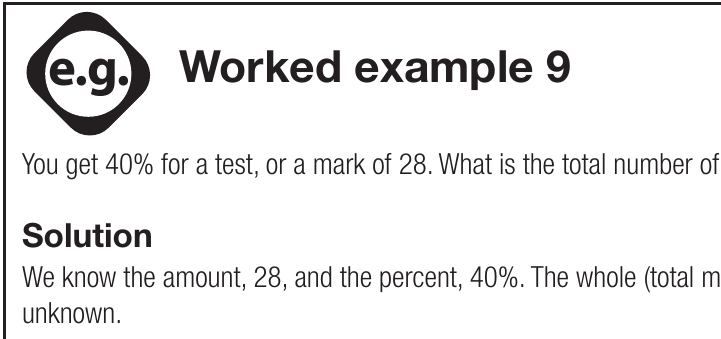
Question: You get 40% for a test, or a mark of 28. What is the total number of marks for the test?
Solution:
- We know: amount = 28, percent = 40%, whole = unknown
- Write equation: percent × whole = amount
- Substitute: 40% × whole = 28
- Convert to decimal: whole = 28
- Simplify: 0.4 × whole = 28
- Divide both sides by 0.4: whole = = 70
Answer: The total marks for the test is 70.
Type 4: Percentage increase or decrease
These problems combine ordinary percentage calculations with addition or subtraction to find final amounts after changes.
Important
Rule for increases: new amount = whole + (percentage × whole)
Rule for decreases: new amount = whole - (percentage × whole)
Percentage increase (adding to an amount)
When a price increases by a percentage, you add the increase to the original price.
Example
Worked Example: Percentage Increase - Method 1 (Two-step method)
Question: The price of petrol increases by 12%. The original price was R10.70 per litre. What is the new petrol price?
Solution:
- Step 1: Calculate the increase: 12% × R10.70 = 0.12 × R10.70 = R1.284
- Step 2: Add to original: R10.70 + R1.284 = R11.984
- Round to nearest cent: R11.98
Note
Alternative Method 2 (One-step method):
- New price = 100% + 12% = 112% of old price
- New price = 1.12 × R10.70 = R11.98
Example
Worked Example: Reverse Percentage Calculation
Question: Nomalizo receives a salary increase of 7%. If her new salary is R10 600, what was her salary before the increase?
Solution:
- New salary = original salary + 7% of original salary
- R10 600 = 107% of original salary
- R10 600 = 1.07 × original salary
- Original salary = = R9 907
Percentage decrease (taking away from an amount)
When a price decreases by a percentage, you subtract the decrease from the original price.
Example
Worked Example: Percentage Decrease
Question: A pair of jeans is on sale with a mark down of 20%. If the original price was R199.00, what is the sale price?
Method 1 (Two-step):
- Calculate discount: 20% × R199 = 0.2 × R199 = R39.80
- Subtract from original: R199 - R39.80 = R159.20
Method 2 (One-step):
- Sale price = 100% - 20% = 80% of normal price
- Sale price = 0.8 × R199 = R159.20
Working with VAT
VAT (Value Added Tax) is a 14% tax added to most goods and services. Understanding VAT calculations is essential for real-world applications.
Important
Key concepts:
- VAT-inclusive price: The marked price you see in shops (includes 14% VAT)
- VAT-exclusive price: The price before VAT is added
Critical rule: You cannot calculate VAT directly from a VAT-inclusive price. You must first find the VAT-exclusive price.
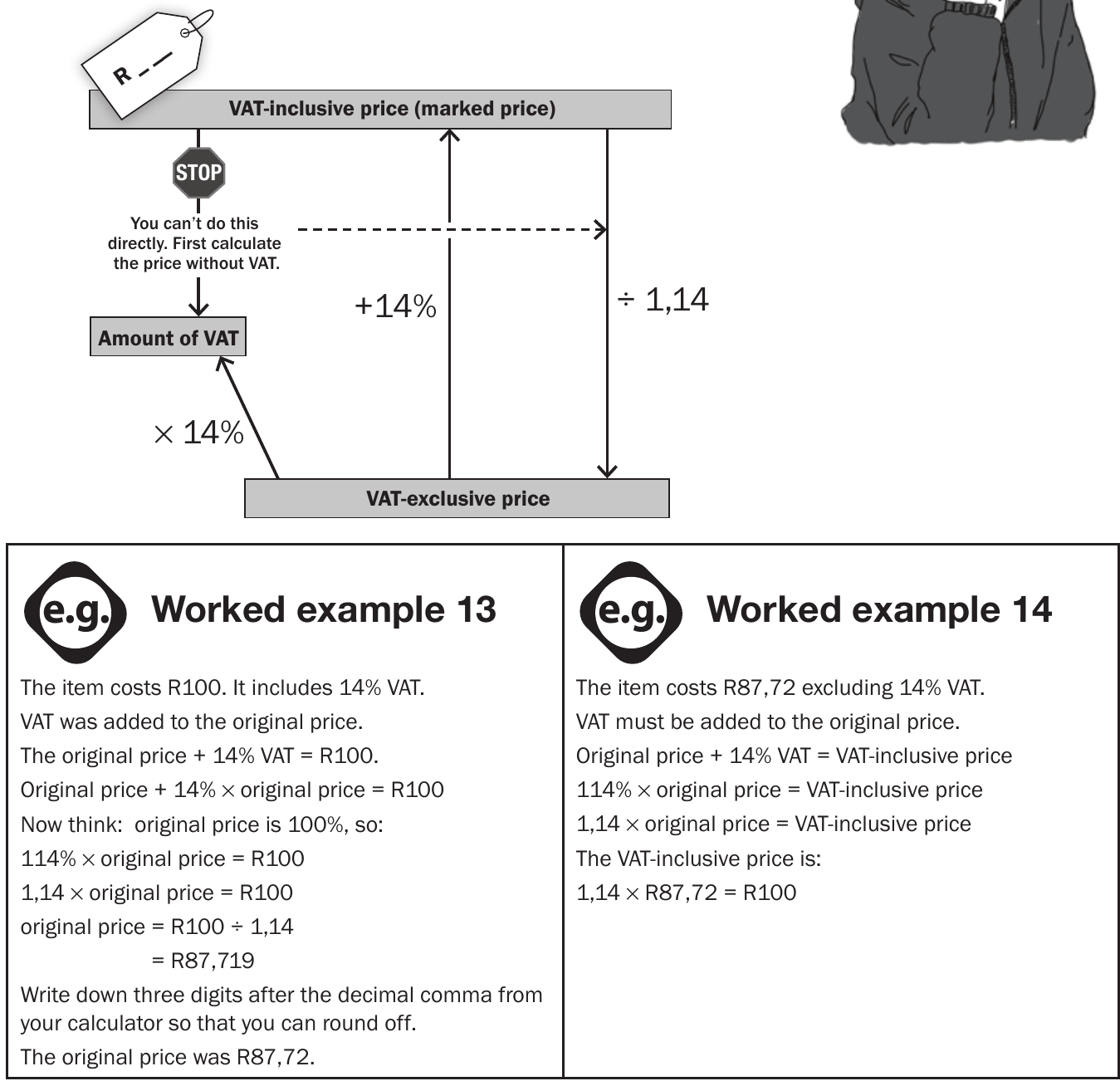
VAT calculation methods
From VAT-exclusive to VAT-inclusive:
- VAT-inclusive price = VAT-exclusive price × 1.14
From VAT-inclusive to VAT-exclusive:
- VAT-exclusive price = VAT-inclusive price ÷ 1.14
Example
Worked Example: Adding VAT
Question: An item costs R87.72 excluding 14% VAT. What is the VAT-inclusive price?
Solution:
- VAT-inclusive price = 1.14 × R87.72 = R100.00
Example
Worked Example: Removing VAT
Question: An item costs R100 including 14% VAT. What was the original price before VAT?
Solution:
- Original price = R100 ÷ 1.14 = R87.719
- Round to nearest cent: R87.72
Exam tips and common mistakes
Important
Common Pitfalls to Avoid:
- Always read questions carefully to identify which calculation method to use
- Remember that "of" means multiply in mathematical contexts
- Always round money calculations to the nearest cent
- Check your calculator's key sequences - some calculators work differently
- For VAT problems, never try to calculate directly from inclusive to exclusive prices
Summary
Key Points to Remember:
- The fundamental rule: percent × whole = new amount - this applies to all percentage problems
- Identify the unknown: Look for which of the three parts (percent, whole, amount) you need to find
- Word clues matter: "of" means multiply, "increase" means add, "decrease" means subtract
- VAT calculations: Use 1.14 to convert between inclusive and exclusive prices - never calculate directly
- Always round money: Round all monetary answers to the nearest cent for accuracy