The Nature of the Roots (Grade 12 NSC Matric Mathematics): Revision Notes
📚Revision Notes
The Nature of the Roots
Understanding the nature of the roots
The discriminant is a powerful tool that reveals important information about quadratic equations before we even solve them. When we have a quadratic equation in the standard form , the roots are the values of that make the equation equal to zero. These roots also represent the x-intercepts of the parabola when we graph the quadratic function.
The discriminant (Δ) is the expression found under the square root in the quadratic formula. This single value tells us everything we need to know about the nature of the roots without actually calculating them.
Note
The discriminant acts like a "crystal ball" for quadratic equations - it predicts exactly what type of solutions we'll get before we do any complex calculations!
How to determine the nature of the roots
The discriminant allows us to classify roots into three distinct categories based on its value.
When Δ < 0: Non-real roots
When the discriminant is negative, we encounter non-real or complex roots. This happens because we cannot find the square root of a negative number in the real number system.
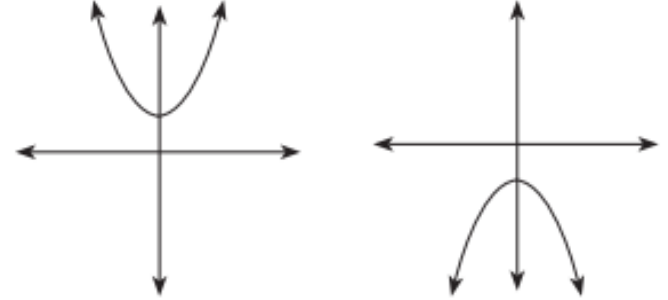
Graphically, this means the parabola does not intersect the x-axis at any point. The parabola either sits entirely above the x-axis (if ) or entirely below it (if ).
Important
Remember: When , there are no real solutions to the quadratic equation, and the parabola never touches the x-axis.
When Δ = 0: Equal roots
When the discriminant equals zero, we get exactly one real, equal, and rational root. This is also called a repeated root or double root.
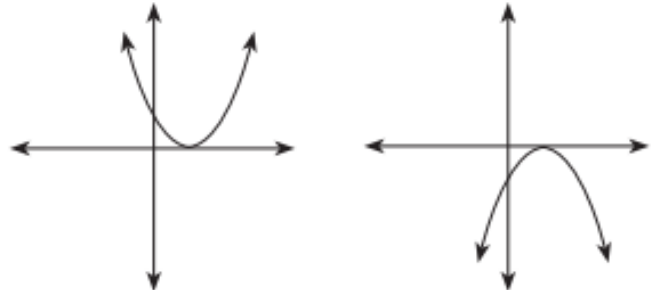
The parabola touches the x-axis at exactly one point, creating what we call a turning point. The vertex of the parabola lies on the x-axis.
When Δ > 0: Two distinct real roots
When the discriminant is positive, we always get two real and unequal roots. However, we need to examine the discriminant more closely:
- If Δ is a perfect square, the roots are rational numbers
- If Δ is not a perfect square, the roots are irrational numbers
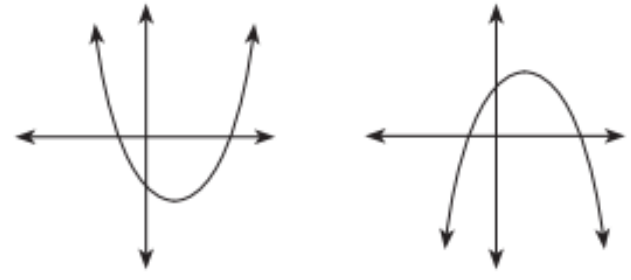
The parabola intersects the x-axis at two distinct points, giving us two separate x-intercepts.
Note
Quick Check Method: To determine if a number is a perfect square, see if its square root is a whole number. For example, (whole number), so 25 is a perfect square.
Worked examples
Example
Worked Example 1: Rational Roots
For the equation with roots :
Step 1: Identify the discriminant
The discriminant is 25.
Step 2: Analyse the discriminant
Since , it is a perfect square and .
Step 3: Determine the nature
The roots are real, rational, and unequal.
Example
Worked Example 2: Irrational Roots
For the equation with roots :
Step 1: Identify the discriminant
The discriminant is 24.
Step 2: Analyse the discriminant
Since 24 is not a perfect square and .
Step 3: Determine the nature
The roots are real, irrational, and unequal.
Example
Worked Example 3: Non-real Roots
For the equation with roots :
Step 1: Identify the discriminant
The discriminant is -9.
Step 2: Analyse the discriminant
Since .
Step 3: Determine the nature
Since we cannot find the square root of a negative number in real numbers, the roots are non-real.
Finding the value of k for equal roots
When a quadratic equation contains a parameter and we need equal roots, we set the discriminant equal to zero.
Example
Worked Example: Equal Roots with Parameter
Find if the equation has equal roots.
Step 1: Set the discriminant equal to zero
For equal roots, the expression under the square root must equal zero:
Step 2: Solve for the parameter
Therefore, when , the equation will have equal roots.
Problem solving using quadratic equations
Real-world problems often lead to quadratic equations where we must consider the practical meaning of our solutions.
Example
Worked Example: Rectangle Dimensions
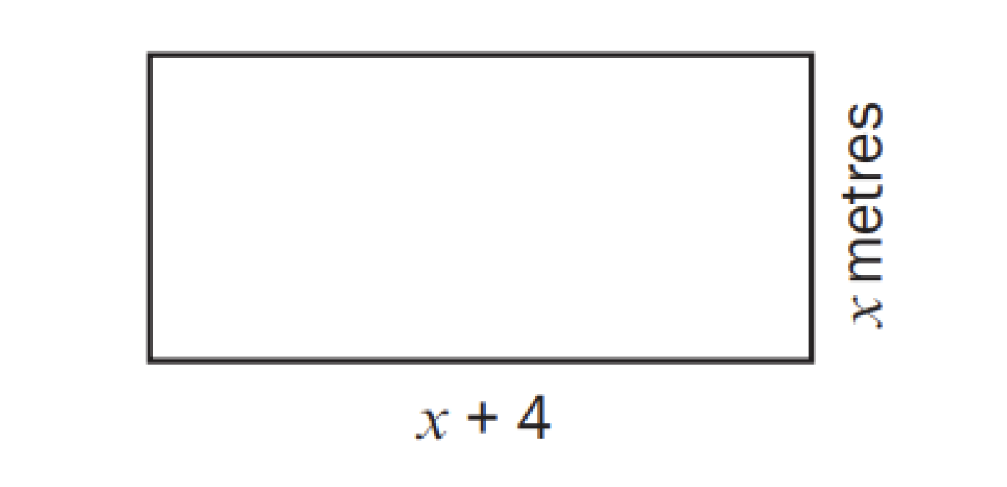
Given: Area = 12 m² and the length is 4 m longer than the breadth.
Step 1: Define variables
- Let breadth = metres
- Then length = metres
Step 2: Set up the equation
- Using Area = length × breadth:
Step 3: Solve by factorising
- So or
Step 4: Consider practical constraints
- Since length and breadth must be positive, we reject .
- Therefore .
Step 5: Find final dimensions
- Breadth = 2 m
- Length = 6 m
Important
Exam Tip: Always check whether negative solutions make sense in the context of the problem. In geometry problems involving measurements, negative values are typically rejected.
Summary
Key Points to Remember:
- The discriminant determines the nature of the roots without solving the equation
- x-intercepts on the graph correspond directly to the real roots of the equation
- Equal roots occur when , creating a turning point on the x-axis
- In real-life problems, always consider whether negative solutions are practically meaningful
- Perfect squares under the discriminant give rational roots, while non-perfect squares give irrational roots