Applications of Differential Calculus (Grade 12 NSC Matric Mathematics): Revision Notes
📚Revision Notes
Applications of Differential Calculus
Optimisation problems
Optimisation problems are mathematical problems where we need to find the maximum or minimum value of a quantity. These problems appear frequently in real-world situations such as maximising profits, minimising costs, or finding the most efficient solutions.
Differential calculus provides us with powerful tools to solve these problems by finding stationary points - points where the rate of change is zero.
Finding the optimum point
To solve optimisation problems, follow this systematic approach:
- Set up the problem - Define variables and write equations
- Express the quantity to optimize - Write as a function of one variable only
- Find the derivative and set it equal to zero:
- Solve for the critical values
- Use the second derivative test to determine if it's a maximum or minimum
- Write the final answer in context
Important
The quantity to be optimised must be expressed in terms of only one variable before you can differentiate and find the optimum point.
Second derivative test
Once you find the stationary points by setting , use the second derivative to classify them:
- If , then gives a local maximum
- If , then gives a local minimum
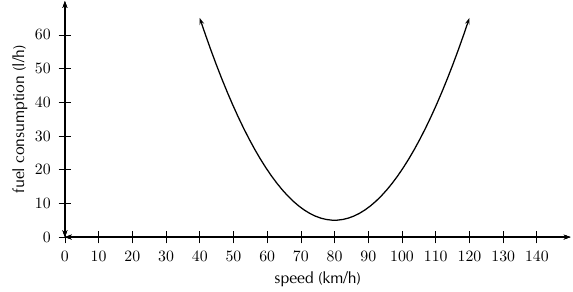
The fuel consumption graph above shows a classic optimisation problem where there is an optimal speed that minimises fuel usage.
Example
Worked Example 1: Maximising a Product
Question: The sum of two positive numbers is 10. One number is multiplied by the square of the other. Find the numbers that make this product maximum.
Solution:
Step 1: Set up the equations Let the two numbers be and , with product .
- ... (1)
- ... (2)
Step 2: Express in terms of one variable
From equation (1):
Substitute into equation (2):
Expanding:
Step 3: Find the derivative
Step 4: Find stationary points
Set :
Using factorisation:
Therefore: or
Step 5: Check which gives maximum using second derivative
For :
This confirms gives a maximum.
Step 6: Find the corresponding value of b
When :
Answer: The two numbers are and that give the maximum product.
Example
Worked Example 2: Garden Fencing Optimization
Question: Michael wants to fence a rectangular vegetable garden using a wall as one border. He has 160 m of fencing. Calculate the dimensions that give the largest possible area.
Solution:
Step 1: Set up the problem Let width = and length =
- Area =
- Fencing needed: (since wall provides one side)
- Therefore:
Step 2: Express area in terms of one variable
From the constraint:
Area =
Step 3: Find the derivative
Step 4: Find stationary point
Set :
Step 5: Check it's a maximum
, confirming maximum
Step 6: Calculate width
Answer: The garden should be 80 m wide and 40 m long for maximum area.
Note
Important Optimisation Tips:
- Always check your answer makes practical sense in the real-world context
- Consider the domain restrictions (e.g., dimensions must be positive)
- Use the second derivative test to confirm whether you have a maximum or minimum
Rates of change
Rate of change describes how fast one quantity changes with respect to another. In mathematics, we can represent these changes using derivatives.
Understanding rates of change is fundamental in many real-world applications, from analysing motion to studying economic trends and population growth.
Average vs instantaneous rates of change
Average rate of change =
Instantaneous rate of change =
Note
When we simply mention "rate of change," we typically mean the instantaneous rate of change (the derivative).
Velocity and acceleration
Velocity is one of the most common applications of rates of change:
- Average velocity = Average rate of change of distance
- Instantaneous velocity = Instantaneous rate of change of distance = Derivative
If represents distance at time , then:
- Velocity:
- Acceleration:
Important
Acceleration is the rate of change of velocity, which means it's the second derivative of distance. This relationship is crucial for understanding motion problems.
Example
Worked Example 3: Golf Ball Motion Analysis
Question: The height (in metres) of a golf ball seconds after being hit is given by . Find:
- The average velocity during the first two seconds
- The velocity after 1.5 s
- The time when velocity is zero
- The velocity when hitting the ground
- The acceleration
Solution:
Step 1: Average velocity in first two seconds
Average velocity =
- =
- =
Step 2: Instantaneous velocity
Velocity after 1.5 s:
Step 3: Time when velocity is zero
Set :
The velocity is zero after 2 seconds.
Step 4: Velocity when hitting ground
Ball hits ground when :
- or
The ball hits the ground after 4 seconds.
Velocity at :
The negative sign indicates downward motion.
Step 5: Acceleration
The acceleration is constant at (due to gravity).
Key formulas for rates of change
- Average rate of change =
- Instantaneous rate of change =
- Velocity = where = distance, = time
- Acceleration = where = velocity
Summary
Key Points to Remember:
- Set to find stationary points for optimisation problems
- Use the second derivative test to determine maximum or minimum
- Express optimisation problems in terms of one variable only before differentiating
- Rate of change problems often involve velocity (first derivative) and acceleration (second derivative)
- Always check your answers make practical sense in the context of the problem