Limits (Grade 12 NSC Matric Mathematics): Revision Notes
📚Revision Notes
Limits
What are limits?
Limits are a fundamental concept in calculus that help us understand how functions behave as we approach specific values. A limit describes the value that a function gets closer and closer to, even if it never actually reaches that value.
Think of limits as asking the question: "What happens to the function values as we get very close to a particular x-value?"
Note
The key idea is that we're interested in the behaviour of a function near a point, not necessarily at that exact point. This becomes especially important when the function is undefined at that point.
Understanding limits through examples
Let's examine a function to see how limits work in practice. Consider the rational function:
We can factorise the numerator:
When , we can cancel the common factor , leaving us with .
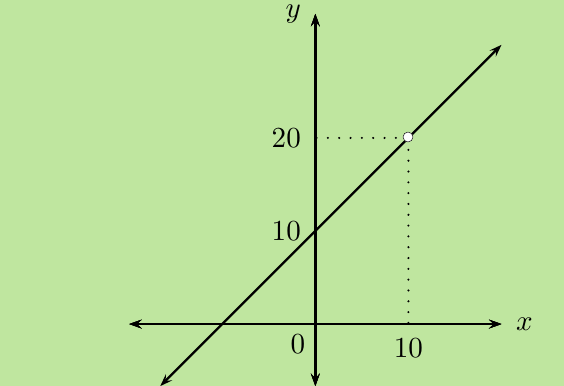
However, when , the denominator becomes zero, making the function undefined at this point. But we can still investigate what happens as approaches .
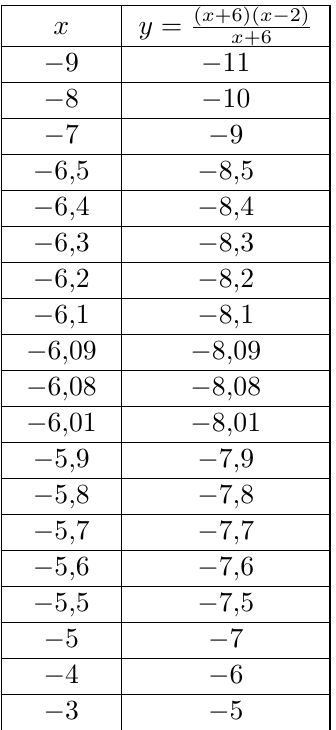
The table shows that as gets closer and closer to from both sides, the -values approach . This means the limit of the function as approaches is .
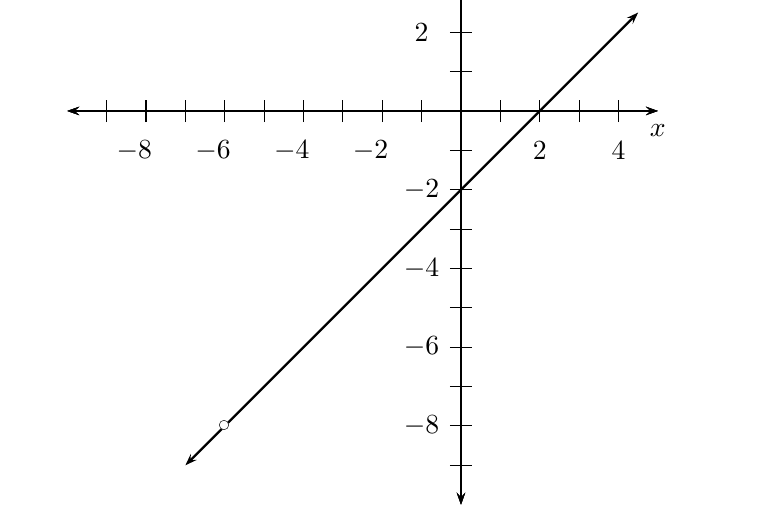
The graph shows a straight line with a "hole" at , where the function would equal if it were defined there.
Limit notation
We use special mathematical notation to express limits:
Important
This reads: "The limit of as approaches equals "
For our previous example, we write:
Example
Worked Example: Basic Limit Notation
Question: Write the following using limit notation: as gets close to , the value of the function approaches .
Solution: This is written as:
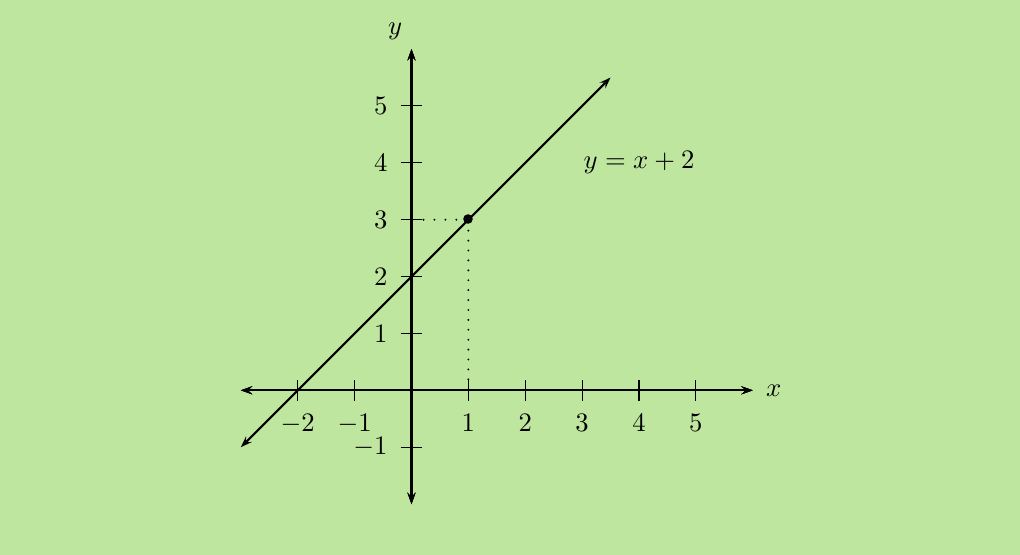
The diagram shows that when , the function equals .
One-sided limits
Sometimes a function approaches different values depending on whether we approach from the left or the right side.
- Left-hand limit: (approaches from the left)
- Right-hand limit: (approaches from the right)
Important
When both one-sided limits exist and are equal, the limit exists. When they're different, the limit does not exist.
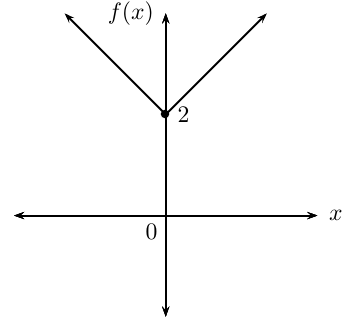
This absolute value function demonstrates how limits can vary based on the direction of approach.
Example
Worked Example: Simple Limits
Question: Determine:
Solution:
Step 1: Simplify the expressions
We cannot simplify further and there are no terms to cancel.
Step 2: Calculate the limits
- (constant function)
Example
Worked Example: Rational Function Limits
Question: Determine:
Solution:
Step 1: Simplify the expression
Factorise the numerator:
Step 2: Cancel common terms
Step 3: Calculate the limit
Gradient at a point
The concept of limits helps us find the gradient (slope) of a curve at any specific point. This connects to the idea of tangent lines.
Average gradient vs instantaneous gradient
The average gradient between two points on a curve is calculated using:
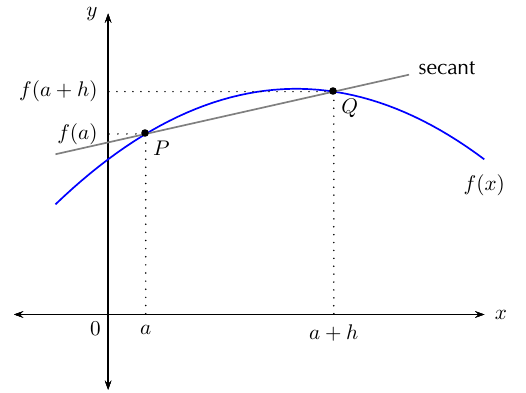
As point moves closer to point , the secant line approaches the tangent line.
Gradient at a point formula
The gradient at a point (instantaneous gradient) is found using limits:
Important
This formula is fundamental to differential calculus and forms the basis for finding derivatives.
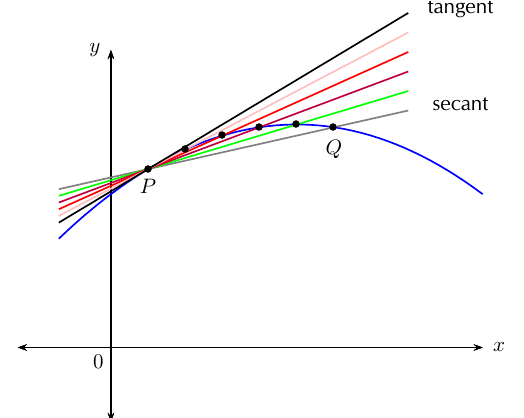
This diagram shows how multiple secant lines approach the tangent line as the second point gets closer to the first.
Example
Worked Example: Finding Gradient at a Point
Question: Given , determine the gradient of the curve at the point .
Solution:
Step 1: Write the gradient formula
Step 2: Determine and
With :
Step 3: Substitute and simplify
Step 4: Final answer
The gradient of the curve at is .
Example
Worked Example: More Complex Gradient Calculation
Question: Given , determine the gradient of the tangent to the curve at .
Solution:
Step 1: Write the gradient formula
Step 2: Determine and
With :
Step 3: Substitute and simplify
Step 4: Final answer
The gradient of the tangent to the curve at is .
Note
Remember that finding the gradient at a point using limits is essentially finding the derivative of the function at that point. This connection between limits and derivatives is one of the most important relationships in calculus.
Summary
Key Exam Tips:
- Always check if direct substitution works first - if it doesn't give or , that's your answer
- Factorise and cancel when you get indeterminate forms like
- Remember the gradient formula - it's the foundation for derivatives
- One-sided limits may be different - check both sides
- Show all working clearly - examiners want to see your method
Summary
Key Points to Remember:
- Limits describe what value a function approaches, not necessarily what it equals
- Use the notation to express limits mathematically
- One-sided limits from left () and right () must be equal for the limit to exist
- The gradient at a point is found using
- Secant lines approach the tangent line as points get closer together