The Number System (Grade 12 NSC Matric Mathematics): Revision Notes
📚Revision Notes
The Number System
Understanding real numbers
Real numbers form the foundation of mathematics and include all the numbers we use in everyday calculations. These numbers are organised into different subsets, each with specific characteristics and properties. Understanding these subsets is crucial for working with exponents and surds effectively.
The real number system follows a hierarchical structure where each subset is contained within larger subsets. This relationship can be visualised through a diagram that shows how natural numbers are contained within whole numbers, which are contained within integers, and so on.
Note
The hierarchical nature of number systems means that every number in a smaller subset automatically belongs to all the larger subsets that contain it. For example, the number 5 is simultaneously a natural number, whole number, integer, rational number, and real number.
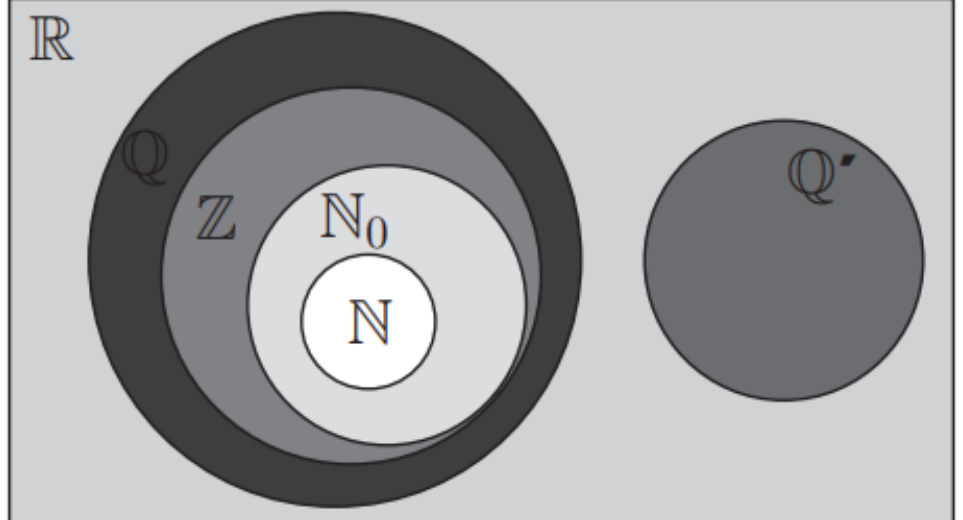
Natural numbers (N)
Natural numbers are the counting numbers we learn first in mathematics. They represent quantities in the real world and form the smallest subset in our number system.
Definition: Natural numbers are positive whole numbers used for counting.
Examples: 1, 2, 3, 4, 5, ...
These numbers start from 1 and continue infinitely. They exclude zero, fractions, decimals, and negative numbers. Natural numbers are fundamental to understanding all other number types.
Whole numbers (N₀)
Whole numbers extend natural numbers by including zero. This addition makes whole numbers useful for representing situations where "nothing" needs to be counted.
Definition: Whole numbers are natural numbers including zero.
Examples: 0, 1, 2, 3, 4, 5, ...
The inclusion of zero allows whole numbers to represent empty sets or starting points in mathematical contexts. Every natural number is a whole number, but zero is a whole number that is not a natural number.
Integers (Z)
Integers expand our number system to include negative numbers. This expansion is essential for representing concepts like debt, temperature below zero, or positions below a reference point.
Definition: Integers include all whole numbers, both positive and negative.
Examples: ..., -3, -2, -1, 0, 1, 2, 3, ...
Note
Integers allow us to perform subtraction without restriction. When we subtract a larger number from a smaller number, the result is a negative integer. This capability makes integers crucial for algebraic operations.
Every whole number is an integer, but negative numbers are integers that are not whole numbers.
Rational numbers (Q)
Rational numbers represent quantities that can be expressed as fractions. This subset includes many of the numbers we encounter in practical situations involving parts of wholes.
Definition: Rational numbers are any numbers that can be written as a fraction , where and are integers and .
Examples include:
- Fractions: ,
- Decimals that terminate: 0.25, 1.5
- Recurring decimals: 0.333... (or ), 2.727272...
Every integer is also a rational number because any integer can be written as a fraction with denominator 1. For example, . Rational numbers can be converted between fraction and decimal forms, and their decimal representations either terminate or repeat in a pattern.
Irrational numbers (Q')
Irrational numbers cannot be expressed as simple fractions. These numbers have decimal representations that continue forever without repeating patterns.
Definition: Irrational numbers cannot be written as fractions. Their decimal forms never terminate and never repeat.
Examples include:
- Surds: ,
- Special constants: (pi ≈ 3.14159...)
Important
Irrational numbers often arise when we calculate square roots of numbers that are not perfect squares. Understanding irrational numbers is particularly important when working with surds in algebra.
Real numbers (R)
Real numbers combine all rational and irrational numbers into one complete system. This system includes every number that can be placed on a number line.
Definition: Real numbers are the set of all rational and irrational numbers combined.
Examples: -3, 0, 2.5, ,
Real numbers can represent any quantity that can be measured or calculated in practical situations. They form a continuous number line with no gaps between values.
Non-real (imaginary) numbers
When we attempt to find square roots of negative numbers, we encounter values that cannot be represented on the real number line. These are called non-real or imaginary numbers.
Important
Non-real numbers result when you try to find the square root (or any even root) of a negative number. Since no real number multiplied by itself gives a negative result, these square roots exist outside the real number system.
Example: is not real because there is no real number whose square equals -25.
In mathematics, non-real numbers are represented using , where:
This imaginary unit allows us to work with square roots of negative numbers in a systematic way.
Worked example: quadratic formula with non-real solutions
Example
Worked Example: Solving a Quadratic with Non-Real Solutions
Let's examine how non-real numbers appear in practical mathematical problems:
Solve using the quadratic formula:
The quadratic formula is:
Step 1: Identify coefficients
- , ,
Step 2: Substitute into the formula
Step 3: Recognise the non-real result
Since is non-real, this equation has no real solutions.
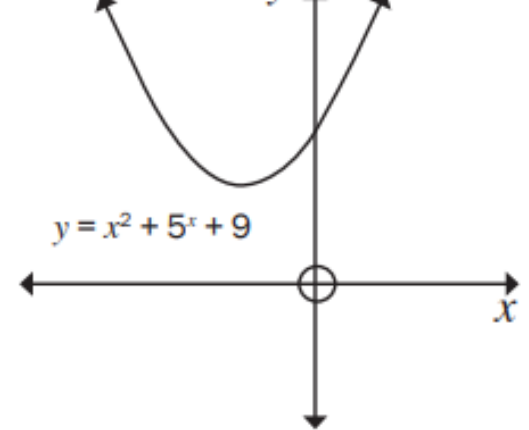
This graph shows the parabola . Notice that the curve does not intersect the x-axis, which confirms that the equation has no real solutions.
Important
Exam Tips and Common Traps
- Always check whether square roots involve negative numbers - if so, the result is non-real
- Remember that rational numbers include integers, whole numbers, and natural numbers
- When classifying numbers, consider the most specific category they belong to
- Terminating and recurring decimals are always rational
- and square roots of non-perfect squares are always irrational
Summary
Key Points to Remember:
-
Real numbers are organised in a hierarchy: Natural ⊂ Whole ⊂ Integers ⊂ Rational ⊂ Real
-
Rational numbers can be written as fractions or decimals that terminate or repeat in patterns
-
Irrational numbers have decimal forms that never terminate and never repeat (like and )
-
Non-real numbers occur when finding even roots of negative numbers, leading to expressions involving
-
Quadratic equations with negative discriminants have non-real solutions, meaning their graphs don't cross the x-axis