Functions (Grade 12 NSC Matric Mathematics): Revision Notes
📚Revision Notes
Exponential Functions & Logarithms
What are exponential functions?
An exponential function is a mathematical function where a constant base is raised to a variable power. The general form is:
where:
- is the base (a positive constant)
- is the exponent or index (the variable)
- and
Understanding exponents
An exponent tells us how many times to multiply the base by itself. For example:
- The base is 10, the exponent is 3
Note
The exponent or index is the key feature that makes exponential functions so powerful in modelling growth and decay patterns in real-world situations.
Behaviour of exponential functions
The value of the base determines how the exponential function behaves:
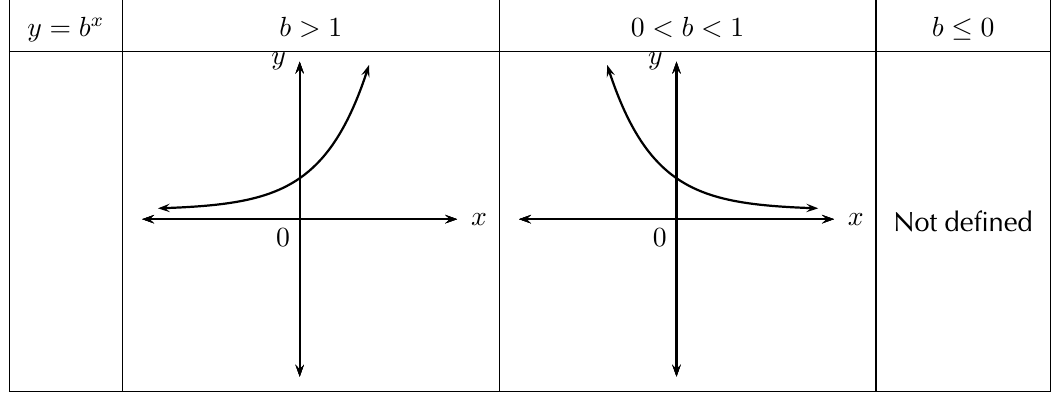
When (exponential growth)
- The function is increasing
- The graph rises steeply from left to right
- As increases, grows rapidly
- As decreases, approaches zero
When (exponential decay)
- The function is decreasing
- The graph falls from left to right
- As increases, approaches zero
- As decreases, grows rapidly
Important
When : The function is not defined for real numbers. This is a critical restriction that must always be remembered.
Finding inverse functions
When we want to find the inverse of an exponential function, we face a problem. Consider :
To find the inverse, we interchange and :
However, we cannot easily solve for when it appears as an exponent. This is where logarithms come to our rescue.
Note
The challenge of solving for is what led mathematicians to develop the concept of logarithms as a new mathematical operation.
Introduction to logarithms
Definition: If , then , where , and .
This means that logarithms are the inverse functions of exponentials. The logarithm answers the question: "To what power must I raise the base to get ?"
Restrictions on logarithms
Important
Critical Restrictions on Logarithms:
- : If is negative, then oscillates between positive and negative values
- : Since , we cannot find unique logarithm values
- : Since , we can only take logarithms of positive numbers
Converting between forms
To find the inverse of :
- Interchange and :
- Make the subject:
Therefore, if , then .
Example
Worked Example: Exponential to Logarithmic Form
Question: Write the following exponential expressions in logarithmic form:
Solution: Remember: is the same as
In words:
- 2 is the power to which 5 must be raised to give 25
- -3 is the power to which 10 must be raised to give 0.001
- is the power to which must be raised to give
Example
Worked Example: Logarithmic to Exponential Form
Question: Write the following logarithmic expressions in exponential form:
Solution: For , we can write
Types of logarithms
Common logarithm
The common logarithm has base 10 and can be written as . When no base is shown, we assume base 10.
Natural logarithm
The natural logarithm has base (approximately 2.71) and can be written as .
Special logarithmic values
Note
Two Important Values to Remember:
- (because )
- (because )
These values are fundamental and appear frequently in logarithmic calculations.
Laws of logarithms
These laws help us simplify logarithmic expressions:
Power law
Example
Worked Example: Applying the Power Law
Question: Determine the value of .
Solution:
Step 1: Apply the logarithmic law
Change of base formula
Special applications of change of base
Example
Worked Example: Change of Base
Question: Show that .
Solution:
Using the change of base formula:
Right-hand side
Left-hand side
Therefore, .
Using calculators for logarithms
Finding logarithmic values
Most scientific calculators have three logarithm buttons:
- log: for common logarithms (base 10)
- ln: for natural logarithms (base e)
- log with base: for logarithms with any base
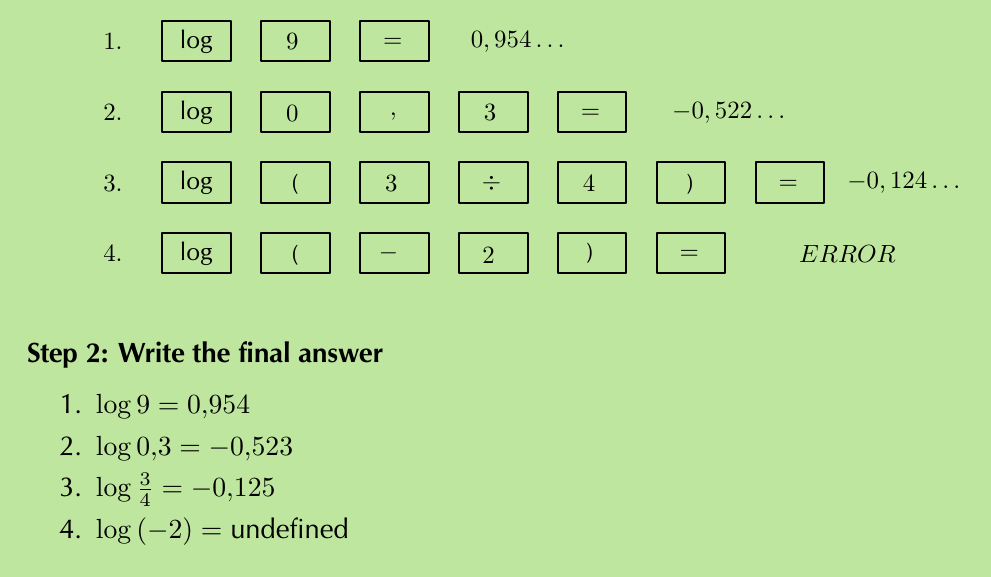
Important
Important Calculator Tips:
- Do not round intermediate steps - this can cause errors
- Perform calculations in one step on your calculator when possible
- Be familiar with the "2ndF" or "SHIFT" button for inverse functions
Example
Worked Example: Using a Calculator
Question: Use a calculator to find correct to two decimal places.
Solution:
Step 1: Apply change of base formula
Step 2: Use calculator in one step
Enter:
Therefore,
Graphs of logarithmic functions
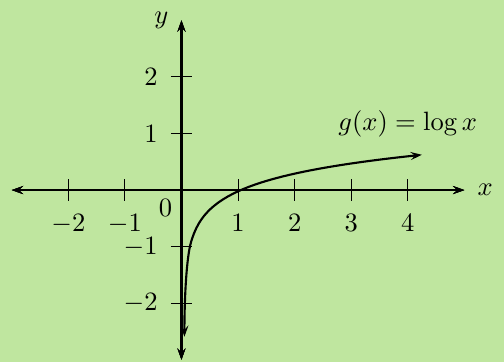
Basic logarithmic function properties
For where and :
Note
Key Properties of Logarithmic Functions:
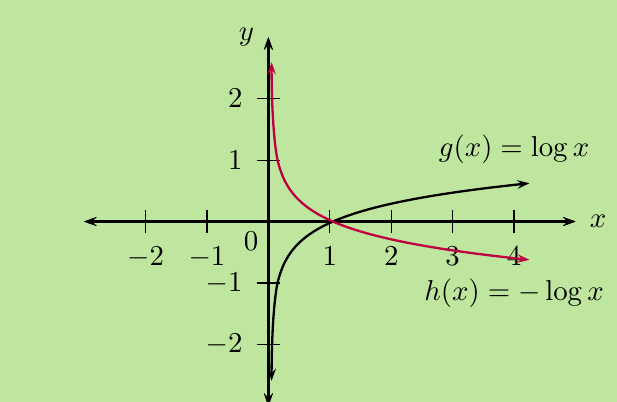
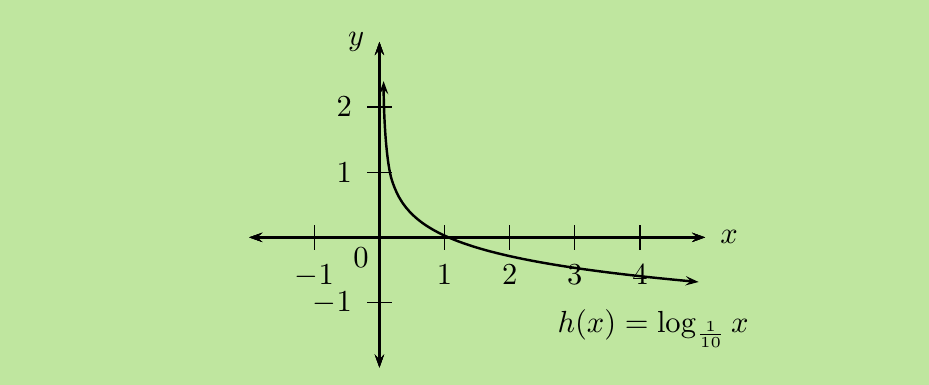
- Domain:
- Range:
- x-intercept:
- Vertical asymptote: (y-axis)
- Shape: increasing if , decreasing if
Relationship between exponential and logarithmic graphs
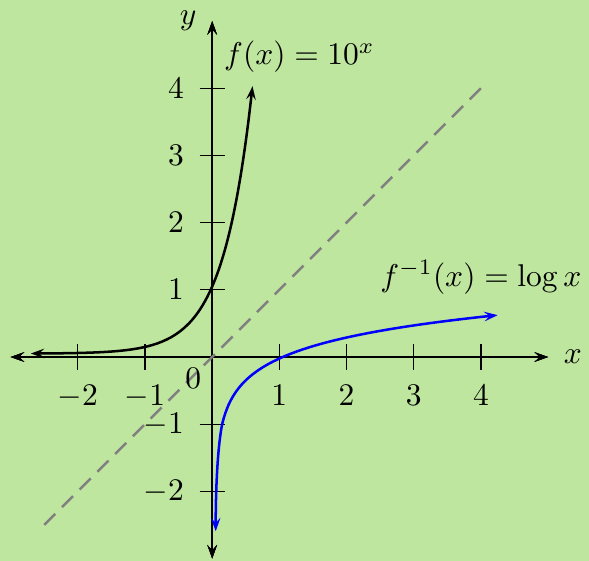
Exponential and logarithmic functions are inverses of each other. This means:
- The domain of one equals the range of the other
- Their graphs are reflections of each other about the line
- If is on the exponential graph, then is on the logarithmic graph
Applications of logarithms
Logarithms have many practical applications in real-world situations:
Population growth
Formula:
Where is final amount, is initial amount, is growth rate, and is time period.
Example
Worked Example: Population Growth
Question: A city's population grows by 5% every two years. How long will it take for the population to triple?
Solution: Step 1: Set up the equation
Let , then
Growth rate
Time period is every 2 years, so we use
Step 2: Take logarithm of both sides
Answer: It will take approximately 45 years for the population to triple.
Other applications include:
- Seismology: calculating earthquake magnitudes
- Finance: compound interest calculations
- Science: radioactive decay rates
- Biology: population growth rates
- Chemistry: pH levels
Key graph summary
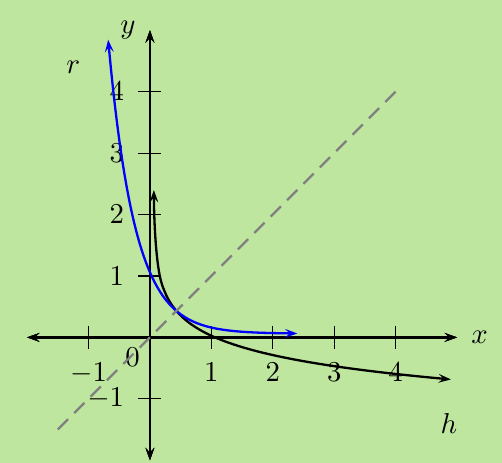
For exponential functions and logarithmic functions :
- When : exponential shows growth, logarithmic increases slowly
- When : exponential shows decay, logarithmic decreases
- Both functions pass through key points that are inverses of each other
- The line serves as the axis of symmetry between inverse functions
Summary
Key Points to Remember:
- Exponential functions have the form where the variable is in the exponent
- Logarithms are the inverse of exponentials - they answer "what power gives this result?"
- Key restrictions: base must be positive and not equal to 1, argument must be positive
- Special values: and for any valid base
- Use laws of logarithms to simplify complex expressions, especially the power law