Functions and Relations (Grade 12 NSC Matric Mathematics): Revision Notes
📚Revision Notes
Functions and Relations
Understanding the difference between functions and relations is crucial for mastering algebra and coordinate geometry. This concept forms the foundation for much of higher-level mathematics and appears frequently in NSC examinations.
Note
Functions and relations are among the most frequently tested topics in NSC Mathematics examinations, appearing in both algebraic and graphical contexts. Mastering these concepts early will significantly improve your performance in coordinate geometry and calculus.
What is a relation?
A relation is a rule that connects elements from one set to elements in another set. In mathematical terms, a relation associates each element of set A with at least one element in set B. Think of it as a way of pairing up numbers or values according to some rule.
The key characteristic of relations is that one input value can be connected to multiple output values. This flexibility makes relations broader than functions, but also means they don't always represent predictable mathematical relationships.
Note
The flexibility of relations makes them useful for describing many real-world situations where one input might legitimately produce multiple outputs, such as the relationship between a person and their phone numbers, or between a country and its cities.
What is a function?
A function is a special type of relation with a stricter rule. A function uniquely associates elements of one set (called the domain) with elements of another set (called the range). The crucial requirement is that each element in the input set maps to only one element in the output set.
Important
The Function Rule: Every input has exactly one output.
This is the fundamental property that distinguishes functions from general relations. If you can find even one input value that produces multiple outputs, then the relationship is not a function.
When working with functions, we use specific terminology:
- The domain is the set of all possible input values
- The range is the set of all possible output values
- The independent variable represents the input (usually x)
- The dependent variable represents the output (usually y)
Types of functions
Functions can be classified into different types based on how they map inputs to outputs.
One-to-one functions
In a one-to-one function, each input value corresponds to a unique output value, and each output value corresponds to only one input value. This creates a perfect pairing between inputs and outputs.
Example
Worked Example: One-to-One Function
Consider the function
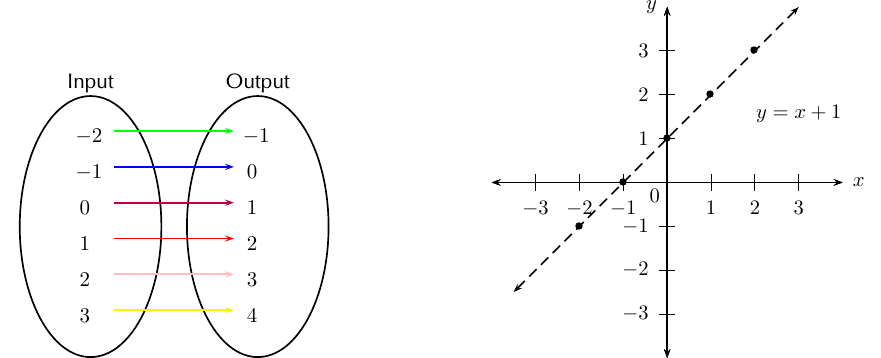
This linear function demonstrates a one-to-one relationship. Each input value produces a unique output value that no other input can produce. For instance:
- When ,
- When ,
- When ,
Notice that no other x-value will give the same y-value, making this a perfect one-to-one correspondence.
Many-to-one functions
In a many-to-one function, multiple input values can produce the same output value, but each input still produces only one output.
Example
Worked Example: Many-to-One Function
Consider the function
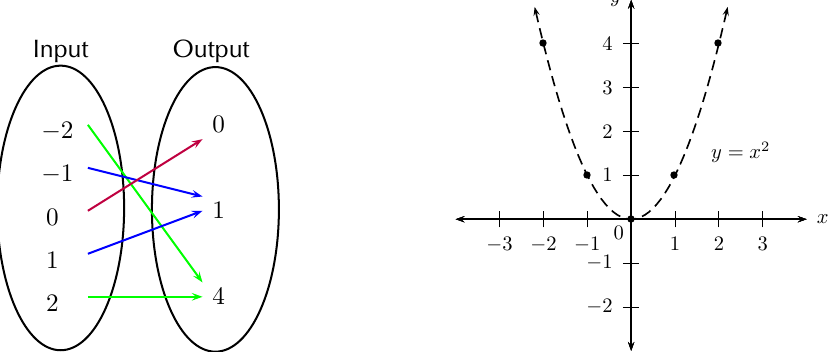
This quadratic function shows how different input values can produce identical outputs:
- When :
- When :
- When :
- When :
Both positive and negative values of x produce the same y-value, but each individual input still produces exactly one output.
When relations are not functions
Not every mathematical relationship qualifies as a function. Some common mathematical constructions fail the function test because single input values produce multiple outputs.
Important
One-to-Many Relations Are NOT Functions
Whenever a single input value produces multiple output values, the relationship violates the fundamental function rule and cannot be classified as a function.
Example
Worked Example: Circle Equation
Consider the circle with equation
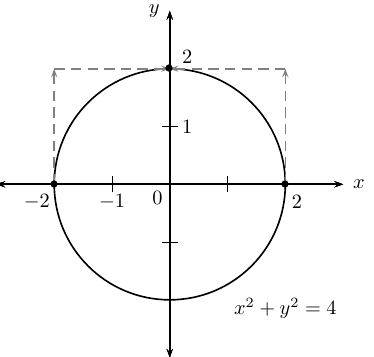
Let's test whether this is a function by substituting :
- (meaning or )
Since one x-value gives two different y-values and , this relation is not a function. The circle represents a one-to-many relationship, which violates the fundamental rule of functions.
The vertical line test
The vertical line test provides a simple visual method for determining whether a graph represents a function. This test works by imagining vertical lines drawn across the graph at different x-values.
Important
Vertical Line Test Rules:
- If any vertical line intersects the graph at more than one point, the relation is NOT a function
- If every possible vertical line intersects the graph at most once, the relation IS a function
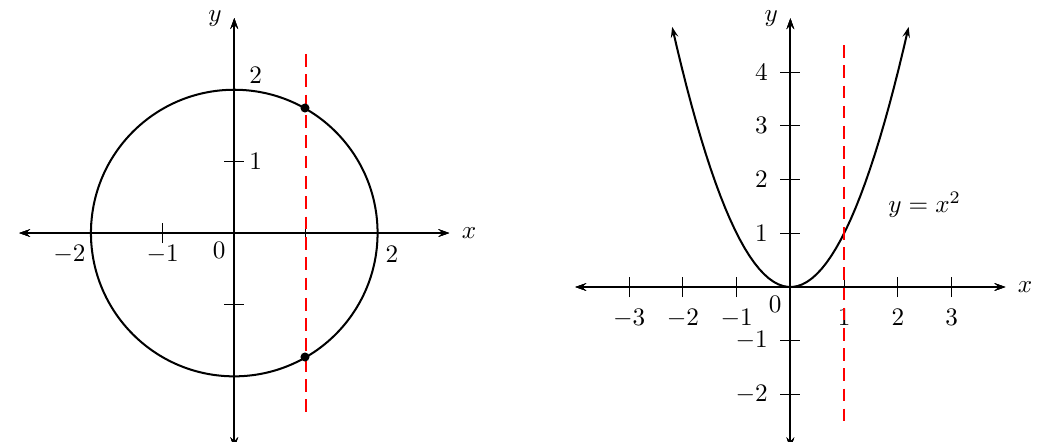
The diagram shows two examples:
- The circle fails the vertical line test because a vertical line can intersect it twice
- The parabola passes the vertical line test because any vertical line intersects it at most once
This visual test is particularly useful during examinations when you need to quickly identify functions from their graphs.
Summary
Key Points for Using the Vertical Line Test:
- Draw or imagine vertical lines at various x-positions across the graph
- Count intersection points for each vertical line
- More than one intersection = not a function
- One or zero intersections = function
Function notation
Function notation provides a standardised way to express and work with functions. Instead of writing , we use , where f represents the function name and x represents the input variable.
Key notation elements:
- indicates a general function relationship
- means "substitute x = 3 into the function f"
- defines a specific function rule
Working with function notation
Function notation allows us to work systematically with input and output values, making calculations more organised and clear.
Example
Worked Example: Function Evaluation
Given the function
Finding the output when given the input: If , then:
Finding the input when given the output: If , then:
Therefore, .
Introduction to inverse functions
An inverse function performs the "reverse" operation of the original function. If a function takes input x and produces output y, its inverse function takes input y and produces output x.
Key concepts:
- The inverse of function f is written as f⁻¹
- For inverse functions: if , then
- Only one-to-one functions have inverse functions
- A function with an inverse is called invertible
Note
Important Relationship: If you have a function and its inverse, applying one after the other returns you to your original value. Mathematically: and .
Example
Worked Example: Finding an Inverse Function
Given , find .
Step 1: Start with the function equation
Step 2: Interchange x and y variables
Step 3: Solve for y in terms of x
Step 4: Express in inverse function notation
Verification: Check that ✓
Exam tips and common errors
Understanding common pitfalls and effective strategies can significantly improve your performance in function-related exam questions.
Important
Common Exam Mistakes:
- Confusing relations with functions - remember the "one output per input" rule
- Incorrectly applying the vertical line test - look carefully for multiple intersections
- Mixing up domain and range terminology - domain is input, range is output
- Forgetting that not all functions have inverses - only one-to-one functions are invertible
Exam strategies:
- Use the vertical line test for quick graph analysis
- Check your function notation carefully - f(3) means substitute, not multiply
- When finding inverses, verify your answer by composition
- Practice identifying function types from graphs and equations
Summary
Essential Function Concepts to Remember:
- Functions require exactly one output for each input, while relations can have multiple outputs for one input
- The vertical line test quickly identifies functions from graphs - one intersection per vertical line means it's a function
- Function notation provides a clear way to express and evaluate mathematical relationships
- One-to-one functions can have inverses, while many-to-one functions cannot
- Domain refers to inputs and range refers to outputs - don't mix them up in exam answers