Inverse Functions (Grade 12 NSC Matric Mathematics): Revision Notes
📚Revision Notes
Inverse Functions
What is an inverse function?
An inverse function is a function that reverses the operation of another function. Think of it as "undoing" what the original function does.
More formally, if we have a function with domain , then is its inverse function when for every value of in the domain .
For a function to have an inverse, it must be a one-to-one relation. This means each input value produces exactly one output value, and each output value comes from exactly one input value. When a function has an inverse, we say the function is invertible.
Note
The concept of "undoing" is key to understanding inverse functions. Just like subtraction undoes addition, or division undoes multiplication, an inverse function undoes whatever operation the original function performs.
Understanding function notation
Before working with inverses, let's clarify the notation:
- indicates a function
- means we substitute a specific value into the function to get the corresponding value
- indicates the inverse function
- means we substitute a specific value into the inverse to return the specific value
Note
Understanding this notation is crucial for working with inverse functions. The superscript in is not an exponent - it's simply the symbol we use to denote the inverse function.
How to find the inverse of a function
To determine the inverse of a given function , follow these three steps:
- Interchange x and y in the equation
- Make y the subject of the equation
- Express the new equation in function notation
Example
Worked Example: Finding an Inverse Function
Let's find the inverse of :
Step 1: Start with , then interchange and
Step 2: Make the subject
Step 3: Express in function notation
Verification: If and , then: ✓
Graphical representation of inverse functions
When we graph a function and its inverse function , the two graphs are reflections of each other about the line y = x.
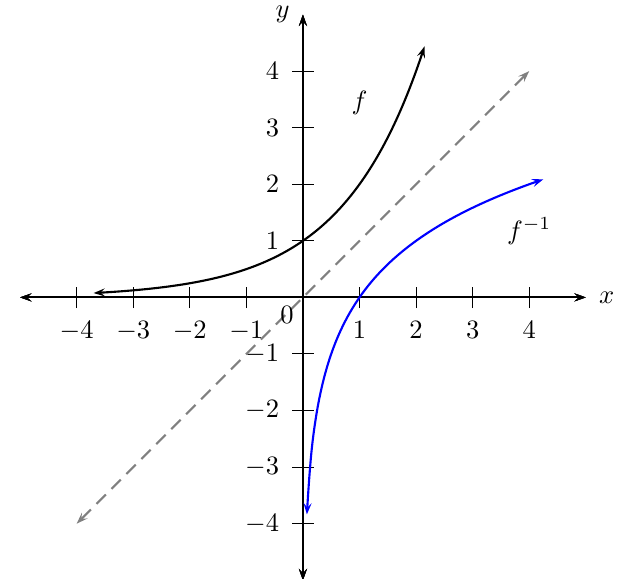
This diagram shows an exponential function (black curve) and its inverse (blue curve) reflected about the line (grey dashed line).
Note
Any point on the line has - and -coordinates with the same numerical value, such as and . This is why interchanging the - and -values makes no difference when finding inverses.
Important distinction: inverse vs reciprocal
Important
Be very careful not to confuse the inverse of a function with the reciprocal of a function. These are completely different concepts.
Key differences:
Inverse function
- Notation:
- and are symmetrical about the line
- Example: If , then
Reciprocal function
- Notation:
- Relationship:
- Example: If , then the reciprocal is
Critical notation note: The superscript in is not an exponent. It is simply the notation for indicating the inverse of a function. Do not confuse this with exponents like or .
When a function has no inverse
If the inverse is not a function, then it cannot be written in function notation. For example, the inverse of cannot be written as because it is not a function (one input gives two outputs). We write the inverse as and conclude that is not invertible.
Note
This is a common issue with quadratic and other even-powered functions. They fail the horizontal line test, which means they're not one-to-one and therefore don't have inverse functions.
Exam tips
Important
Essential Exam Strategies:
- Always check your inverse by verifying that
- Remember the three-step method: swap, solve, express
- Watch for the distinction between (inverse) and (reciprocal)
- For graphical questions, remember inverse functions are reflections across y = x
- A function must be one-to-one to have an inverse function
Summary
Key Points to Remember:
- Inverse functions "undo" the operation of the original function
- Use the three-step method: interchange x and y, make y the subject, express in function notation
- Graphs of inverse functions are reflections about the line y = x
- f^(-1) means inverse, not reciprocal - don't confuse with
- Only one-to-one functions are invertible and have inverse functions